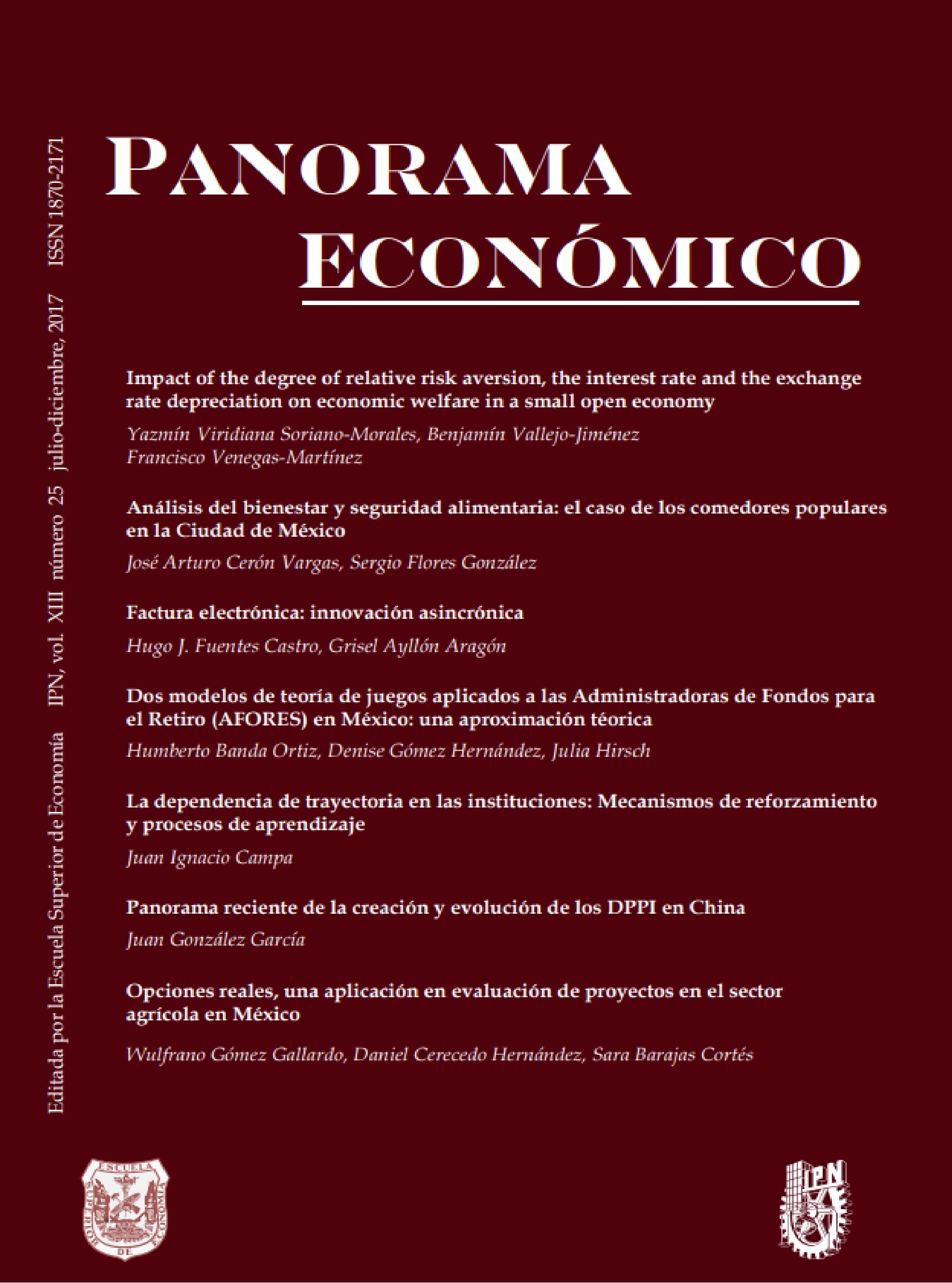
Impact of the degree of relative risk aversion, the interest rate and the exchange rate depreciation on economic welfare in a small open economy
DOI:
https://doi.org/10.29201/peipn.v13i25.398Keywords:
consumer-producer economics, economic welfare, degree of relative risk aversion, small open economy, interest rate, foreign exchangeAbstract
This paper is aimed at assessing the impact of the degree of relative risk aversion on economic welfare for different levels of the interest rate and the exchange rate depreciation in a small open beconomy. To do this, a representative consumer-producer makes decisions on consumption, money balances, and leisure. In order to find a closed-form solution of the household’s economic welfare, it is assumed that individual’s preferences belong to the family of Constant Relative Risk Aversion (CRRA) utility functions. Several comparative statics graphical experiments about the effects of the degree of relative risk aversion on economic welfare for different levels of nominal variables are carried out. Finally, we find that, under the stated assumptions, household’s economic welfare seen as a function of the degree of relative risk aversion is responsive to different values of nominal variables.
Downloads
References
Barro, R. and X. Sala-i-Martin (1995). Economic Growth. Mc. McGraw-Hill, New York, pp. 240-266.
Battermann, H.; U. Broll and J. Wahl (1997). “Constant Relative Risk Aversion and Form Equivalence Classes”. Working Paper Series II, No. 345, pp. 219-145.
Betts, C. and M. B. Devereux (2000). “Exchange Rate Dynamics in a Model of Pricing-to-Market”. Journal of International Economics, vol. 50, No. 1, pp. 215–244.
Boulier, J.; S. Huang and G.; Taillard (2001). “Optimal Management under Stochastic Interest Rates: the Case of a Protected Defined Contribution Pension Fund”. Insurance: Mathematics and Economics, vol. 28, No. 2, pp. 173-189.
Cairns, A., D. Blake and K. Dowd (2006). “Stochastic Life styling: Optimal dynamic asset allocation for defined-contribution pension plans”, Journal of Economic Dynamic and Control, vol. 30, No. 5, pp. 843-877.
Deelstra, G., M. Grasselli and P. Koehl (2003). “Optimal Investment Strategies in the Presence of a Minimum Guarantee”. Insurance: Mathematics and Economics, vol. 33, No. 1, pp. 189-207.
Devereux, M. B. and C. Engel (2003). “Monetary Policy in the Open Economy Revisited: Price Setting and Exchange-Rate Flexibility”. Review of Economic Studies, vol. 70, No. 4, pp. 765-783.
Dohmen, T.; A. Falk, D. Huffman and U. Sunde (2010). “Are Risk Aversion and Patience Related to Cognitive Ability?” American Economic Review, vol. 100, pp. 1238-1260.
Gao, J. (2008). “Stochastic Optimal Control of DC Pension Funds”. Insurance: Mathematics and Economics, vol. 42, No. 3, pp. 1159-1164.
González-Aréchiga, B.; J. Díaz-Tinoco y F. Venegas-Martínez (2001). “Riesgo cambiario, brecha de madurez y cobertura con futuros: análisis local y de valor en riesgo”. Economía Mexicana, Nueva Época, vol. 10, No. 2, pp. 259-290.
Kim, J. (2003). “Welfare Evaluation of Monetary Policy Rules in a Model with Nominal Rigidities”. Federal Reserve Bank of Minneapolis. Working Paper. Retrievable from: https://www.mpls.frb.org/~/media/files/pubs/bankingpolicy/papers/wp3-03.pdf.
Krause, A. (2012). “Optimal Saving Taxation when Individuals have Different CRRA Utility Functions”. Annals of Economics and Statistics. No. 113-114, pp. 207.
Moreno-Bromberg, S.; T. Pirvu and A. Réveillac (2012). CRRA Utility Maximization under Risk Constraints. arXiv preprint arXiv: 1106.1702.
Pugsley, B. and H. Rubinton (2016). "Inequality in the Welfare Costs of Disinflation. Princeton University". Working Paper. Retrievable from: https://www.newyorkfed.org/medialibrary/media/research/economists/pugsley/mpinequality_april2016.pdf?la=en.
Shi, J. (2015). "The Short Run Welfare Implications of Openness to FDI and Monetary Policy. Peking University", Working Paper. Retrievable from: https://www.nottingham.ac.uk/gep/documents/conferences/2015-16/china/shi.pdf.
Soriano-Morales, Y. V.; F. Venegas-Martínez y B. Vallejo-Jiménez (2015). "Determination of the Equilibrium Expansion Rate of Money when Money Supply is driven by a Time-homogeneous Markov Modulated Jump Diffusion Process". Economics Bulletin, vol. 35, No. 4, pp. 2074-2084.
Venegas-Martínez, F. y A. Islas Camargo (2005). "Volatilidad en los mercados de América Latina. Efectos de Largo plazo". Comercio Exterior, vol. 55, núm. 11, pp. 936-947.
Venegas-Martínez, F. (2000). "On Consumption, Investment", and Risk. Economía Mexicana, Nueva Época, vol. 9, No. 2, pp. 227-244.
Venegas-Martínez, F. (2005). "Política fiscal, estabilización de precios y mercados incompletos". Estudios Económicos, vol. 20, núm. 1, pp. 3-18.
Venegas-Martínez, F. (2006). "Fiscal Policy in a Stochastic Temporary Stabilization Model: Undiversifiable Devaluation Risk". Journal of World Economic Review, vol. 1, No. 1, pp. 87-106.
Venegas-Martínez, F. (2009). "Temporary Stabilization in Developing Countries and Real Options on Consumption". International Journal of Economic Research, vol. 6, No. 2, pp. 237-257.
Venegas-Martínez, F. y B. González-Aréchiga (2000). "Mercados financieros incompletos y su impacto en los programas de estabilización de precios: el caso mexicano". Momento Económico, núm. 111, pp. 20-27.
Vigna, E. (2009). "Mean-variance Inefficiency of CRRA and CARA Utility Function for Portfolio Selection in Defined Contribution Pension Schemes". Working Paper No. 108.
Xie, D. (2000). "Power Risk Aversion Utility Functions". Annals of Economics and Finance, vol. 1, No. 2, pp. 265-282.
Downloads
Published
How to Cite
Issue
Section
License
Copyright (c) 2026 Panorama Económico

This work is licensed under a Creative Commons Attribution-NonCommercial-NoDerivatives 4.0 International License.