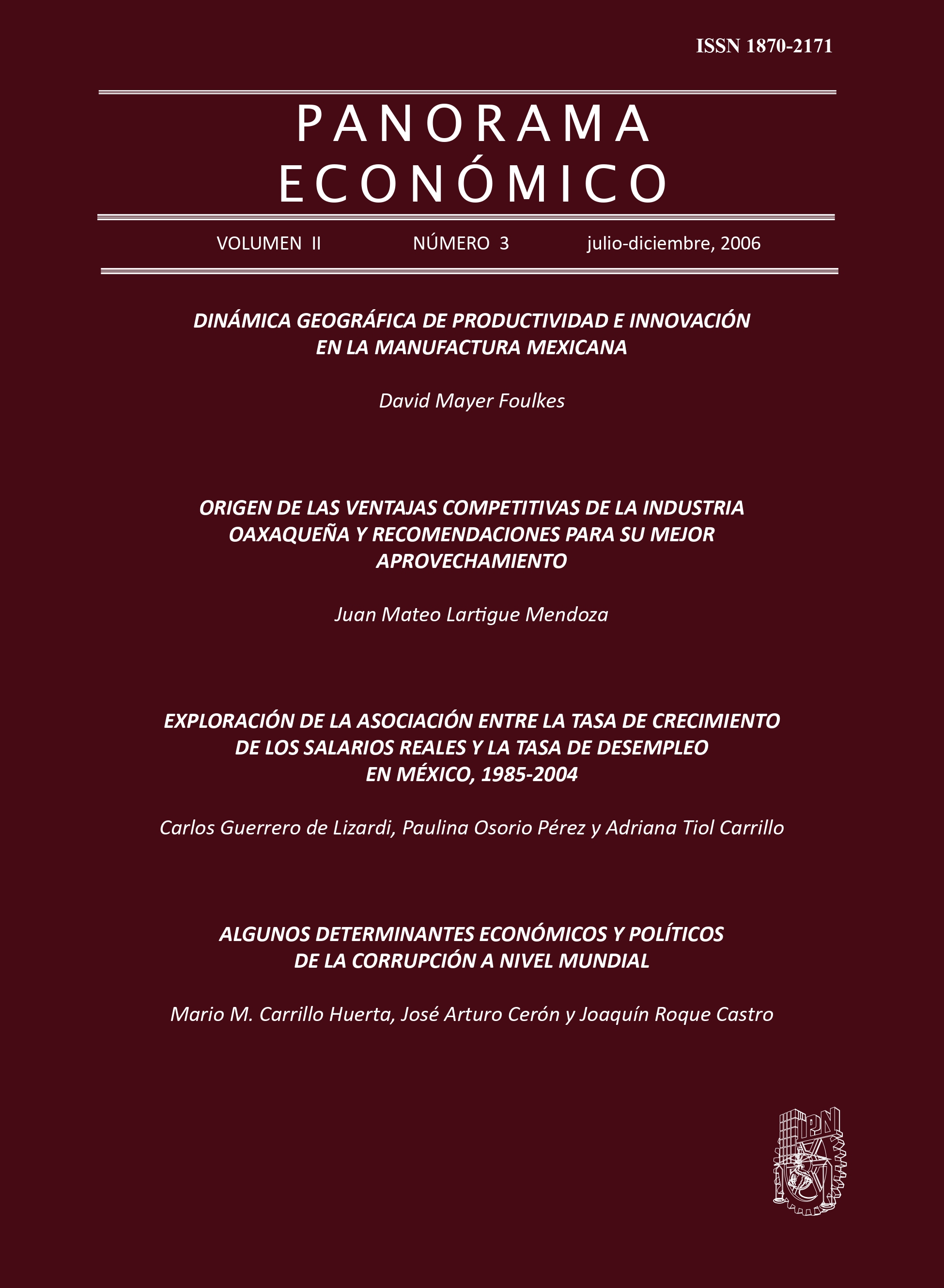
Some Economic and Political Determinants of Global Corruption
DOI:
https://doi.org/10.29201/peipn.v2i3.243Keywords:
Industrial Organization, corruption, Two Steps Least SquaresAbstract
This essay is focused in the study of the causes of corruption by means of a theoretical model proposed by Alberto Ades and Rafael Di Tella (1999). From this model three hypotheses were derived: a) the natural gains (mainly derived from petroleum) stimulate the corruption; b) the increases in the wages of the bureaucrats diminish the corruption and; c) the degree in which a society is able to monitor to its government officials reduces the corruption level. Because of endogeneity, the estimations were made by Two Steps Least Squares (2SLS). The results showed that, leaving like the only variable that measure the degree of monitoring of the society to the GDP per capita, the totality of the parameters is very significant. With this model the use of the variable of petroleum exports confirms the hypothesis that the natural gains stimulate the corruption, but the wages of the bureaucrats do not have the waited signs, that is to say, that greater wages of the bureaucrats do not reduce the corruption in the world-wide level sample. In which it concerns to the role of the petroleum exports, its effect only was significant in the group of countries of medium income, being observed that such exports increase the corruption of this group of countries.
Downloads
References
Ades, Alberto y Di Tella, Rafael (1999). “Rents, Competition and Corruption”. The American Economic Review. Vol. 89. Núm. 4. Págs. 982-993.
Barro, R. y Lee, J. (1994). “Data Set for a Panel of 138 Countries”. Mimeo, Harvard University, 1994.
Becker, G. y Stigler, G.J. (1974). “Law Enforcement, Malféasance, and the Compensation of Enforcers”. Journal of Legal Studies. Vol. 3. Págs. 1-19.
Kaufmann, D., Kraay, A. y Mastruzzi, M. (2003). “Governance Matters III: Governance Indicators for 1996-2002”. The World Bank.
Leff, Nathaniel (1964). “Economic Development Through Bureaucratic Corruption”. The American Behavioral Scientist, Nov. 8 (2). Págs. 8 – 14.
Mauro, Paolo (1995). “Corruption and Growth”. The Quarterly Journal of Economics. Vol. 110. Núm. 3. Págs. 681-712.
Rose-Ackerman, Susan (1978). Corruption: A study of political economy. New York, Academic Press.
Shleifer, A. y Vishny, R. (1993). “Corruption”. The Quarterly Journal of Economics. Vol. 109. Págs. 599-617.
United Nations (1999). Reporte de la Iniciativa Anticorrupción de Líbano. .
World Bank (2001). “Government Employment and Wages Dataset”. .
World Bank (2002). “World Development Indicators Dataset”. CD-ROM.
White, H. (1980). “A Heteroskedasticity-Consistent Covariance Matrix Estimator and a Direct Test for Heteroskedasticity”, Econometrica. Vol. 48(4), pages 817-38, May.
Downloads
Published
How to Cite
Issue
Section
License
Copyright (c) 2025 Panorama Económico

This work is licensed under a Creative Commons Attribution-NonCommercial-NoDerivatives 4.0 International License.