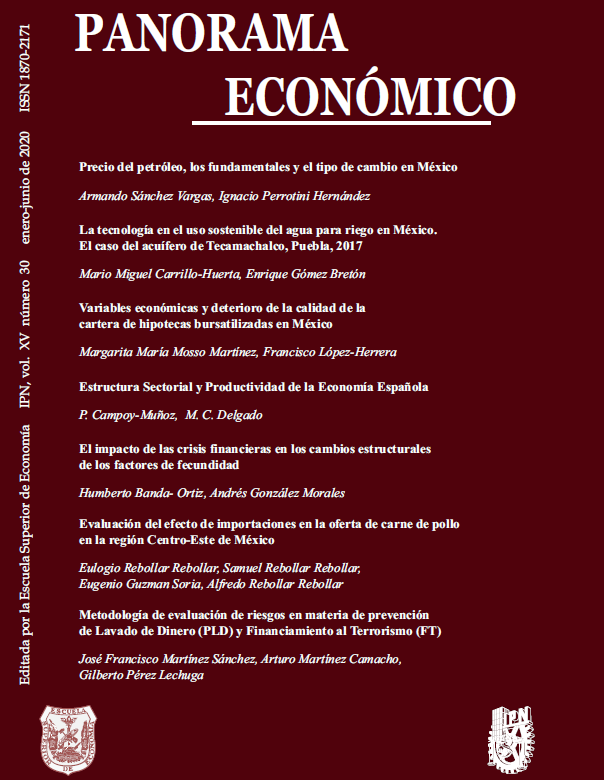
Oil price, the fundamentals and the exchange rate in Mexico
DOI:
https://doi.org/10.29201/peipn.v15i30.32Keywords:
simultaneous equation model, exchange rate, oil price, supply shockAbstract
In this article we offer empirical evidence about the direct and indirect impact channel that crude oil prices have on exchange rate variations in Mexico. We use quarterly time series data for the period between 1997 and 2019 and a system of simultaneous co-integrated equations. Our results suggest that an increase in the price of crude oil produces a foreign exchange appreciation (direct channel); likewise, this rise in the price of oil increases government revenues - via oil revenues -, which causes an improvement in the fiscal balance and, in turn, causes an appreciation of the exchange rate (indirect channel).
Downloads
References
Amano, R. A. y S. Van Norden (1998a). Oil prices and the rise and fall of the US real exchange rate, Journal of International Money and Finance, 17(2), pp. 299-316. https://doi.org/10.1016/S0261-5606(98)00004-7.
___ (1998b). Exchange Rates and Oil Prices. Review of International Economics, 6, pp. 683-694. DOI:10.1111/1467-9396.00136.
Appleyard, D.; A. Field y S. Cobb (1996). International Economics. Bastan: McGraw-Hill / Irwin Boston.
Beckmann, J. y R. Schüssler (2016). Forecasting exchange rates under parameter and model uncertainty. Journal of International Money and Finance, 60, pp. 267-288.
Beckmann J.; R., Czudaj y V. Arora (2017). The Relationship between oil prices and exchange rates: Theory and Evidence. Working Paper Series Independent Statictics & Analysis. Recuperado de: https://www.eia.gov/workingpapers/pdf/oil_exchangerates_61317.pdf
Bermúdez, N.; E., Bermúdez y E. Saucedo (2018). The relationship between oil prices, the stock market and the Exchange rate: Evidence from Mexico. North American Journal of Economics and Finance. 45 (1), pp. 266-275. DOI: https://doi.org/10.1016/j.najef.2018.03.006.
Bilson, J. (1978). Rational expectations and the exchange rate. En Frankel, J., Johnson, H. (Eds.), The economics of Exchange Rates: Selected Studies, pp. 75-96, Adison-Wesley Longman Publishing Co.
Buetzer, S.; M. M., Habib y L. Stracca (2016). Global exchange rate configurations: Do oil shocks matter? IMF Economic Review, 64(3), 443-470.
Cuevas, V. (2002). Efectos del déficit fiscal en la economía mexicana un análisis econométrico. Comercio Exterior, 52 (12). pp. 1106-1123. Recuperado de: http://revistas.bancomext.gob.mx/rce/magazines/7/8/cuev1202.pdf.
Cuevas, V., y F. Chávez (2007). Déficit, deuda y reforma fiscal en México. Problemas del Desarrollo. Revista Latinoamericana de Economía, 38(148), pp 69-97. http://dx.doi.org/10.22201/iiec.20078951e.2007.148.7649.
Gelbard, E. y J. Nagayasi (2004). Determinants of Angola’s real exchange rate, 1992-2002. The Developing Economics, 42(3), pp. 392-404. DOI: 10.1111/j.1746-1049.2004.tb00944.x.
Golub, S. (1983). Oil prices and exchange rates. The Economic Journal, 93(371), pp 576-593.
Greene, W. (2003). Econometric Analysis. 5 ª ed., Estados Unidos: Pearson Education Inc.
Hallwood, P. y R. MacDonald (2000). International Monetary and Finances. Oxford, UK: Wiley-Blackwell.
Ibarra, J., Salazar, J. y R. Navarro (2017). Estimación de modelos estructurales y la evolución del tipo de cambio peso-dólar después de la crisis subprime. Revista mexicana de economía y finanzas. 12(4), pp. 405-429. DOI: https://dx.doi.org/10.21919/remef.v12i4.241
Insah, B. y A. Chiaraah (2013). Sources of real exchange rate volatility in the Ghanaian economy. Journal of Economics and International Finance, 5(6), pp. 232-238. DOI: https://doi.org/10.5897/JEIF2013.0517.
Krugman, P. (1983). Oil and the dollar. En B. Jagdeeps, y P. Bulfordh (eds.), Economic interdependence and flexible exchange rates. Cambridge, MA: MIT Press.
McDermott, J. y R. Wescott (1996). An Empirical Analysis of Fiscal Adjustments IMF. Publicacion anticipada, 43(4), pp. 1-26. Recuperado de https://ssrn.com/abstract=882959.
Meese, R. y K. Rogoff (1983). Empirical Exchange rate models of the seventies. Do they fit out of sample? Journal of International Economics, 14(1-2), pp. 3-24. Recuperado de https://doi.org/10.1016/0022-1996(83)90017-X.
Rodríguez, V. (2015). Límites de la estabilidad cambiaria de México. Problemas del Desarrollo. Revista Latinoamericana de Economía, 46(181), pp 49-74. https://doi.org/10.1016/j.rpd.2015.03.001
Rogoff, K. (1996). The Purchasing Power Parity Puzzle. Journal of Economic Literature, 34 (2), pp. 647-668. Recuperado de https://www.jstor.org/stable/2729217.
Sosa, M. y E. Ortiz (2015). Desequilibrios cambiarios y crisis: Canadá, México, Japón y Reino Unido vs dólar de EE.UU. (1994-2014). Contaduría y Administración, 60(S2), pp. 106-127. DOI:http://dx.doi.org/10.1016/j.cya.2015.08.014.
Spanos, A. (1986). Statistical Foundations of Econometric Modeling, Cambridge University Press.
Taylor, M. (1985). The Economics of Exchange rates. Journal of Economic Literature, 33(1), 13-47. Recuperado de http://www.jstor.org/stable/2728909.
Downloads
Published
How to Cite
Issue
Section
License

This work is licensed under a Creative Commons Attribution-NonCommercial 4.0 International License.