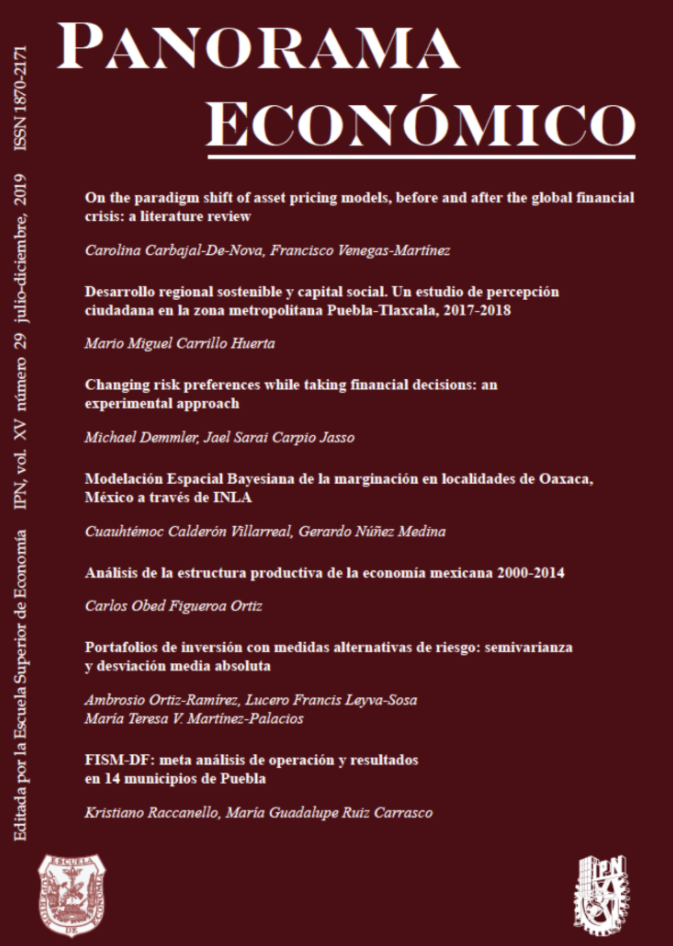
Investment portfolios with alternative risk measures
semi-equity and absolute mean deviation
DOI:
https://doi.org/10.29201/peipn.v15i29.52Keywords:
portfolio optimization, rate or return, portfolio choiceAbstract
In this research an analysis is made between risk measures of an investment portfolio: variance, semivariance, absolute average deviation and Sharpe index, the optimal weights are determined for each measure of an investment portfolio consisting of 12 stocks listed on the Mexican Stock Exchange Index. The study period covers from january 01, 2015 to december 29, 2017. The models to optimize the four risk measures were programmed in Matlab 2017a and 100 optimal portfolios are generated to construct the efficient frontier of each measure. In order to assess the efficiency of the risk measures, an analysis of profitability of the portfolios that resulted from the optimization for a period of 92 days is executed. Under the previous assumptions, it is concluded that the semivariance and the absolute average deviation present a higher weighted return, while the portfolio that obtained a lower drop in value to the considered term was the portfolio with the variance approach and the one with greater drop in value was the portfolio with the Sharpe index.
Downloads
References
Álvarez García, R. D.; G. A. Ortega Oliveros; A. M. Sánchez Ospina y M. Herrera Madrid (2004). Evolución de la teoría económica de las finanzas: Una breve revisión. Semestre Económico, 7(4), 105-127. Recuperado de https://revistas.udem.edu.co/index.php/economico/article/download/1132/1101.
Banda Ortiz, H.; L. M. González García y D. Gómez Hernández (2014). Una aproximación de la teoría de portafolio a las siefores en México. Pensamiento y Gestión, 28-55.
Bassetti A. y C. Torricelli (1991). Optimal portfolio selection as a bargaining game. En: Hämäläinen R.P., Ehtamo H.K. (editores) Dynamic Games in Economic Analysis. Lecture Notes in Control and Information Sciences, Springer, Berlin, Heidelberg, vol. 157, pp. 249-259.
De Jesús Uribe, L. M.; M. A. Martínez Damián y G. Ramírez Valverde (2009). Método de semivarianza y varianza para la selección de un portafolio óptimo. Colegio de Postgraduados Campus Montecillo, 103-113.
Estrada, J. (2008). Mean-Semivariance Optimization: A Heuristic Approach (December 3, 2015). Journal of Applied Finance (Formerly Financial Practice and Education), 18(1). Available at SSRN: https://ssrn.com/abstract=2698700.
Fabozzi, F. J. (2016). Robust Equity Portfolio Management. United States of America: Wiley.
Fabozzi, F.; P. N. Kolm; D. Pachamanova y S. Focardi (2012). Robust Portfolio Optimization and Management. USA: John Wiley & Sons, Inc., Hoboken, NJ.
Black, F., y M. Scholes (1973). The Pricing of Options and Corporative Liabilities, Journal of Political Economy, 81(3), 637-654.
García Gómez, E. A. (2012). Selección de portafolios eficientes de inversión a través de carteras colectivas. Tesis de Maestría. Medellín, Colombia.
Gomero Gonzales, N. A. (2014). Portafolios de activos financieros. Revista de la Facultad de Ciencias Contables, 135-146.
Hincapié Cifuentes, M. A. (2011) Diseño de una metodología de optimización para los indicadores de costo, duración y vida media de un portafolio de deuda. Master thesis, Universidad Nacional de Colombia, Sede Medellín. Recuperado de http://bdigital.unal.edu.co/5280/1/200961482.2011.pdf
Hogan, W. W. y J. M. Warren (1974). Toward the development of an equilibrium capital market model based on semivariance. Journal of Financial and Quantitative analysis, 1-11.
Jin, H., Markowitz, H. y X. Yu Zhou (2006). A note on semivariance. Mathematical Finance, 16, 53-61. doi:10.1111/j.1467-9965.2006.00260.x.
Konno, H. y Yamazaki, H. (1991). Mean-Absolute Deviation Portfolio Optimization Model and Its Applications to Tokyo Stock Market. Management Science, 37(5), 519-531. Retrieved from http://www.jstor.org/stable/2632458.
Lewis, A. (1990). Semivariance and the Performance of Portfolios with Options. Financial Analysts Journal, 46(4), 67-76. Retrieved from http://www.jstor.org/stable/4479350.
Mao, J. C. T. (1970). Survey of Capital Budgeting: Theory and Practice. The Journal of Finance, 25(2), 349-360. doi:10.2307/2325481.
Markowitz, H. (1952). Portfolio Selection. The Journal of Finance, 7(1), 77-91. doi:10.2307/2975974.
Medina, L. Á. (2003). Aplicación de la teoría del portafolio en el mercado accionario colombiano. Cuadernos de economía, 129-168.
Merton, R. C. (1973a). Theory of Rational Option Pricing. Bell Journal of Economics, 4(1), 141-183. doi:10.2307/3003143.
Merton, R. C. (1973b). An Intertemporal Capital Asset Pricing Model. Econometrica, 41(5), (Sep., 1973), 867-887. doi:10.2307/1913811.
Nantell, T., y B. Price (1979). An Analytical Comparison of Variance and Semivariance Capital Market Theories. The Journal of Financial and Quantitative Analysis, 14(2), 221-242. doi:10.2307/2330500.
Pachamanova, D. (2010). Simulation and optimization in Finance. John Wiley & Sons.
Plá, S. (2000). Modelos multicriterio para la selección de portafolios en la bolsa de Madrid. Alcoy.
Quirk, P. James and R. Saposnik (1962). Admissibility and Measurable Utility Functions, The Review of Economic Studies, 29(2), 140-146. Retrieved from http://www.jstor.org/stable/2295819.
Sharpe, W. (1963). A Simplified Model for Portfolio Analysis. Management Science, 277-293.
Sharpe, W. (s.f.). Capital Asset Prices: A Theory of Market Equilibrium under Condition Risk. The Journal of Finance, 425-442.
Swalm, R. O. (1966). Utility Theory-Insights into Risk Taking. Harvard Business Review, 12 (november-december).
Urbina, J. (2015). Estimación del riesgo en portafolios de inversión. Tesis de Maestría. México, Ciudad de México.
Venegas-Martínez, F. y A. Rodríguez Nava (2009). Consistencia entre minimización de varianza y maximización de utilidad en la evaluación de derivados. Contaduría y Administración, 229, 9-30.
Downloads
Published
How to Cite
Issue
Section
License

This work is licensed under a Creative Commons Attribution-NonCommercial 4.0 International License.