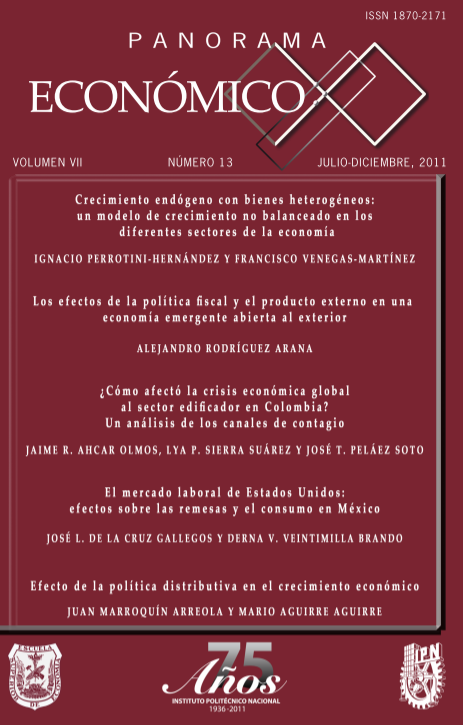
The effects of fiscal policy and external output in an emerging economy open to the outside world
DOI:
https://doi.org/10.29201/peipn.v7i13.309Keywords:
fiscal policy, current account, foreign output, real exchange rateAbstract
The effects of an expansive fiscal policy and an increase in foreign output are similar for the domestic output and the real exchange rate in the short run, However, in the long run an expansive fiscal policy generates a net reduction of the domestic output and a net increase of the real exchange rate, while the increase in foreign output increases even more the domestic output and generates an additional reduction of the real exchange rate. When foreign output falls, a countercyclical fiscal policy may stabilize the domestic output in the short run. In the long run, however, this policy reinforces the recessive effects ofthe original shock.
Downloads
References
Barro, R. (1974), "Are Government Bonds Net Wealth?", Journal of Political Economy, núm. 82, pp. 1095-11 17.
Bemnheim, D. (1987), "Ricardian Equivalence: An Evaluation of Theory and Evi- dence", NBER Macroeconomics Annual 1987, pp. 263-304, National Bureau of Economic Research.
Blanchard, O. (1985), "Debt, Deficits and Finite Horizons", Journal of Political Economy, núm. 93, pp. 223-247.
Blanchard, O. (2008), "The State of Macro", NBER Working Paper 14259, National Bureau of Economic Research.
Blanchard, O. y S. Fischer (1989), Lectures on Macroeconomics, The MIT Press, Cambridge, Massachusetts.
Blanchflower, D. y A. Oswald (1994), The wage curve, MIT Press. Primera edición Buiter, W. (2009), "The Unfortunate Uselessness of Most State of the Art Academic Monetary Economics", <http://blogs.fit.com/maverecon/2009/03/ the-unfortunate-uselessness-of-most-state-of-the-art-academic-monetary- economics/>.
Calvo, G. (1986), "Temporary stabilization: Predetermined exchange rates", Journal of Political Economy, núm. 94, pp. 1319-1329.
Christiano, L., M. Eichenbaum y S. Rebelo (2009), "When is the government spending multiplier large?", NBER Iorking Paper 15394, National Bureau of Economic Research. Cambridge, Massachusetts.
Cogan, J., T. Cwik y J.B. Taylor (2010), "New Keynesian versus old Keynesian Go- vernment Spending Multipliers", Journal of Economics, Dynamics and Control, núm. 34, Pp. 281-295.
Dornbusch, R. (1976), "Expectations and exchange rate dynamics", Journal of Poli- tical Economy, núm. 84, pp. 1161-1176.
Dombusch, R. (1980), Open Economy Macroeconomics, Harper and Row Dornbusch, R. y S. Fischer (1978), Macroeconomics, McGraw Hill, Nueva York. Drazen, A. y E.
Helpman (1987), "Stabilization with Exchange Rate Management", Quarterly Journal of Economics, núm. 102, pp. 835-855.
Driffin, J. y M. Miller (2009), "Liquidity Constraints and Non Market Clearing: A Recipe for Recession?", En 6-7" November 2009 CESifo Conference: What is wrong with Modern Macroeconomics?, CEFiso Munich.
Edwards, S. (2004),”Financial Openness, Sudden Stops and Current Account Rever- sals”, NBER Working Paper 10277, National Bureau of Economic Research.
Funke, K. y C. Nickel (2006), “Does Fiscal Policy Matter for the Trade Account?: A Panel Cointegration Study”, Working Paper Series 620, European Central Bank.
Giavazzi, F, and M. Pagano (1996), “Non Keynesian Effects of Fiscal Policy Changes: International Evidence and the Swedish Experience`, Swedish Economic Policy Review, núm. 3, pp. 67-103.
Gordon, R. (1978), Macroeconomics, Boston, Little Brown.
Gordon, R. (2009), “Is Modern Macro or 1978-era Macro More Relevant to the Understanding of the Current Economic Crisis?”, Artículo presenta- do en el Coloquio Internacional de Historia del Pensamiento Económico en Sao Paolo, Brasil, Agosto de 2009.
Harrigan, F. P. McGregor, K. Swales y Ya Ping Yin (1993), “Openness, imperfect competition and the NAIRU”, Journal of Economic Studies, núm. 20, pp. 52-72.
Helpman, E. y A. Razin (1987), “Exchange Rate Management: Intertemporal Trad- eoffs”, American Economic Review, pp. 107-123.
Kim, S. y N. Roubini (2004), “Twin Deficits or Twin Divergence?: Fiscal Policy, the Current Account and Real Exchange Rate in the US”, Articulo presentado en el Encuentro de Invierno de la Sociedad Econométrica para Norte América. Mimeo.
Krugman, P. (2009), “How Did Economists Get it So Wrong”, New York Times Ma- gazine, September 6”h, pp. 30ff.
Layard, R.S. Nickell y R. Jackman (1991), Unemployment, Oxford University Press, Millesi Ferreti, G. y A. Razin (1998), “Current Account Reversals and Currency Crises: Emprical Regularities”, NBER Working Paper 6620, National Bureau of Economic Research.
Mundell, R. (1968), International Economics, McMillan, Nueva York.
Nickel, C. e I. Vansteenkiste (2008), “’Fiscal Policies, the Current Account and Ricar- dian Equivalence”, Working Paper Series 935, European Central Bank.
Obstfeld, M. (1985), “The capital inflows problem revisited: A stylized model of the Southern Cone disinflation”, Review of Economic Studies, num. 52, pp. 605- 623.
Romer, D. (2000), “Keynesian Macroeconomics Without the LM Curve”, Journal of Economic Perspectives. Núm. 14, pp. 149-169
Sargent, T. y N. Wallace (1973), “The Stability of Models of Money and Growth”, Econometrica, 41, pp. 1043-1048.
Sutherland, A. (1995), “”Fiscal Crises and Aggregate Demand: Can High Public Debt Reverse the Effects of Fiscal Policy?”, CEPR Discussion Paper 1246, Center for Economic Policy Research.
Taylor, J. (1993). “Discretion versus policy rules in practice”, Carnegie-Rochester Conference Series in Public Policy, núm. 39, pp. 195-214.
Tobin, J. (1993), “Price Flexibility and Output Stability: An Old Keynesian View”, Journal of Economic Perspectives, núm. 7, pp. 45-75.
Woodford, M. (2001), “The Taylor Rule and Optimal Monetary Policy`, American Fconomic Review, núm. 2, pp. 232-237.
Woodford, M. (2008), “Convergence in Macroeconomics: Elements of a New Syn- thesis”, Mimeo.
Woodford, M. (2010). “Simple Analytics of the Govemnment Expenditure Multlplier.”” Articulo preparado para la Sesión Fiscal Stabilization Policy, Allied social Science Association, Atlanta, Georgia.
Downloads
Published
How to Cite
Issue
Section
License
Copyright (c) 2025 Panorama Económico

This work is licensed under a Creative Commons Attribution-NonCommercial-NoDerivatives 4.0 International License.