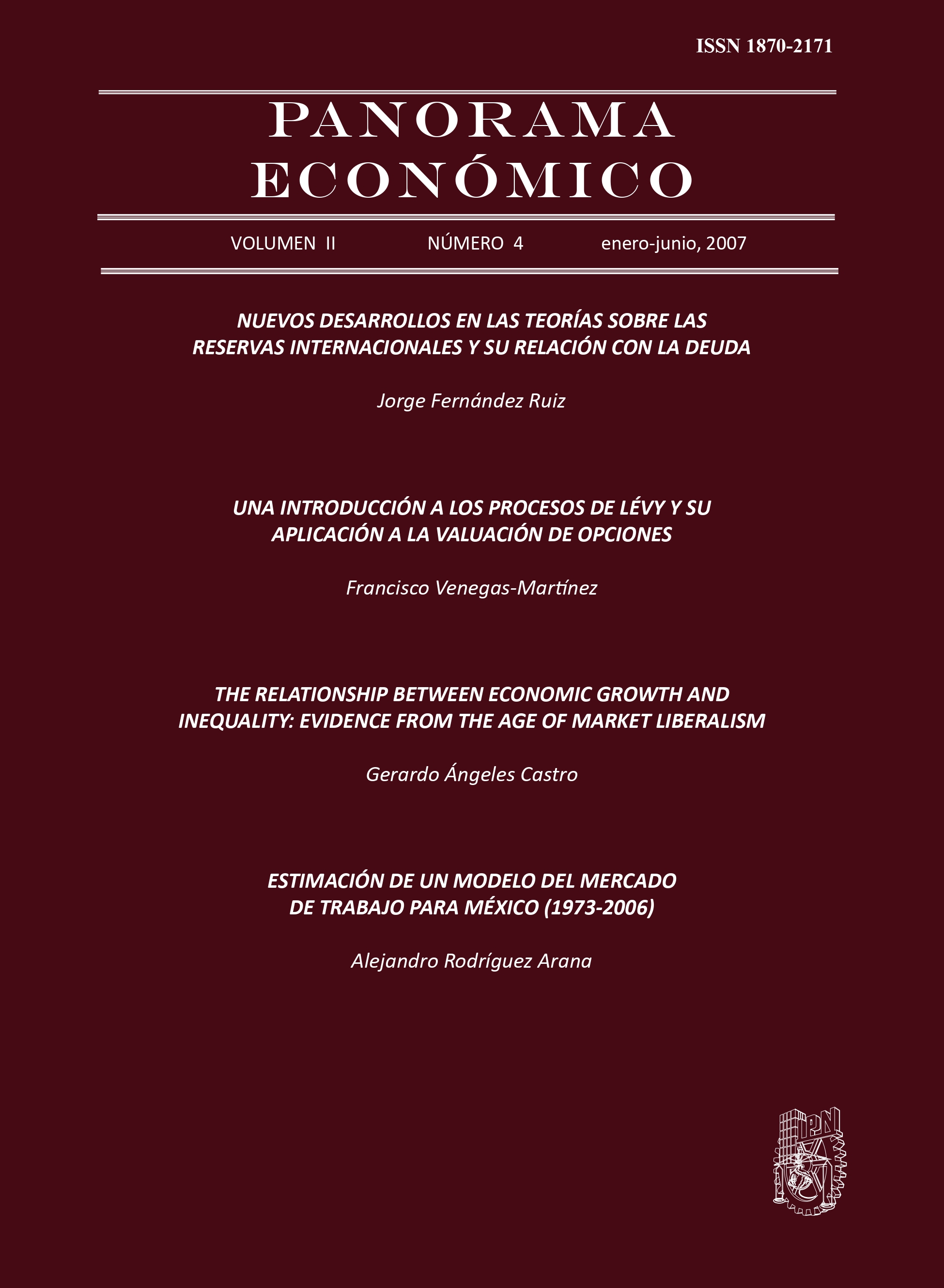
An Estimation of a Labor Market Model for Mexico (1973–2006)
DOI:
https://doi.org/10.29201/peipn.v2i4.250Keywords:
Forecasting and simulation, employment, unemployment, wages, labor forceAbstract
This paper presents a dynamic econometric model of labor demand and supply for Mexico. The long term labor demand depends positively on the Gross Domestic Product (GDP) and negatively on the real wages. An equation that behaves as a wage curve in the long run and as a Phillips curve in the short term reflects the labor supply. The model is estimated combining techniques of simultaneous equations with error correction mechanisms.
Downloads
References
Banerjee, A., J. Dolado, J. Galbraith y D. Hendry (1993) Co-integration, Error Correction and the Econometric Analysis of Non-stationary Data. Oxford University Press. Oxford.
Benassy, J.P. (1990) “Non Walrasian Equilibria, Money and Macroeconomics” en Handbook of Monetary Economics, vol 1. B. Friedman and F. Hahn (eds). North Holland.
Bentolila, S. y G Saint-Paul (1994) “A model of labour demand with linear adjustment costs”, Labour Economics, 12, pp. 303-326.
Blanchard, O. and L. Katz (1997) “What we know and do not know about the natural rate of unemployment”, Journal of Economic Perspectives, 11, pp. 51-72.
Blanchflower, D. y A. Oswald (1994). The Wage Curve. MIT Press.
Blanchflower, D. y A. Oswald (1995) “Estimating a wage curve for Britain 1973-1990”, NBER Working Paper 4770. National Bureau of Economic Research.
Blanchflower, D. y A. Oswald (2005) “The wage curve reloaded”, NBER working paper 11338. National Bureau of Economic Research.
Cuthbertson, K., S. Hall y M. Taylor (1992) Applied Econometric Techniques. Harvester Wheatsheaf.
Davidson, R. y J. MacKinnon (1993). Estimation and Inference in Econometrics. Oxford University Press.
Downick, S. y G. Wells (2004) “Modelling aggregate demand for labour: A critique of Lewis and MacDonald”, The Economic Record, 80, pp. 436-440.
Engle, R. y C.W. Granger (1987). “Co-integration and error correction: representation, estimation and testing”, Econometrica, 55, pp. 251-276.
Fischer, S. (1977) “Long term contracts, rational expectations and the optimal money supply rule”, Re impreso en Rational Expectations and Econometric Practice (Lucas, R. y T. Sargent editores). University of Minessota Press.
Fleck, S. y C. Sorrentino “Employment and unemployment in Mexico’s labor force”, Monthly Labor Review 117, pp. 3-31.
Friedman, M. (1968) “The role of monetary policy”, American Economic Review, 68, pp. 1-17.
Green, W.H. (2000). Econometric Analysis. Prentice Hall.
Hamermesh, D. (1993) Labor Demand. Princeton University Press.
Hausman, J.A (1985). “Taxes and labor supply”. En Handbook of Public Economics. (Auerbach, A. y M. Feldstein editores). Amsterdam, North Holland.
Hendry, D. (1995) Dynamic Econometrics. Oxford University Press. Oxford.
Johansen, S. (1988) “Statistical analysis of cointegration vectors”, Journal of Economics, Dynamics and Control, 12, pp. 231-254.
Keele, L. (2005) “No just cointegration: Error correction models with stationary data”, *Working Paper 2005-W7*. Nuffield College, Oxford University.
Kennedy, S. y J. Borland (2000) “A wage curve for Australia?” Oxford Economic Papers, 52, pp. 784-803.
King, R. y J. Thomas (2003) “Partial adjustment without apology”, Staff report 327. Federal Reserve Bank of Minneapolis.
Klein, L. (1950) *Economic fluctuations in the United States 1921-1941*. John Wiley and Sons. Nueva York.
Layard, R. S. Nickell y R. Jackman (1991) “Unemployment”, Oxford University Press.
Lewis, P. y G. MacDonald (2002) “The elasticity of demand for labour in Australia”, The Economic Record, 78, pp. 18-30.
Maloney, W. y P. Fajnzylber (2001) “How comparable are labor demand elasticities across countries?”, Policy Research Working Paper series 2658. The World Bank.
Mamgain, V. (1999) “Are the Kaldor-Verdoom laws applicable in the newly industrializing countries?”, Review of Development Economics, 3(3), pp. 295-309.
Manning, A. (1993) “Wage bargaining and the Phillips curve: The identification and specification of aggregate wage equations”, Economic Journal, 103, pp. 98-118.
Nickell, S. (1986) “Dynamic model of labour demand”. En Handbook of Labour Economics. (O. Ashenfelter y R. Layard editores). Amsterdam. North Holland.
Patterson, K. (2000) An Introduction to Applied Econometrics: A Time Series Approach. Palgrave.
Phelps, E. (1967) “Phillips curves, expectations of inflation and optimal unemployment over time”, Economics, 34, pp. 254-281.
Phillips, A.W. (1958) “The relation between unemployment and the rate of change of money wage rates in the United Kingdom 1861-1957”, Economics, 25, pp. 283-299.
Roberts, J. (1997) “The wage curve and the Phillips curve”, *Board of Governors of the Federal Reserve System, Finance and Economics Discussion Paper Series 1997/57*.
Sargan, D. (1964) “Wages and prices in the United Kingdom: A study in econometric methodology”. Reimpreso en Hendry, D. y K. Wallis (editores), Econometrics and Quantitative Economics, Basil Balckwell, Oxford.
Sargent, T. (1979) “Estimation of dynamic labor schedule under rational expectations”, Journal of Political Economy, 86, pp. 1009-1044.
Sims, C. (1980). “Macroeconomics and Reality”, Econometrica, 48, pp. 1-48.
Solow, R. (1979) “Another possible source of wage stickiness”, Journal of Macroeconomics, 1, pp. 79-82.
Stern, N. (1984) “On the specification of labour supply functions”. En Unemployment, Search and Labour Supply. (Blundell, R y I. Walker editores). Cambridge University Press.
Taylor, J. (1979) “Staggered wage setting in a macro model”, American Economic Review, 69, pp. 108-113.
Whelan, K. (1997) “Wage curve vs Phillips curve: are there macroeconomic implications?” *Board of Governors of the Federal Reserve System. Finance and Economic Discussion Series: 1997/51*.
Downloads
Published
How to Cite
Issue
Section
License
Copyright (c) 2025 Panorama Económico

This work is licensed under a Creative Commons Attribution-NonCommercial-NoDerivatives 4.0 International License.