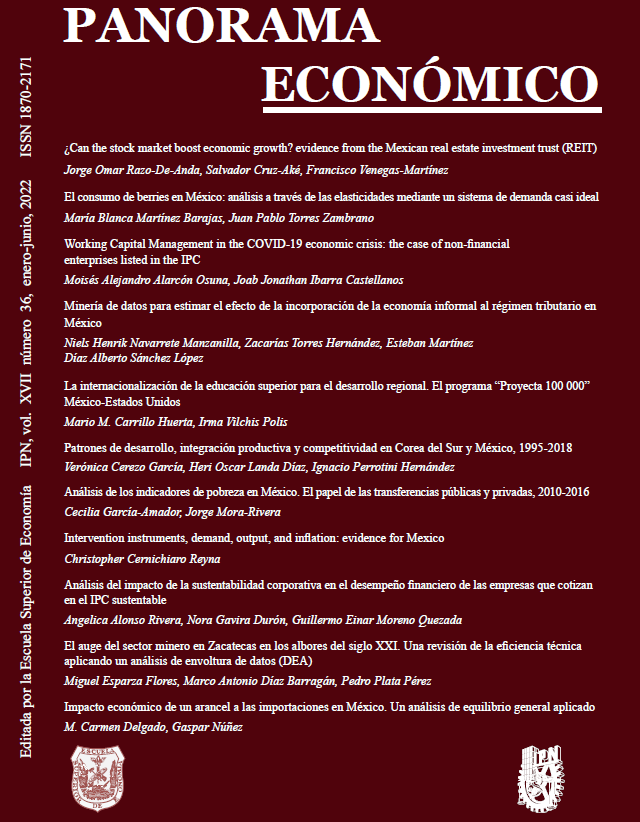
Development patterns, productive integration and competitiveness in South Korea and Mexico, 1995-2018
DOI:
https://doi.org/10.29201/peipn.v17i36.113Keywords:
economic development, productivity, competitiveness, South Korea, MexicoAbstract
The aim of this paper is to deal with the different patterns of industrialization followed by South Korea and Mexico during 1995-2018. The ability -derived thereof- of both economies to successfully cushion and fence exogenous shocks as the Covid-19 pandemic is also dealt with. To that effect, Laumas’s weighted index is used to conduct a comparative analysis of the said countries’ productive chains integration associated to the industrial sector. The relevance of the latter’s competitiveness and productivity to avoid the dynamic insufficiency phenomenon is also tested. In the case of South Korea, contrary to Mexico, there exists a domestic industrial sector featuring a high technology profile and a greater share in international trade, which confer faster output growth and stronger conditions to face an economic crisis.
Downloads
Downloads
Published
How to Cite
Issue
Section
License

This work is licensed under a Creative Commons Attribution-NonCommercial-NoDerivatives 4.0 International License.