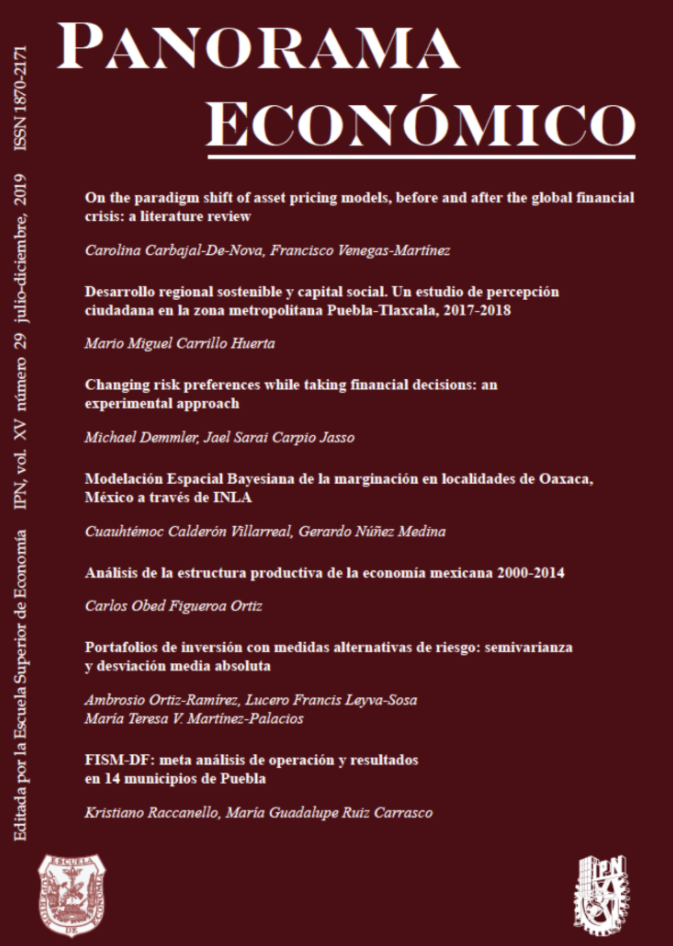
Analysis of the productive structure of the mexican economy 2000-2014
DOI:
https://doi.org/10.29201/peipn.v15i29.51Keywords:
input-output analysis, US-Mexico bilateral trade, economic integrationAbstract
Input-Output Analysis is applied through different methodologies to assess the Mexican productive structure: Streit´s specific linkages and symmetric coefficients approach and the Non-Hypothetical Extraction Method. This is done aiming to capture distinct aspects of the economic intersectoral relationships. The study period covers from 2000 to 2014 using Input-Output Tables, with a level of disaggregation of 56 economic sectors. Thus, through the methodologies implemented is possible to detect changes in the productive structure both excluding the external sector and due to trade liberalisation that was experimented by the Mexican economy. The overall conclusion is that the Mexican productive structure experienced changes leading a substitution of domestic goods by foreign goods.
Downloads
References
Cella, G. (1984). The Input-Output Measurement of lnterindustry Linkages. Oxford Bulletin of Economics and Statistics, 46(1), 73-84. DOI: 10.1111/j.1468-0084.1986.mp48004006.x.
Chenery, H. B. and T. Watanabe (1958), International Comparisons of the Structure of Production, Econometrica, 26 (4), 487-521. DOI: 10.2307/1907514.
Dietzenbacher, E. and J. A. van der Linden (1997). Sectoral and Spatial Linkages in the EC Production Structure. Journal of Regional Science, 37(2), 235-257. DOI: 10.1111/0022-4146.00053.
Ghosh, A. (1958). Input-Output Approach in an Allocation System, Economica, 25(94), 58-64. DOI:10.2307/2550694.
Hirschman, A. O. (1958). The Strategy of Economic Development. Yale Univ. Press, New Haven.
Jones, L. P. (1976). The Measurement of Hirschmanian Linkages. Quarterly Journal of Economics, 323-33. DOI:10.2307/1884656.
Leontief, W. W. (1936). Quantitative input and output relations in the economic systems of the United States. The Review of Economics and Statistics, 18(3), 105-125. DOI:10.2307 / 1927837.
Leontief, W. (1937). Interrelation of prices, output, savings, and investment.
The Review of Economics and Statistics, 19(3), 109-132. DOI:10.2307/1927343.
Leontief, W. (1951). The structure of American economy, 1919-1939; an empirical application of equilibrium analysis. New York, Oxford University Press.
Rasmussen, P. N. (1956). Studies in Intersectorial Relations. Amsterdam, North-Holland Publ. Co.
Strassert, G. (1968). Zur Bestimmung strategischer Sektoren mit Hilfe von Input-Output-Modellen. Jahrbucher fur nationalokonomie und Statistik, 182, 211-215.
Streit, M. E. (1969). Spatial Associations and Economic Linkages between industries. Journal of Regional Science, 9(2), 177-188. DOI: 10.1111/j.1467-9787.1969.tb01332.x
Timmer, M. P.; E. Dietzenbacher; B. Los; R. Stehrer and G. J. de Vries (2015). "An Illustrated User Guide to the World Input–Output Database: the Case of Global Automotive Production", Review of International Economics, 23: 575-605. DOI: 10.1111/roie.12178.
Downloads
Published
How to Cite
Issue
Section
License

This work is licensed under a Creative Commons Attribution-NonCommercial 4.0 International License.