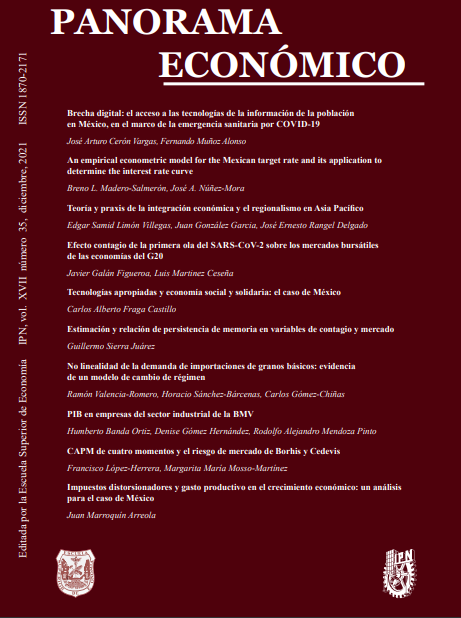
Nonlinearity of demand for basic grains imports
evidence from a regime-switching model
DOI:
https://doi.org/10.29201/peipn.v17i35.98Keywords:
nonlinearity, demand for imports, Markov regime-switching model, Oryza sativa L., Zea mays var. indentata (Sturtev.) L.H. Bailey and TriticumAbstract
Since the 1990s, the decrease in the production of basic grains has intensified, such as rice (Oryza sativa L.), yellow corn (Zea mays var. indentata (Sturtev.) L. H. Bailey) and wheat (Triticum), covering this decrease with an increase in imports. The purpose of this research is to analyze the demand for imports of these three grains during the North American Free Trade Agreement (1994-2018). The starting point is the use of linear models, obtaining a minimum goodness of fit, as well as absence of statistical significance of the exogenous variables (economic activity and real exchange rate). It is by using Markov regime-switching models that it is found that the demand for imports behaved in a non-linear way for each study grain. This behavior is seen through two regimes of import volatility, with imports responding symmetrically in each regime to changes in the exogenous variables. Likewise, the results show that the high volatility of imports occurred during economic and financial crises, total elimination of tariffs, variations in international prices and even the effects of climate change. Finally, the results allow us to conclude that the growth of imports of these three basic grains predominated over their decline in the NAFTA era.
Downloads
References
BANXICO (2019). Sistema de Información Económica. Disponible en: http://www.banxico.org.mx/SieInternet/consultarDirectorioInternetAction.do?sector=6&accion=consultarCuadro&idCuadro=CR60&locale=es (Consultado: el 10 de noviembre de 2019).
Catherwood, K. y D. Henneberry (1997). “The NAFTA Wheat Import Market: Implications of Chilean Accession into the Agreement”, Journal of International Food & Agribusiness Marketing, 9(2), pp. 35-55. https://doi.org/10.1300/J047v09n02_03.
Cermeño, R. S. y H. Rivera Ponce (2016). “La demanda de importaciones y exporta-ciones de México en la era del TLCAN.”, El Trimestre Económico, 83(1), pp. 127-147. https://doi.org/10.20430/ete.v83i329.198.
Diebold, F. X.; J. Lee, y G. C. Weinbach (1994). “Regime -Switching with time- varying transition probabilities”, en (Advanced Texts in Econometrics, C. W. J. G. and G. M., ed.. Nonstationary Time Series and Cointegration. Hargreaves. Oxford: Oxford University Press, pp. 283-382.
FAO (2021). FAOSTAT, Organización de las Naciones Unidas para la Alimentación y la Agricultura. Disponible en: http://www.fao.org/faostat/es/#data (Consultado: el 30 de abril de 2021).
Fosu, P. y T. I. Wahl (2020). “Empirical analysis of US bilateral corn trade: Evidence from Japan, Mexico, China, South Korea, and the European Union”, Cogent Economics and Finance, 8(1). https://doi.org/10.1080/23322039.2020.1783128.
Fuller, S.; L. Fellin, y V. Salin (2003). “Effect of liberalized U.S.-Mexico rice trade: A spatial, multiproduct equilibrium analysis”, Agribusiness, 19(1), pp. 1-17. https://doi.org/10.1002/agr.10042.
García-Salazar, J. A.; R. K. Skaggs y T. L. Crawford (2012). “World price, exchange rate and inventory impacts on the Mexican corn sector: A case study of market volatility and vulnerability”, Interciencia, 37(7), pp. 498-505.
Goldstein, M. y M. S. Khan (1985) “Income and price effects in foreign trade”, Hand-book of International Economics, 2(C), pp. 1041–1105. https://doi.org/10.1016/S1573-4404(85)02011-1.
González-Rojas, K. et al. (2011). “Vulnerabilidad del mercado nacional de maíz (Zea mays L.) Ante cambios exógenos internacionales”, Agrociencia, 45(6), pp. 733-744.
Hamilton, J. D. (1989). “A new approach to the economic analysis of nonstationary time series and the business cycle”, Econometrica, 57, pp. 357-384. https://doi.org/10.2307/1912559.
INEGI (2013). Encuesta Nacional de Gastos de los Hogares. Mexico: INEGI. Disponible en: http://www3.inegi.org.mx/rnm/index.php/catalog/132 (Consultado: el 12 de octubre de 2019).
INEGI (2019a). Banco de Información Económica. Disponible en: https://www.inegi.org.mx/sistemas/bie/ (Consultado: el 3 de noviembre de 2019).
INEGI (2019b). Indicador Global de la Actividad Económica (IGAE). Base 2013. Disponible en: https://www.inegi.org.mx/programas/igae/2013/ (consultado: el 23 de noviembre de 2019).
Leamer, E. E. y R. M. Stern (1970). Quantitative International Economics. Routledge.
Marquez Berber, S. R. et al. (2014). Trigo en Sonora y su contexto nacional e internacional. Editado por E. L. Gámez. Mexico: Centro de Estudios para el Desarrollo Rural Sustentable y la Soberanía Alimentaria.
Moreno-Brid, J. C. (2002). “Liberalización Comercial y la Demanda de Importaciones en México”, Investigación económica, LXII(240), pp. 13-50.
Moreno-Sáenz, L. I.; S. González-Andrade y J. A. Matus-Gardea (2017). “Dependencia de México a las importaciones de maíz en la era del TLCAN”, Revista Mexicana de Ciencias Agrícolas, 7(1), pp. 115-126. https://doi.org/10.29312/remexca.v7i1.375.
Pacheco-López, P. (2005). “The effect of trade liberalization on exports, imports, the balance of trade, and growth: The case of Mexico”, Journal of Post Keynesian Economics, 27(4), pp. 595-617.
Rojas, O.; Y. Li y R. Cumani (2014). Understanding the drought impact of El Niño on the global agricultural areas: An assessment using FAO’s Agricultural Stress Index (ASI). Rome: Food and Agriculture Organization of the United Nations.
Romero, J. (2012). “Evolución de la demanda mexicana de importaciones: 1940-2009”, Econoquantum, 9(1), pp. 7-34. https://doi.org/10.18381/eq.v9i1.135.
SADER (2020). Sistema de Información Agroalimentaria de Consulta. Mexico., Gobierno de México. Disponible en: https://www.gob.mx/siap/documentos/siacon-ng-161430 (consultado: el 5 de abril de 2020).
SAGARPA (2017a). Planeacion Agricola Nacional 2017-2030. Primera parte. 1a ed. Ciudad de México: Gobierno de México.
SAGARPA (2017b). Planeacion Agricola Nacional 2017-2030. Segunda parte. 1a ed. Ciu-dad de México: Gobierno de México.
Thirlwall, A. P. (2002). The Nature of Economic Growth. An Alternative Framework for Un-derstanding the Performance of Nations. Cheltenham, UK: Edward Elgar Publishing. https://doi.org/10.4337/9781843767466.
Tsay, R. S. y R. Chen (2019). Nonlinear Time Series Analysis. NJ, USA: John Wiley & Sons, Inc.
United States-Mexico-Canada Agreement (2019). Disponible en: https://ustr.gov/trade-agreements/free-trade-agreements/united-states-mexico-canada-agreement (Consultado: el 15 de abril de 2020).
Zahniser, S. y J. Link (2002). Effects of North American Free Trade Agreement on agricultu-re and the rural economy. Economic Research Service, USDA.
Downloads
Published
How to Cite
Issue
Section
License

This work is licensed under a Creative Commons Attribution-NonCommercial-NoDerivatives 4.0 International License.