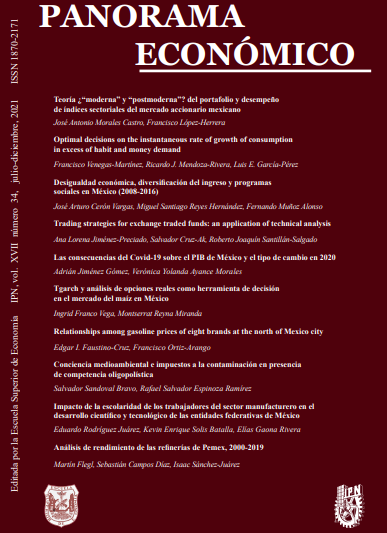
Environmental awareness and taxes to contamination in the presence of oligopolistic competition
DOI:
https://doi.org/10.29201/peipn.v17i34.87Keywords:
Environmental awareness, pollution tax, oligopolistic competition, disutility for pollutingAbstract
We develop an oligopolistic model in which two firms compete with a homogenous good, but consumers have different preferences for them. One good is produced by a polluting technology and the other is produced with nonpolluting technology. The host government set an optimal pollution tax to the polluting firm. The pollution tax is positive if the marginal pollution disutility and/or the level of environmental awareness are sufficiently large. The optimal pollution tax is zero if the marginal pollution disutility and/or the level of environmental awareness are sufficiently small.
Downloads
References
Asako, K. (1979). Environmental pollution in an open economy. Economic Record, 55(4), 359-367. Doi: 10.1111/j.1475-4932.1979.tb02241.x.
Chartand, T. (2005). The role of conscious awareness in consumer behaviour. Journal of Consumer Psychology, 3 (15), 203–210. Doi: 10.1207/s15327663jcp1503_4.
Constant, K. & M. Davin (201). Environmental policy and growth when environmental awareness is endogenous. Macroeconomics Dynamics, 23(3), 1102-1136. Doi:10.1017/s1365100517000189.
Damania D. (1996). Pollution taxes and pollution abatement in an oligopoly supergame, Journal of Environmental Economics and Management, 30(3), 323-336. Doi: 10.1006/jeem.1996.0022.
Damania, R. (2000). Financial structure and the effectiveness of pollution control in an oligopolistic industry. Resource and Energy Economics, 22(1), 21–36. Doi:10.1016/s0928-7655(99)00012-3.
David, M. & B. Sinclair-Desgagné (2005). Environmental regulation and the ecoindustry. Journal of Regulatory Economics, 28(2), 141–155. doi:10.1007/s11149-005-3106-8.
Dechezleprêtre, A. & M. Sato (2017). The impacts of environmental regulations on competitiveness. Review of Environmental Economics and Policy, 11(2), 183-206. Doi: 10.1093/reep/rex013.
Ebert, U. (1992). Pigouvian taxes and market structure: the case of oligopoly and different abatement technologies. Public Finance Analysis, 49(2), 154-166.
Eccleston, C. & F. March (2011). Global Environmental Policy: Concepts, Principles, and Practice. CRC Press: Boca Raton, FL.
Gupta, N. (2014). Environmental awareness policies and its effectiveness: a study of Ludhiana City (India). Environment and Urbanization ASIA, 5 (1), 147-160. Doi: 10.1177/0975425314521547.
Hussen, A. (2018). Principles of Environmental Economics and Sustainability (4a ed.). Routledge: New York.
Kollmuss, A & J. Agyeman (2002). Mind the gap: why do people act environmentally and what are the barriers to pro-environmental behavior? Environmental Education Research, 8 (3), 239-260. Doi: 10.1080/13504620220145401.
Kolstad, C. (2016). Intermediate Environmental Economics (2a ed.). Oxford University Press.
Koźluk, T. & C. Timiliotis (2016). Do environmental policies affect global value chains?: a new perspective on the pollution haven hypothesis. OECD Economics Department Working Papers 1282.
Lahiri, S. & Y. Ono (2000). Protecting environment in the presence of foreign direct investment: tax versus quantity restriction. University of Essex Economics Discussion Papers 9985.
Markusen, J.; E. Morey & N. Olewiler (1993). Environmental policy when market structure and plant locations are endogenous. Journal of Environmental Economics and Management, 24 (1), 69-86. Doi: 10.1006/jeem.1993.1005.
Markusen, J.; E. Morey & N. Olewiler (1995). Competition in regional environmental policies when plant locations are endogenous. Journal of Public Economics, 56 (1), 55–77. doi: 10.1016/0047-2727(94)01419-O.
OECD (2017). Tackling Environmental Problems with the Help of Behavioural Insights. OECD Publishing: Paris. https://read.oecd-ilibrary.org/environment/tackling-environmental-problems-with-the-help-of-behavioural-insights_9789264273887-en#page1.
Park, C.; S. Kim & S. Lee (2012). Optimal policy combinations of abatement subsidy and pollution tax in vertical oligopolies. Procedia - Social and Behavioral Sciences, 40, 215–219. Doi:10.1016/j.sbspro.2012.03.183.
Requate, T. (1993). Pollution control in a Cournot duopoly via taxes or permits. Journal of Economics, 58(3), 255-291. Doi: 10.1007/BF01235250.
Requate, T. (1997). Green taxes in oligopoly if the number of firms is endogenous. Public Finance Analysis, 54(2), 261-280.
Siebert, H. (1976). Emissionssteuern im monopol eine anmerkung. Journal of Institutional and Theoretical Economics, 132(4), 679-682.
Siegel, L.; A. Cutter-Mackenzie-Knowles & A. Bellert (2018). Still ‘minding the gap’ sixteen years later: (re)storying pro-environmental behaviour. Australian Journal of Environmental Education, 34 (2), 189–203. Doi: 10.1017/aee.2018.32.
Stevens, C. (1993). Do environmental policies affect competitiveness? OECD Observer, 183, 22-25.
Stimming, M. (1999). Capital-accumulation games under environmental regulation and duopolistic competition. Journal of Economics, 69(3), 267-287. Doi: 10.1007/BF01231162.
Sugeta, H. & S. Matsumoto (2005). Green tax reform in an oligopolistic industry. Environmental & Resource Economics, 31(3), 253-274. Doi:10.1007/s10640-004-8249-z.
UNEP (2019). Programme Performance Report 2018. UN Environment Programme Publishing. https://wedocs.unep.org/bitstream/handle/20.500.11822/27734/PPR_2018_FINAL.pdf.
Weng, Y.; K. Hsu & B. Liu (2019). Increasing worldwide environmental consciousness and environmental policy adjustment. The Quarterly Review of Economics and Finance, 71, 205−210. Doi: 10.1016/j.qref.2018.08.003.
Downloads
Published
How to Cite
Issue
Section
License

This work is licensed under a Creative Commons Attribution-NonCommercial-NoDerivatives 4.0 International License.