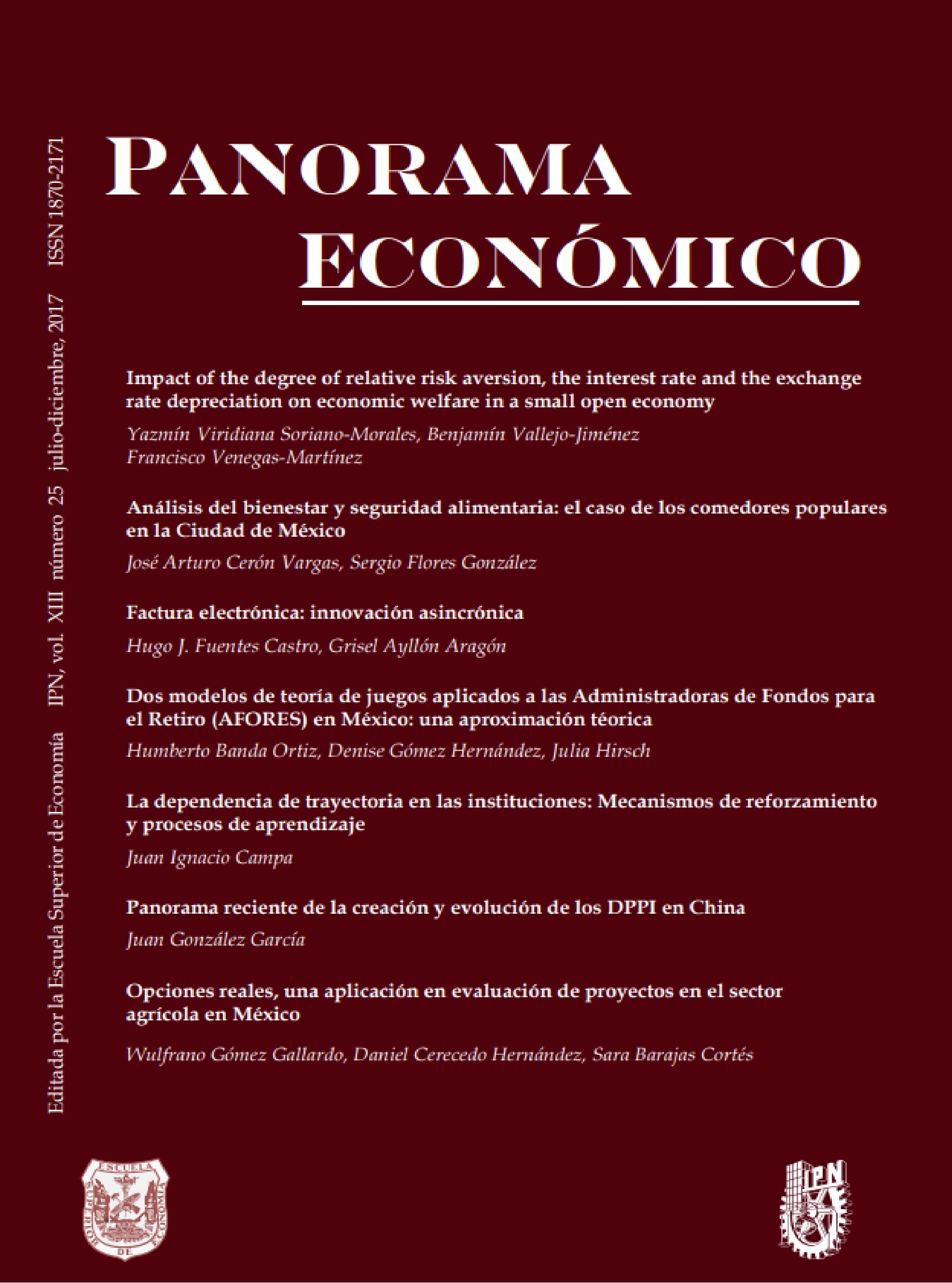
Recent overview of the development and evolution of DPPI in China
DOI:
https://doi.org/10.29201/peipn.v13i25.404Keywords:
intellectual property, institutional framework, economy, trademarks, patentsAbstract
The article analyzes the construction of China‘s institutional framework, from the reform and economic opening of the late 1970s to create and adjust its intellectual property rights system in all its forms, to adjust it the international standard. It also describes the stages China has undergone to design and build the institutional framework. It is postulated that China will only succeed in becoming an economy of medium economic development in this century if it achieves to keep an institutional framework ad hoc to its economic dynamism, as if it does not guarantee the right to intellectual property, it will not be able to maintain its recent leadership in the application trademarks and other names of intellectual property, which is the basis of the global economy. It concludes, with the analysis of the main challenges facing China, to become a knowledge economy.
Downloads
References
Banco Mundial (2016). “Informe Anual”, recuperado de: http://www.bancomun-dial.org/es/about/annual-report.
Becerra-Ramírez, Manuel (2009). “China: una estrategia sobre propiedad intelectual”. Publicación en línea del Instituto de Investigaciones jurídicas de la UNAM. http://ww.juridicas,unam.mx, pp. 379-397.
Casas-Herrera, Gordiano (2006). “Medidas Prácticas para Proteger los Derechos de Propiedad Intelectual en China”. Carta de Asia-Economía. Casa Asia. núm. 153, pp. 1-3.
China Daily (2011). Varios números.
Condon, J. Bradley (2009). Comentario sobre China: Derechos de Propiedad Intelectual. “Informe del Grupo Especial”, 2 de enero de 2009. OMPI.
Constitución Política de la República Popular de China (1982). Lenguas Extranjeras, Beijing.
Constitución Política de la República Popular de China (2004). Consejo de Estado, Beijing RPC.
Gao, Lulin (2008). China’s Patent System and Globalization. Industrial Research Institute. USA, pp. 34-37.
Kong, Qingjiang (2007). “La economía política de la construcción del régimen de propiedad intelectual en China: el ejemplo del régimen de patentes chino”, RJUAM, núm., 16, 2007-II, pp. 99-110.
Mercurio, B. (2012). “The protection and Enforcement of Intellectual Property in China sice Accession to the WTO: Progess and Retreat”. China perspectives, pp. 23- 28.
Miranda-De-Sousa, Joao (2009). “Propiedad Industrial e Intelectual en China: situación actual y Perspectivas”. http://www.iberasia.org.es. (Observatorio Iberoamericano de Asia Pacífico).
Moga-Thomas T. (2002). “The TRIPS and Agreements in China”. The China Business Review. Beijing, pp. 12-18.
OMPI (2015). Informe Mundial sobre la Propiedad Intelectual en 2015: La innovación revolucionaria y el crecimiento económico. Recuperado de: http://www.wipo.int/edocs/pubdocs/es/wipo_pub_944_2015.pdf.
OMPI (2004). Protección Judicial y Administrativa de la propiedad Intelectual en China. Ginebra, p. 9.
OMPI (2010). PCT: The International System on Patent in 2009. Review Yearly. Ginebra.
OMPI (2011). Reporte sobre la Propiedad Intelectual en 2010. http://wipo.org.
___(2011b). Síntesis del Marco jurídico y Normativo de la propiedad Intelectual de la República Popular China, pp. 87-140.
OMPI (2017). “The Global Innovation Index 2017”. Recuperado de: http://www.wipo.int/edocs/pubdocs/en/wipo_pub_gii_2017.pdf.
“Organización Mundial del Comercio” (2015). Informe Anual 2015, recuperado de: https://www.wto.org/spanish/news_s/news15_s/anrp_27may15_s.htm.
Patent Infringement: “An Empirical Study Based on Patent Renewal data of China”. China Economic Review. Beijing, pp. 37-53.
“Perspective”, OECD Trade Policy Working Papers, No. 105, OECD Publishing, pp. 1-19.
Shao, Ken (2013). History in a Key Decoder: Why China Aims at Re-emerging as a Global Leader of Innovation. Intellectual property and New Technologies. USA. pp. 117-132.
Shuterling, John W. (2009). “Intellectual Property Rights: The West, China and India. Koninklijke Brill. Leiden, USA”., pp. 399-413.
UNCTAD (2016). “Reporte sobre las Inversiones en el Mundo en 2016”. UN-UNCTAD, recuperado de: http://unctad.org/es/PublicationsLibrary/wir2016_Overview_es.pdf.
UNESCO (2005). “Hacia las Sociedades del Conocimiento”. Informe Mundial de la UNESCO. París, Francia.
Xinhua (2010). Varios números.
Zhang, Gupeng; Lv Xiaofeng, y Zhou Jinanghua (2009). Private Valeu of Patent Righ.
Zhao, Mingyuan (2010). Policy Complements to the Strengthening of IPRS in Developing Countries -China’s Intellectual Property Environment: A Firm-Level.
Zhao, Young (2012). “Fluking innovation and creativity. Kappan”; pp. 56-61, vol., 94, núm. 54. recuperado de: kappanmagazine.org.
Downloads
Published
How to Cite
Issue
Section
License
Copyright (c) 2026 Panorama Económico

This work is licensed under a Creative Commons Attribution-NonCommercial-NoDerivatives 4.0 International License.