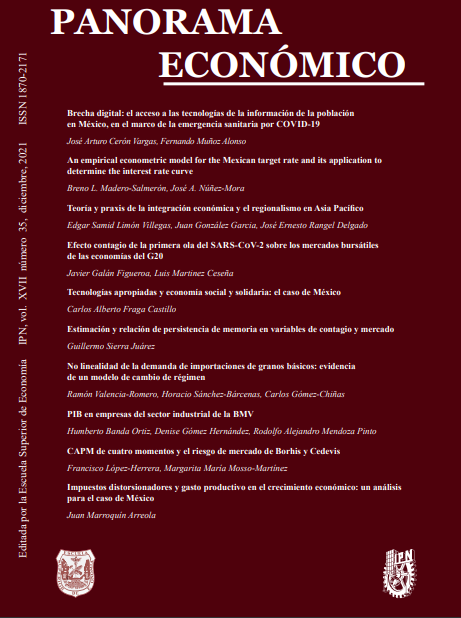
CAPM of four moments and the market risk of Borhis and Cedevis
DOI:
https://doi.org/10.29201/peipn.v17i35.100Keywords:
four moments-CAPM, CAPM 4M, market risk, Borhis, CedevisAbstract
This study was carried out with the aim of testing the hypothesis that, given the characteristics of the risk present in the probability distribution of the returns of the mortgage-based bonds Borhis and Cedevis, a four-moment CAPM model (CAPM-4M) is required to explain the market risk of that mortgage-backed bonds. The characteristics of the probability distributions of the returns of both bonds and the Price and Quotation Index (IPC) of the Mexican Stock Exchange were analyzed finding, as could be expected, bias and kurtosis not typical of a normal probability distribution. The sensitivities of the Borhis and Cedevis returns at the second, third and fourth comoments were calculated with respect to the returns of the stock market index. The two bonds returns show high sensitivity to the coskewness with the Mexican stock market returns, but both of them have low exposure to the covariance and the coskewness. The evidence suggests the relevance of using a CAPM of four moments to explain the market risk of the Borhis and Cedevis. These sources of risk should be considered for the selection and management of portfolios that include these instruments, as well as for the design of risk management measures
Downloads
References
Banco de México. Informe Anual 2020. https://www.banxico.org.mx.
Barberis, N., y M. Huang (2008). Stocks as Lotteries: The Implications of Probability Weighting for Security Prices. American Economic Review, 98(5), 2066-2100. https://doi.org/10.1257/aer.98.5.2066.
Black, F.; M.C. Jensen y M. Scholes (1972). The Capital Asset Pricing Model: Some Empirical Tests. In Studies in the Theory of Capital Markets. Praeger: New York.
Blöchlinger, A. (2018). Credit Rating and Pricing: Poles Apart. Journal of Risk and Financial Management, 11(2), 27. https://doi.org/10.3390/jrfm11020027.
Boyer, B. H.; T. Mitton y K. Vorkink (2010). Expected Idiosyncratic Skewness. Review Financial Studies, 23(1), 169-202.
Brunnermeier, M. K.; C. Gollier y J. A. Parker (2007). Optimal Beliefs, Asset Prices, and the Preference for Skewed Returns. American Economic Review, 97(2), pp. 159-165. https://doi.org/10.1257/aer.97.2.159.
Campbell, J. Y.; J. Hilscher y J. Szilagyi (2008). In Search of Distress Risk. The Journal of Finance, 63(6), pp. 2899-2939. https://doi.org/10.1111/j.1540-6261.2008.01416.x.
Chabi-Yo, F. (2012). Pricing Kernels with Stochastic Skewness and Volatility Risk. Management Science, 58(3), pp. 624-640. https://doi.org/10.1287/mnsc.1110.1424.
Chiao, C., K. Hung y S. C. Srivastava (2003). Taiwan stock market and four-moment asset pricing model. Journal of International Financial Markets, Institutions and Money, 13(4), pp. 355-381. https://doi.org/10.1016/s1042-4431(03)00013-1.
Christie-David, R., y M. Chaudhry (2001). Coskewness and cokurtosis in futures markets. Journal of Empirical Finance, 8(1), pp. 55-81. https://doi.org/10.1016/s0927-5398(01)00020-2.
Conrad, J.; R. F. Dittmar y E. Ghysels (2013). Ex Ante Skewness and Expected Stock Returns. The Journal of Finance, 68(1), pp. 85-124. https://doi.org/10.1111/j.1540-6261.2012.01795.x.
Dichev, I. D. (1998). Is the Risk of Bankruptcy a Systematic Risk?. The Journal of Finance, 53(3), pp. 1131-1147. https://doi.org/10.1111/0022-1082.00046.
Dittmar, R. (2002). Nonlinear Pricing Kernels, Kurtosis Preference, and Evidence from the Cross-Section of Equity Returns. Journal of Finance, 57, pp. 369-403.
Fang, H. and T.-Y. Lai (1997). Co-Kurtosis and Capital Asset Pricing. Financial Review, 32, 293-307. https://doi.org/10.1111/j.1540-6288.1997.tb00426.x.
Fletcher, J., y J. Kihanda, (2005). An examination of alternative CAPM-based models in UK stock returns. Journal of Banking y Finance, 29(12), pp. 2995-3014. https://doi.org/10.1016/j.jbankfin.2004.11.002.
Friend, I, y R. Westerfield (1980). Co-Skewness and Capital Asset Pricing. Journal of Finance, 35(4), 897-913, https://doi.org/10.1111/j.1540-6261.1980.tb03508.x.
González-Urteaga, A.; L. Muga y R. Santamaría (2014). Idiosyncratic coskewness and default risk in the spanish stock market. [Coasimetría idiosincrática y riesgo de insolvencia en el mercado de valores español]. Revista Espanola de Financiacion y Contabilidad, 43(3), pp. 290-315. doi:10.1080/02102412.2014.942969.
Griffin, J. M., y M. L. Lemmon (2002). Book-to-Market Equity, Distress Risk, and Stock Returns. The Journal of Finance, 57(5), 2317–2336. https://doi.org/10.1111/1540-6261.00497.
Harvey, C. R., y A. Siddique (2000). Conditional Skewness in Asset Pricing Tests. The Journal of Finance, 55(3), 1263-1295. https://doi.org/10.1111/0022-1082.00247.
Hwang, S. y E. Satchell (1999). Modelling emerging market risk premia using higher moments. International Journal of Finance and Economics, 4(4), pp. 271-296.
Jang, J., y J. Kang (2017). An intertemporal CAPM with higher-order moments. The North American Journal of Economics and Finance, 42, pp. 314-337. https://doi.org/10.1016/j.najef.2017.07.017.
Johan K.; K. Dimitrios y K. Gregory (2019). Modeling the Risk Dynamics of Hedge Funds. Journal of Finance and Investment Analysis, SCIENPRESS Ltd, 8(1), 1-3.
Jondeau E.; S.-H. Poon, y M. Rockinger (2007): Financial modeling under non-Gaussian distributions. Springer.
Kraus, A. y R. H. Litzenberger (1976). Skewness Preference and the Valuation of Risk As-sets. The Journal of Finance, 31, pp. 1085-1100. https://doi.org/10.1111/j.1540-6261.1976.tb01961.x.
Lal, I., Mubeen, M.; A. Hussain y M. Zubair (2016). An empirical analysis of higher moment capital asset pricing model for Karachi Stock Exchange (KSE). Open Journal of Social Sciences, 4, pp. 53-60. doi:http://dx.doi.org/10.4236/jss.2016.46006.
Lintner, J. (1965). The valuation of risk assets and selection of risky investments in stock portfolio and capital. Review of Economics and Statistics, 47, pp. 13-47. doi:http://dx.doi.org/10.2307/1924119.
Markowitz, H. (1952). Portfolio Selection. Journal of Finance, 7(1), pp. 77-91.
Markowitz, H. (1959). Portfolio Selection: Efficient Diversification of Investments. Nueva York: John Wiley y Sons.
Miller, M. y M. Scholes (1972). Rates of return in relation to risk: a reexamination of some recent findings. En Studies in the Theory of Capital Markets (47-78). Nueva York: Michael C. Jensen, Praeger Publishing Co.
Misra, D.; S. Vishnani y A. Mehrotra (2019). Four-moment CAPM model: Evidence from the indian stock market. Journal of Emerging Market Finance, 18(1_suppl), S137-S166. doi:10.1177/0972652719831564.
Mitton, T., y K. Vorkink (2007). Equilibrium Underdiversification and the Preference for Skewness. Review of Financial Studies, 20(4). pp. 1255-1288, https://EconPapers.repec.org/RePEc:oup:rfinst:v:20:y:2007:i:4:p:1255-1288.
Mossin, S. (1966). Economic Forces and the Stock Market. The Journal of Business, 59(3), pp. 383-403.
Nishantha, J. M. (2018). Testing the Validity of Conditional Four Moment Capital Asset Pricing Model: Empirical Evidence from the Colombo Stock Exchange. Staff Studies, 48(1), 99-129. DOI: http://doi.org/10.4038/ss.v48i1.4710.
Ranaldo, A. y L. Favre (2005). How to Price Hedge Funds: From Two- to Four-Moment CAPM. SSRN Electronic Journal. Published. https://doi.org/10.2139/ssrn.474561.
Redondo, J. I. (2019). Análisis de la estructura de rendimiento y riesgo de los fondos comunes de inversión en la Argentina. Buenos Aires, Argentina: Biblioteca Digital Académica.
Sharpe, W. (1963). A Simplified Model for Portfolio Analysis. Management Science, IX, No., enero, pp. 277-293.
Sharpe, W. (1964). Capital asset prices: A theory of market equilibrium under conditions of risk. Journal of Finance, 19, pp. 425-442.
Tobin, James (1958). Liquidity preference as behavior towards risk. Review of Economic Studies, 25(2), pp. 65-86.
Treynor, J. (1961). Market Value, Time, and Risk [Manuscrito no publicado]. pp. 95-209.
Treynor, J. (1962). Toward a Theory of Market Value of Risky Assets [Manuscrito no publicado]. Londres: Rough Draft.
Vassalou, M. and Y. Xing (2004). Default Risk in Equity Returns. Journal of Finance, 59, pp. 831-868. https://doi.org/10.1111/j.1540-6261.2004.00650.x.
Vendrame, V.; J. Tucker y C. Guermat (2016). Some extensions of the CAPM for individual assets. International Review of Financial Analysis, 44(C), pp. 78-85, https://EconPapers.repec.org/RePEc:eee:finana:v:44:y:2016:i:c:p:78-85.
Downloads
Published
How to Cite
Issue
Section
License
Copyright (c) 2022 Panorama Económico

This work is licensed under a Creative Commons Attribution-NonCommercial-NoDerivatives 4.0 International License.