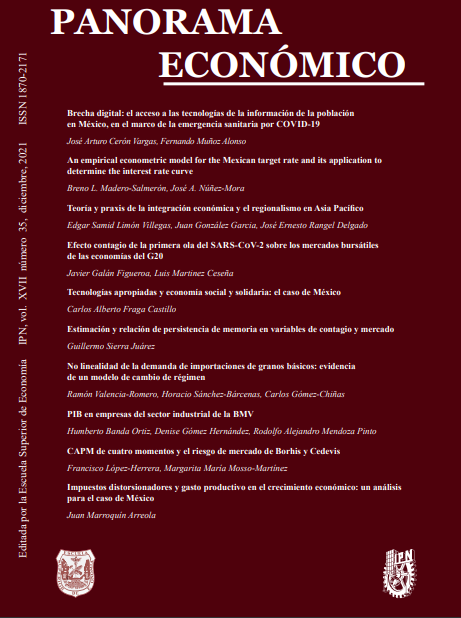
Contagion effect of the first wave of SARS-CoV-2 on the stock markets of the G20 economies
DOI:
https://doi.org/10.29201/peipn.v17i35.95Keywords:
SARS-CoV-2, contagion effect, EGARCH model, DCC-GARCH modelAbstract
This paper analyzes the transmission of the variance volatility among the stock markets that make up the G20 during the first wave of SARS-CoV-2. Also validate the existence of a contagion effect. To do this, first, the symmetric and asymmetric models of heteroscedastic conditional variance are used to determine the magnitude of the impact of the virus on the sample of the stock market indices analyzed; secondly, to validate the existence of the contagion effect, the DCC-GARCH model is used. With these methodologies, evidence was found that the first wave of the virus generated a scenario of stock market instability accompanied by a high degree of volatility that was transmitted from the more developed financial markets to the less developed ones.
Downloads
References
Akerlof, G. y R. Shiller (2009). Animal spirits. How human psychology drives the economy, and why it matters for global capitalism, Princeton University Press, EUA.
Baur, D. (2012). “Financial contagion and the real economy”, Journal of Banking & Fi-nance, 36(10): 2680-2692. Doi: https://doi.org/10.1016/j.jbankfin.2011.05.019.
Bollerslev, T.; R. Chou y K. Kenneth (1992). “ARCH modelling in finance: A review of the theory and empirical evidence”, Journal of Econometrics, 52(1-2): 5-59. Doi: https://doi.org/10.1016/0304-4076(92)90064-X.
Bollerslev, T. (1986). “Generalized autoregressive conditional heteroskedasticity”, Journal of Econometrics, 31(3): 307-327. Doi: https://doi.org/10.1016/0304-4076(86)90063-1.
Casas, M. y E. Cepeda (2008). “Modelos ARCH, GARCH y EGARCH: aplicaciones a series financieras”, Cuadernos de Economía, 27(48): 287-319.
Caporale, G.; N. Pittis y N. Spagnolo (2003). “IGARCH models and structural breaks”, Applied Economics Letters, 10(12): 765-768, Doi: https://doi.org/10.1080/1350485032000138403.
Celik, S. (2012). “The more contagion effect on emerging markets: The evidence of DCC-GARCH model”, Economic Modelling, 29: 1946-1959. Doi: https://doi.org/10.1016/j.econmod.2012.06.011.
Chiang, T.; B. Jeon y H. Li (2007). “Dynamic correlation analysis of financial contagion: evidence from Asian markets”, Journal of International Money and Finance, 26(7): 1206-1228. Doi: https://doi.org/10.1016/j.jimonfin.2007.06.005.
Chirinos, M. (2013). “Medición de contagio e interdependencia financieros mediante cópulas y eventos extremos en los países de la América Latina”, El Trimestre Eco-nómico, 80(317): 169-206. Doi: https://doi.org/10.20430/ete.v80i317.86
Corbet, S.; Y. Hou, Y. Hu, B. Lucey y L. Oxley (2021). “Aye Corona! The contagion effects of being named Corona during the COVID-19 pandemic”, Finance Research Letters, 38:101591. Doi: https://doi.org/10.1016/j.frl.2020.101591
Dornbusch, R., Y. Park y S. Claessens (2000). “Contagion: understanding how it spreads”, The World Bank Research Observer, 15(2), pp 177-197. Doi: https://doi.org/10.1093/wbro/15.2.177
Engle, R. y T. Bollerslev (1986). “Modelling the persistence of conditional variances”, Econometric Reviews, 5(1): 1-50. Doi: https://doi.org/10.1080/07474938608800095
Engle, R. (1982). “Autorregresive Conditional Heterocedasticity with Estimates of the Variance of the U.K. Inflation”, Econometrica, 50(4): 987-1007. Doi: https://doi.org/10.2307/1912773.
___ (2002). “Dynamic conditional correlation: a simple class of multivaria-te generalized autoregressive conditional heteroskedasticity models”, Journal of Business & Economic Statistics, 20(3): 339-350. Doi: https://doi.org/10.1198/073500102288618487.
Forbes, K. y Rigobon, R. (2002). “No Contagion, Only Interdependence: Measuring Stock Market Comovements”, The Journal of Finance, 57(5), 2223-2261. Doi: https://doi.org/10.1111/0022-1082.00494.
Galán, J. (2016). “Los precios a través de la economía de la información. Una aplicación entre el peso mexicano y el dólar estadounidense, 2014-2016”, Economía Informa, 401: 4-17, Doi: https://doi.org/10.1016/j.ecin.2016.11.001.
Granados, M. R., J. Galán y J. A. Leos (2020). “Volatilidad en los precios de los cereales básicos y su impacto en la seguridad alimentaria. México, 1995-2018”, Nóesis. Revista de Ciencias Sociales, 29(58): 79-105. Doi: DOI:
Iheke, D. y B. Lin (2020). “Stock markets and the COVID-19 fractal contagion effects”, Finance Research Letters, 38(101640). Doi: https://doi.org/10.1016/j.frl.2020.101640
Lamoureux, C. y W. Lastrapes (2012). “Persistence in Variance, Structural Change, and the GARCH Model”, Journal of Business & Economic Statistics, 8(2): 225-234. Doi: https://doi.org/10.1080/07350015.1990.10509794.
Nelson, D. (1991). “Conditional heteroskedasticity in asset returns: a new approach”, Econometrica, 59(2): 347-370. https://doi.org/10.2307/2938260
Novales, A. y M. Gracia-Díez (2013). “Guía para la estimación de modelos ARCH”, Estadística Española, 35(132): 5-38.
Okorie, D. I., & B. Lin (2020). “Stock Markets and the COVID-19 Fractal Conta-gion Effects”, Finance Research Letters, 101640. Doi: https://doi.org/10.1016/j.frl.2020.101640.
Russo, A. (2008). “Vulnerabilidad y contagio en el lenguaje de la economía”, en Elestra, Actas del III Congreso de Puebla (México); El español, lengua de traducción. Disponible: https://cvc.cervantes.es/LENGUA/esletra/pdf/03/012_russo.pdf
Selik, C. (2012). “The more contagion effect on emerging markets: The evidence of DCC-GARCH model”, Economic Modelling, 29(5): 1947-1959. Doi: https://doi.org/10.1016/j.econmod.2012.06.011.
Shiller, R. (2015). Irrational Exuberance, Princeton University Press, EUA.
Syllignakis, M. y G. Kouretas (2011). “Dynamic correlation analysis of finan-cial contagion: evidence from the Central and Eastern European markets”, International Review of Economics & Finance, 20(4): 717-732. Doi: https://doi.org/10.1016/j.iref.2011.01.006.
Downloads
Published
How to Cite
Issue
Section
License

This work is licensed under a Creative Commons Attribution-NonCommercial-NoDerivatives 4.0 International License.