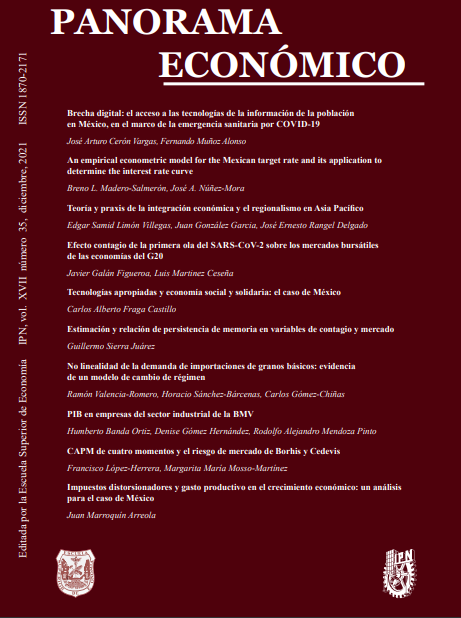
An empirical econometric model for the Mexican target rate and its application to determine the interest rate curve
DOI:
https://doi.org/10.29201/peipn.v17i35.92Keywords:
econometric modeling, monetary policy, term structure of interest rates, fixed income securitiesAbstract
The term structure of interest rates has been a field of intense research both from the theoretical point of view as well as from the purely applied point of view. We propose in this work a novel approach to model empirically the Target Rate that Banco de México sets as part of their monetary policy using a difference of two Poisson distributions in terms of public data: the monetary decisions taken by the Federal Reserve, the exchange rate, the inflation rate and its expectation, and the economic growth results and expectations. We apply later this rate to determine with excellent statistical significance, the short-term rates and then, using it together with the ratio of public spending without financial costs to GDP, the corresponding behavior of mid-term rates also with a very good significance.
Downloads
References
Álvarez R. J.; J. Alvarez; E. Rodriguez; G. Fernández (2008). Time-varying Hurst exponent for US stock markets, Physica A: Statistical Mechanics and its Applications, 387 ( 24), pp. 6159-6169, https://doi.org/10.1016/j.physa.2008.06.056.
Arouxet M. B.; A. F. Bariviera; V. E. Pastor y V. Vampa (2020). Covid-19 impact on cryptocurrencies: evidence form a wavelet-based Hurst exponent, https://arxiv.org/abs/2009.05652v1.
Barua, S. (2020). COVID-19. Pandemic and World Trade: Some Analytical Notes, SSRN, http://dx.doi.org/10.2139/ssrn.3577627.
Bodenstein M.; G. Corsetti; L. Guerrieri (2020). “Disruptions in a Pandemic”, Social Distancing and Supply VOX EU CEPR, https://voxeu.org/article/social-distancingand-supply-disruptions-pandemic.
Hurst, H. (1951). The long-term storage capacity of reservoirs, Transactions of the American Society of Civil Engineers, 1951, vol. 116, Issue 1, pp. 770-799.
Laktyunkin, A.; A. Potapov (2020). Impact of COVID-19 on the Financial Crisis: Calculation of Fractal Parameters, Biomed J. Sci & Tech Res 30(5)-2020. BJSTR. MS.ID.005019.
Mandelbrot, B. (1982). The Fractal Geometry of Nature, NY W.H. Freeman.
Mandelbrot, B. and V. Ness (1968). Fractional Brownian Motions, Fractional Noises and Applications, SIAM review 10, 11(3).
Okorie, D.; B. Lin (2021). Stock markets and COVID-19 fractal contagion effects, Finance
Research Letters, vol., 38, https://doi.org/10.1016/j.frl.2020.101640.
Palomas E. (2002). Evidencia e Implicaciones del fenómeno Hurst en el mercado de capitales, Gaceta de economía, año 8, núm., p. 15.
Peters, E. (1991). Chaos and Order in Capital Markets, New York, 2nd ed., John Wiley and Sons.
Peters, E. (1994). Fractal Market Analysis, Applying Chaos Theory to Invesment an Economic, New York: John Wiley and Sons.
Swetadri S.; G. Koushik (2020). Analysis of Self-Similarity, Memory and Variation in Growth Rate of COVID-19 Cases in Some Major Impacted Countries, Journal of Physics: Conference Series, vol., pp. 1797.
Zavarce C. (2020). Comportamiento Estocástico de la COVID-19 en la República Bolivariana de Venezuela ¿Persistencia o antipersistencia de los Contagios?, vol. 5, num. 2, mayo-agosto 2020, pp. 91-110.
Downloads
Published
How to Cite
Issue
Section
License

This work is licensed under a Creative Commons Attribution-NonCommercial-NoDerivatives 4.0 International License.