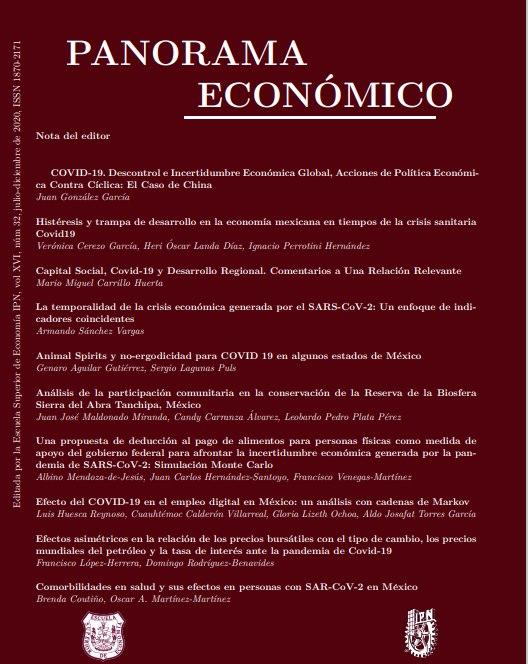
Hysteresis and development trap in the Mexican economy in the era of the Covid19 crisis
DOI:
https://doi.org/10.29201/peipn.v16i32.7Keywords:
Economic Development, Economic growth, Mexico, Health, PovertyAbstract
In this paper the hypothesis of the existence of both a poverty trap à la Nurkse (Nurkse (1952); Nurkse et al. (1953)) and a hysteresis phenomenon in the Mexican economy is dealt with theoretically and empirically. Such phenomena tend to magnify the economic effects imparted by the Covid19 sanitary crisis: there is a vicious circle configured by the interplay between a poverty trap and economic stagnation, whereby a low level of per capita income constrains the size of the market, voluntary savings and the incentives for investment. Likewise, the observed low levels of productivity and gross capital formation limit the expansion of the domestic market for the local manufacturing industry which is not part and parcel of the export-led growth model.
Downloads
References
Aghion, P. & Howitt, P. W. (2008).The economics of growth. MIT press.
Atkinson, A. B. (2016). Desigualdad:¿Qué podemos hacer? Fondo de Cultura Económica.
Baldwin, R. (1988). Hysteresis in import prices: the beachhead effect (inf. téc.). National Bureau of Economic Research. https://www.nber.org/papers/w2545
Baldwin, R. & Krugman, P. (1989). Persistent trade effects of large exchange rate shocks. The Quarterly Journal of Economics,104(4), 635-654. https://doi.org/10.2307/2937860
Blanchard, O. J. & Summers, L. H. (1986). Hysteresis in unemployment (inf. téc.). National Bureau of Economic Research.
CEPAL, N. (2020). Informe sobre el impacto económico en América Latina y el Caribe de la enfermedad por coronavirus (COVID-19). https://repositorio.cepal.org/handle/11362/45602
Cross, R. (1993). On the foundations of hysteresis in economic systems. Economics & Philosophy,9(1),53-74. https://doi.org/doi.org.10.1017/S0266267100005113
De Palacios, A. P. & Romero, J. (2009).México: de la crisis de la deuda al estancamiento económico. Colegio de México.
Ewing, J. A. (1885). X. Experimental researches in magnetism. Philosophical Transactions of the Royal Society of London, (176), 523-640. https://royalsocietypublishing.org/doi/pdf/10.1098/rstl.1885.0010
Franz, W. (1990). Hysteresis in economic relationships: an overview. Hysteresis effects in economic models (pp. 1-17). Springer.
Furtado, C. (1954). Capital formation and economic development. International Economic Papers,4(1),124-144.
Furtado, C. M. (1986). Teoría e polıetica do desenvolvimento econˆomico. Nova Cultural Sao Paulo.
Galíe, J. (2015). Hysteresis and the European unemployment problem revisited (inf. téc.). National Bureauof Economic Research. https://www.nber.org/papers/w21430.pdf
Garcıéa, J. C. T., Hernández, E. C. R. & Bolı ́evar, H. R. (2017). Análisis de la histéresis del desempleo en México ante shocks macroeconómicos. Contadurıéa y administración,62(4), 1228-1248. https://doi.org/10.1016/j.cya.2017.06.005
Georgescu-Roegen, N. (1966). Analytical economics: issues and problems.
Georgescu-Roegen, N. (1986). The entropy law and the economic process in retrospect. Eastern Economic Journal,12(1), 3-25. https://www.jstor.org/stable/40357380
Grossman, G. M. & Helpman, E. (1991).Innovation and growth in the global economy. MIT press.
Helpman, E. (2009).The mystery of economic growth. Harvard University Press.
Hirschman, A. O. (1958).The strategy of economic development (inf. téc.).
Kemp, M. C. & Wan Jr, H. Y. (1974). Hysteresis of long-run equilibrium from realistic adjustment costs[https://doi.org/10.1016/B978-0-12-356750-5.50014-1]. En G. Horwich & P. Samuelson (Eds.), Trade, Stability, and Macroeconomics(pp. 221-242). Elsevier.
Keynes, J. M. (1937). The general theory of employment.The quarterly journal of economics,51(2),209-223.
Lindbeck, A., Snower, D. J.et al. (1987). Efficiency wages versus insiders and outsiders. European Economic Review,31, 407-416.
Lora, E. (2011). The effects of trade liberalization on growth, employment, and wages. The Oxford Handbook of Latin American Economics.
Mejía Reyes, P. & Veleros, Z. H. (1998). Evolución del Producto Interno Bruto de México, 1921-1995:¿Declinación o histéresis?Economıéa, sociedad y Territorio,1(3), 457-491. https://www.redalyc.org/pdf/111/11110302.pdf
Milton, F. (1968). The role of monetary policy. American economic review,58(1), 1-17.
Nurkse, R. (1952). Some international aspects of the problem of economic development.The Americaneconomic review,42(2), 571-583. https://www.jstor.org/stable/1910629
Nurkse, R.et al. (1953). Problems of capital formation in underdeveloped countries.
Ocampo, J. A. & Ros, J. (2011). Shifting paradigms in Latin America’s economic development. The Oxford Handbook of Latin American Economics.
Pasinetti, L. L. (1993). Dinamica economica strutturale Un’indagine teorica sul le conseguenze economichedel l’apprendimento umano. Il mulino.
Pesaran, M. H., Shin, Y. & Smith, R. J. (2001). Bounds testing approaches to the analysis of level relationships.Journal of applied econometrics,16(3), 289-326. https://doi.org/10.1002/jae.616
Phelps, E. S. (1972). Inflation policy and unemployment theory: the cost-benefit approach to monetaryplanning. Macmillan.
Ros, J. (2013). Rethinking economic development, growth, and institutions. Oxford University Press.
Samuelson, P. A. (1965). Some notions on causality and teleology in economics.
Smith, A. (1776). La riqueza de las naciones.
Young, A. A. (1928). Increasing returns and economic progress.The economic journal,38(152), 527-542.https://www.jstor.org/stable/222409749
Downloads
Published
How to Cite
Issue
Section
License

This work is licensed under a Creative Commons Attribution-NonCommercial-NoDerivatives 4.0 International License.