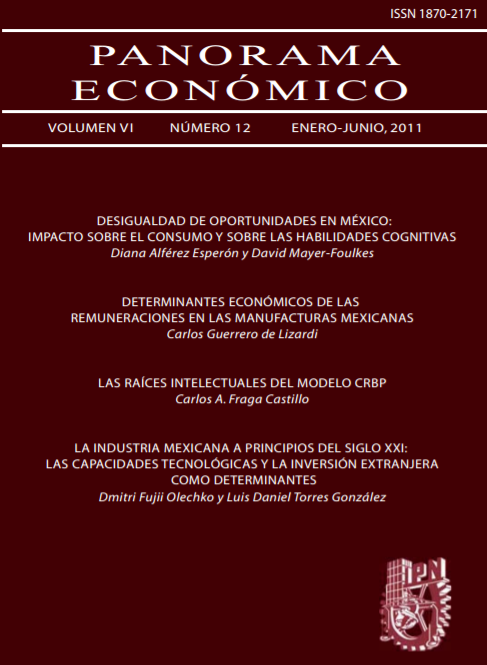
The intellectual roots of the CRBP model
DOI:
https://doi.org/10.29201/peipn.v6i12.296Keywords:
foreign trade multiplier, cumulative causation, economic growth, increasing returns, technical progress, balance paymentsAbstract
Thirlwall's model, known as the CRBP model, has made several contributions to the explanation of economic growth issues. Some of these contributions have referred to profound roots that support the model. Our research explores these principles, firstly in finding the Harrod foreign trade multiplier the antecedent of the 1979 CRBP model; secondly in finding that Smith's approach to the relationship between specialization and market extension, together with Young's concepts of increasing returns and technological progress, make up an image of cumulative causation, within which CRBP's model is found; thirdly in finding that this approach has been successfully contrasted by Myrdal and fourthly that the most thorough approach is that of Kaldor who introduces Keynes's Principle of effective demand and Verdoorn's law.
Downloads
References
Harrod, R, (1933), International Economics, Cambridge University Press, Cam- bridge.
Harrod, R. (1966), Economía Internacional. Colección Flores Lemus Sociedad de Estudios y Publicaciones, Madrid.
Harrod, R. (1973), Economic Dynamics, London: Mcmillan.
Kaldor, N. (1968), "Productivity and growth in manufacturing industry: a reply",Economica, vol. 35, No. 140 (Nov., 1968), pp. 385-391.
Kaldor, N. (1971), "Conflicts in National .Economics Objetives", Economic Jour-nal, Vol 81, March.
Kaldor, N. (1975), "What is Wrong with Economic Theory", Quarterly Journal ofEconomics, vol. 89, No. 3, pp. 347-57.
Kaldor, N. (1978), Further Essays on Economic Theory. Londres: Duckworth.
Kaldor, N. (1979), "Equilibrium Theory and Growth Theory", in M. Baskin, (ed.),Economic and Human Welfare, Essays in Honour of Tibor Skitovsky, Lon- don: Academic Press.
León-Ledesma, M. (2003), Reseña, en A. P. Thirlwall, Naturaleza del CrecimientoEconómico. Un Marco Alternativo para Comprender el Desempeño de lasNaciones. México: Fondo de Cultura Económica.
McCombie, J.S.L., (1993), "Economic Growth, Trade Interlinkages, and the Balance-of-Payments Constraint", Journal ofPost Keynesian Economics, Vol.15, No. 4, Summer, pp. 471-505.
McCombie, J.S.L. y A. P. Thirlwall (1994), Economic Growth and the Balance-of-Payments Constraint, St. Martin's Press, Kent, England.
McCombie, J.S.L. (1998), "Harrod Economic Growth and International Trade", edi- tado por Giorgio Rampa, Luciano Stella y A.P. Thirlwall, Economic Dynamics,Trade and growth Essays on Harrodian Themes, St. Martin's Press, New York.
Ocegueda, J. (2003), "Análisis Kaldoriano del Crecimiento Económico de los Estados de México". Comercio Exterior, BANCOMEXT, vol. 23, No. 11, noviembre, pp. 1024-1034.
Panico, C. (2003), "01d and New Growth Theories: what role for aggregate de- mand?", editado por N. Salvadori, Old and New Growth Theories: an as-sessment, Cheltenham: Edward Elgar.
Panico, C. y N. Salvadori (2006), Classical, neoclassical and Keynesian views ongrowth and distribution, Cheltenham: Edward Elgar.
Panico, C. y O. Rizza (2006), "Myrdal, Growth Process and Equilibrium Theories", (Versión preeliminar).
Ricoy, C. (1987), "Cumulative Causation", en J. Eatwell, M. Milgate y P. New- man (eds) The New Palgrave, Vol. I: pp. 730-36, London: Macmillan Press.
Ricoy, C. (1994), Valor, División del Trabajo, Progreso Técnico y Demanda Efec-tiva: el Principio de Causalidad Acumulativa y el 'Enfoque del Excedente '. Tesis Doctoral. Universidad de Santiago de Compostela, (España).
Thirlwall, A. P. (1979), "The Balance ofPayments Constraint as an Explanation of Internacional Growth Rate Differences", Banca Nazionale del Lavoro Quar-terly Review, march, pp. 45-53.
Thirwall, A. P. y N. Hussain (1982), ' 'The Balance of Payments Constraint, Ca- pital Flows and Growth Rate Differences between Devolping Countries".Oxford Economic Papers, 1982, No. 34, pp. 498-510.
Thirlwall, A.P. (1998), "The Balance of Payments and Growth: from Mercanti- lism to Keynes to Harrod and Beyond", editado por Giorgio Rampa, Luciano Stella y AP. Thirlwall, Economic Dynamics, Trade and YOM'th Essays onHarrodian Themes, St. Martin's Press, New York.
Thirlwall, A-P. (2002), The Nature of Economic Grovvth, An Alternative Fra-mework for Understanding the Performance of Nations, Edward Elgar, Cheltenham, UK.
Thirlwall, A. P. (2003), La Naturaleza del Crecimiento Econåmico. Un marcoAlternativo para Conpender el Desempeno de las Naciones, FCE, México.
Young, A. (1928), "Increasing Retur-ns and Economic Progress", Economic Jour-nai, Vol. 38, No. 152. (Dec., 1928), pp. 527-542.
Downloads
Published
How to Cite
Issue
Section
License
Copyright (c) 2025 Panorama Económico

This work is licensed under a Creative Commons Attribution-NonCommercial-NoDerivatives 4.0 International License.