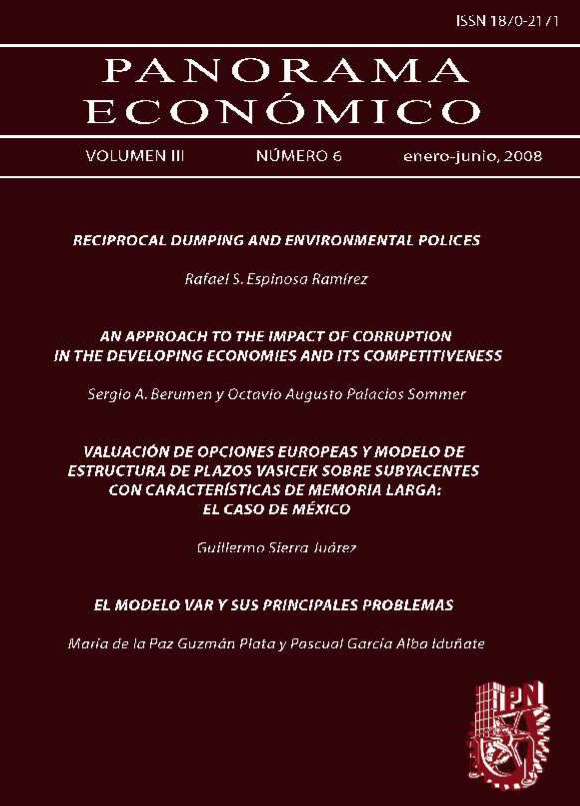
The VAR Model and Its Main Problems
DOI:
https://doi.org/10.29201/peipn.v3i6.263Keywords:
VAR models, Reduced Form, Recursive Form, Structural VAR, CritiquesAbstract
To almost three decades of existence of the VAR models, it is important to ask what are the essential objections that have faced this type of models? To give an answer to this question, it is made this work of investigation which object is determine the principal critiques to the VAR models. To reach the object, we have to study the origin of the VAR models, describe the central stating of these models and beneath the literature about the theme; we find the stating critiques to mention models.
Downloads
References
Canova, F. (2001), “Vector Autoregressive Models: Specification, Estimation, Inferencia and Forecasting”, Handbook of Applied Econometrics, Vol. 1, Malden Massachusetts, M. Hashem Pesaran y Michael R. Wickens, págs. 73-138.
Cochrane, J.H. (1998), “What Do the VARs Mean? Measuring the Output Effects of Monetary Police”, Journal of Monetary Economics. No. 41, págs. 277-300.
Faust, J. y E.M. Leeper (1997), “When Do long-Run Identifying Restrictions Give Reliable Results?”, Journal of Business and Economic Statistics, No.15, julio, págs. 345-53.
Granger, C.W.J. (1969), “Investigation causal relation by econometric models and cross-spectral methods”, Econometrica, vol. 37, No. 3, julio, pp. 425-438.
Granger, C.W.J. (1988), “Some recent developments in a concept of causality”, Journal of Econometrics. No. 39, págs. 199-211.
Greene, W. (1999), Análisis Econométrico. 3ª ed., España, Prentice Hall, págs.1-952.
Guerrero, V. (2003), Análisis Estadístico de Series de Tiempo Económicas. 2º ed. México, Thomson, págs.1-392.
Hall, S. (1995), “Macroeconomics and bit more reality”. The Economic Journal. No.105, julio, págs. 974-988.
Litteman, R.B. (1986), “Forecasting With Bayesian Vector. Autoregressions. Five Years of Experience”. Journal of Business and Economic Statistics, No. 4, enero, págs. 25-38.
Loria, E. (2007), Econometría con aplicaciones, México, Pearson Educación, págs. 1-331.
Lucas, R.E. (1976), “Economic Policy Evaluation: A Critique”, Journal of Monetary Economics. No. 1, febrero, pp. 19-46.
Littlepohl, H. (2004), Applied Time Series Econometrics. Cambridge, England Cambridge University Press, págs. 1-722.
Hamilton, J.D. (1994), Time Series Analysis, United Kingdom, Princeton, págs. 1-800.
Nuñez, R. (2007), Introducción a la Econometría. Enfoques Tradicional y Contemporáneos, México D. F., Trillas, págs. 5-339.
Sims, Ch. (1980), “Macroeconomics and Reality”, Econometrica, Vol. 48, No. 1, pp. 1-48.
Sims, Ch. (1982), “Policy Analysis with Econometrics Models”. Brookings Papers on Economic Activity, No. 1, págs. 107-52.
Sims, Ch. (1986), “Are Forecasting Models Usual for Policy Analysis?”, Federal Reserve of Minneapolis Quarterly Review. Vol. 10, No. 1, págs. 2-16.
Sims, Ch. (1988), “Models and Their Uses”. American Journal of Agricultural Economics, Vol. 1, No.10 págs. 2-16.
Sims, Ch. y T. Zha (1997), Bayesian Methods for Dynamic Multivariate Models, Department of Economics Yale University and Federal Reserve of Atlanta, Julio.
Sims, Ch. y T. Zha (1999), “Error Bans for Impulse Responses”. Econometrica, Vol. 67, No. 5, septiembre, págs. 1113-115.
Sims, Ch. (2006), Making Macro Models Behave Reasonably. Department of Economics Yale University, noviembre.
Stock, J.H. y M.W. Watson (2001), “Vector Autoregressions”. Journal of Economic Perspectives, Vol. 15, No. 4, págs. 101-115.
Stock, J.H. y M.W. Watson (2007), Introduction to Econometrics. 2° ed. Estados Unidos de América, Pearson, págs. 4-795.
Wright, J. (2000), “Confidence Intervals for Univariate Impulse Responses with a Near Unit Root”. Journal of Business and Economic Statistics, No. 18, Julio págs. 368-373.
Downloads
Published
How to Cite
Issue
Section
License
Copyright (c) 2025 Panorama Económico

This work is licensed under a Creative Commons Attribution-NonCommercial-NoDerivatives 4.0 International License.