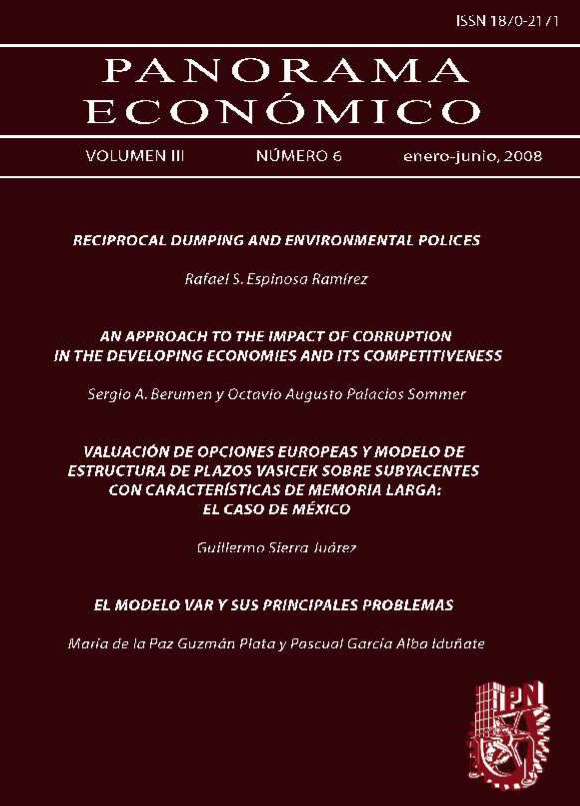
An Approach to the Impact of Corruption in the Developing Economies and Its Competitiveness
DOI:
https://doi.org/10.29201/peipn.v3i6.261Keywords:
Corruption, FDI, developing countriesAbstract
In countries where the government encourages “donations” and “gifts” from private companies, FDI firms are more likely than their domestic counterparts to engage in corrupt forms of political influence, known as State Captures. Different types of foreign investors engage in particular types of corruption, depending on what competitive advantage they will get out of it. FDI firms with local partners are more likely to engage in State Capture. Larger multinational firms with headquarters overseas rely much less on State Capture, yet are more likely to resort to political corruption and bribery, kickbacks, in their dealing with foreign governments. Though quite often, foreign direct investors might claim that they are specifically targeted for bribes by local governments, it has been found that there is no evidence that FDI firms pay higher overall bribes than domestic firms, even though they are more likely to engage in specific forms of corruption.
Downloads
References
Abed, G.T. and H.R. Davoodi (2006), “Corruption, Structural Reforms and Economic Performance in the Transition Economies”. IMF Working Paper, WP/06/132.
Alesina, A. and B. Weder (2007), “Do corrupt governments receive less foreign aid?”. National Bureau of Economic Research Working Paper, 7108. NBER Cambridge, Massachusetts.
Bahre, E. (2005), “How to ignore corruption: reporting the shortcomings of development in South Africa”. Current Anthropology, 46 (1), February, pp. 107-121.
Blum, J., “U.S. Oil Firms Entwined in Equatorial Guinea Deals”, The Washington Post, September 7, http://www.washingtonpost.com/wp-dyn/articles/A1101-2005Sep7.html.
Cuervo, A. (2006), “Who cares about corruption?”. Journal of International Business Studies, 37 (6), Nov, pp. 807-823.
De Costa, P. (1996), “The politics of settlement”, African Report, 38 (6), Nov-Dec, pp. 53-57.
Drabek, Z. and W. Payne (2006), “The impact of transparency on Foreign Direct Investment”. World Trade Organisation Working Paper, ERAD-99-02.
Elliot, K.A. (2002), “Corruption and the Global Economy”. Journal of International Business Studies, Apr, pp. 557-560.
Fredriksson, P.G., J.A. List and D.L. Millimet (2005), “Bureaucratic corruption, environmental policy and inbound US FDI: theory and evidence”. Journal of Public Economics, Vol 87, pp. 1407-1430.
Gallup (2006), Corruption in Russia: Is Bribery Always Wrong?, New York, Gallup Poll News Service. November 15.
Gordon, K. and M. Miyake (2003), Deciphering codes of corporate conduct, Paris, OECD.
Gradirovski, S. and N. Esipova (2006), Corruption in Russia: Greasing the Wheels to Get By, Gallup Poll News Service. November 14.
Grossman, G.M. and E. Helpman (2001), “Protection for Sale”. American Economic Review, 84 (4), pp. 833-850.
Habib, M. and L. Zurawicki (2002), “Corruption and Foreign Direct Investment”. Journal of International Business Studies, 33 (2), Summer, pp. 291-308.
Herbst, J. (1996), “Is Nigeria a viable state?”. The Washington Quarterly, 19 (2), Spring, pp. 151-173.
Hines, J.R. (2005), “Forbidden Payment: Foreign Bribery and American Business after 1977”. National Bureau of Economic Research Working Paper, 5266. NBER, Cambridge, Massachusetts.
Kwok, Ch.C.Y. and S. Tadesse (2006), “The MNC as an agent of change for host-country institutions: FDI and corruption”, Journal of International Business Studies, 37 (6), November, pp. 767-786.
Luo, Y. (2006), “Political behavior, social responsibility, and perceived corruption: a structuration perspective”, Journal of International Business Studies, 37 (6), November, pp. 747-767.
Moran, T.H. (2005), Foreign Direct Investment and Development: The new policy agenda for developing countries and countries in transition, Institute for International Economics.
Obasanjo, O. (1994), “Positive Tradition Perverted by Corruption”, The Financial Times, 14 October.
OECD (2007), Corruption Report (2001-2007), Paris.
OECD (2002), Transparency for FDI: investment is partly about taking risks, though not just any risk. In fact, transparent systems where the judicial framework is efficient and corruption is low tend to receive more investment, Paris.
Oman, Ch. (2000), Policy competition for Foreign Direct Investment: A study of competition among governments to attract FDI, Paris, OECD Development Center.
Pei, M. (2006), “The dark side of China’s rise: China’s economic boom has dazzled investors and captivated the world. But beyond the new high-rises and churning factories lie rampant corruption, vast waste, and an elite with little interest in making things better. Forget about political reform. China’s future will be decay, not democracy”. Foreign Policy, 153, March-April, pp. 32-40.
Rodriguez, P., D.S. Siegel, A. Hillman and L. Eden (2006), “Three lenses on the multinational enterprise: politics, corruption, and corporate social responsibility”, Journal of International Business Studies, November, pp. 733-747.
Shleifer, A. and R. Vishny (2003), “Corruption”. Quarterly Journal of Economics, pp. 599-617, Harvard University Press.
Shleifer, A. and R. Vishny (2004), “Politicians and Firms”. Quarterly Journal of Economics, pp. 995-1025, Harvard University Press.
Smarzynska, B. and S. Wei (2000), “Corruption and the composition of Foreign Direct Investment: Firm Level Evidence”. World Bank Working Paper, 2360.
Stiglitz, J.E., “Cómo hacer que funcione la globalización”, Taurus, 433 p, 970-770-732-1
Wei, S. (2003), “How taxing is corruption on international investors”, National Bureau of Economic Research Working Paper, 6030.
Weitzel, U. and S. Berns (2006), “Cross-border takeovers, corruption, and related aspects of governance”, Journal of International Business Studies, November, pp. 786-807.
Werlin, H.H. (2005), “Corruption in a third world country: why Nigerians cannot handle garbage”, World Affairs, 168 (2), Fall, pp. 79-85.
World Bank (2006b), Anticorruption in Transition: Confronting the Challenge of State Capture, Washington D.C., The World Bank.
World Bank (2006a), Public Procurement Kickback Bribes paid by Firms, Washington, D.C. The World Bank.
Zhao, J.H., S.H. Kim and J. Du (2003), “The impact of corruption and transparency on Foreign Direct Investment: an empirical analysis”, Management International Review, 43 (1), January, pp. 41-63.
Downloads
Published
How to Cite
Issue
Section
License
Copyright (c) 2025 Panorama Económico

This work is licensed under a Creative Commons Attribution-NonCommercial-NoDerivatives 4.0 International License.