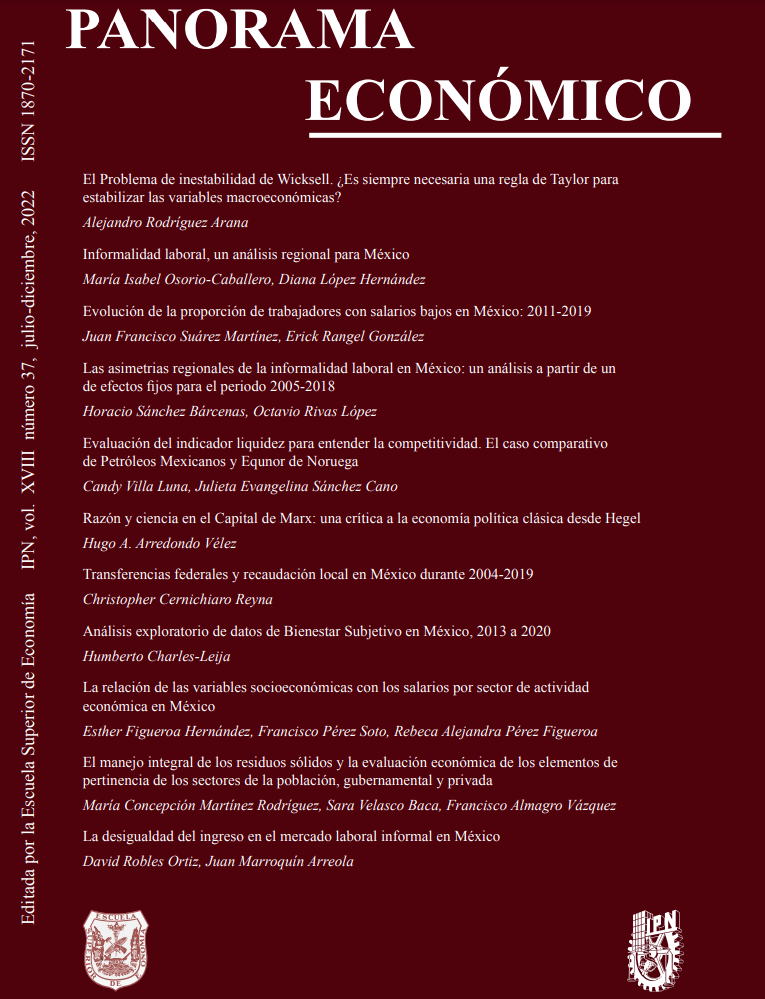
Evolution of the proportion of low-wage workers in Mexico
2011-2019
DOI:
https://doi.org/10.29201/peipn.v18i37.130Keywords:
low wages, labor market, minimum wageAbstract
This article analyzes some of the factors that influence the proportion of low-wage workers in Mexico. An annual data panel is constructed for the period 2011-2019 where the unit of analysis is the states of Mexico. The methodology used is Feasible Generalized Least Squares since it allows estimation in the presence of AR (1) autocorrelation specific to each entity and heteroscedasticity. The main results show that an increase in the schooling of workers has a statistically significant impact and reduces the proportion of workers with low wages (PTSB). For the Kaitz ratio (indicator used to measure the strength of the minimum wage) it is found that there is a relationship in the form of a “u” with the dependent variable, that is, low Kaitz values cause a decrease in the PTSB and for high values, this effect is reversed.
Downloads
Downloads
Published
How to Cite
Issue
Section
License

This work is licensed under a Creative Commons Attribution-NonCommercial-NoDerivatives 4.0 International License.