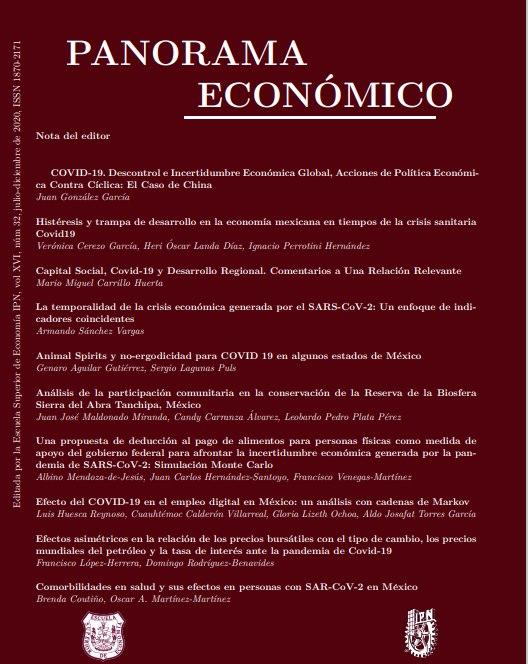
The timing of the economic crisis generated by the SARS-CoV-2
An approach of coincident indicators
DOI:
https://doi.org/10.29201/peipn.v16i32.9Keywords:
Early warning indicator, recession, covid-19, business cycles, turning points, forecastingAbstract
An early warning indicator of the turning points of the Mexican business cycle, the IAEM-MA3, is estimated.
It is calculated using 34 representative variables of economic activity. This indicator allows us to detect the moment of the recession and, together with other predictive models, get conclusions on the depth of the recession and the moment of the recovery. It was found that the recession generated by the SARS-CoV-2 actually started in March 2020 and that its lowest point will be in May. The recession could last only a few months and the recovery of growth to its trend level could be observed until October 2020.
This result is conditioned not only on the performance of economic policy, but also on future outbreaks
that might generate other recessions.
Downloads
References
Acevedo, I. (2018). Indicadores cıéclicos del IMAE. Foro de Investigadores de Bancos Centrales del Consejo Monetario Centroamericano. http://www.secmca.org/recard/index.php/foro/article/view/73
Bernanke, B. S. & Boivin, J. (2003). Monetary policy in a data-rich environment. Journal of Monetary Economics,50(3), 525-546. https://doi.org/10.1016/S0304-3932(03)00024-2
Bry, G. & Boschan, C. (1971). Programmed selection of cyclical turning points. Cyclical analysis of timeseries: Selected procedures and computer programs (pp. 7-63). NBER. https://www.nber.org/chapters/c2148.pdf
Burns, A. F. & Wesley, C. M. (1946). Measuring business cycles. Studies in Business Cycles, (2).
Chaverri-Morales, C. A. & Van-Patten-Rivera, D. M. (2014). Diseño de un indicador adelantado para la actividad económica de Costa Rica. https://repositorioinvestigaciones.bccr.fi.cr/handle/20.500.12506/94
Chicago Fed. (2020a). Background on the Chicago Fed National Activity Index. https://www.chicagofed.org/∼/media/publications/cfnai/background/cfnai-background-pdf.pdf
Chicago Fed. (2020b). Background on the Chicago Fed National Activity Index. https://www.chicagofed.org/∼/media/publications/cfnai/2020/cfnai-june2020-pdf.pdf?la=en
Drautzburg, T.et al. (2019). Why Are Recessions So Hard to Predict? Random Shocks and Business Cycles. Economic Insights,4(1), 1-8. https://www.philadelphiafed.org/- /media/research- and-data/publications/economic-insights/2019/q1/eiq119-predicting-recessions.pdf
Elizondo, R. (2017). Pronósticos de la estructura temporal de las tasas de inter ́es en México con base en un modelo afıén. Estudios Económicos (México, DF),32(2), 213-253. http://www.scielo.org.mx/scielo.php?script=sciarttext&pid=S0186-72022017000200213&lng=es&nrm=iso
Evans, C. L., Liu, C. T. & Pham-Kanter, G. (2002). The 2001 recession and the Chicago Fed National Activity Index: Identifying business cycle turning points. Economic Perspectives-Federal Reserve Bank of Chicago,26(3), 26-43. http://citeseerx.ist.psu.edu/viewdoc/download?doi=10.1.1.198.1254&rep=rep1&type=pdf
Fisher, J. D., Liu, C. T. & Zhou, R. (2002). When can we forecast inflation? Economic Perspectives-Federal Reserve Bank of Chicago,26(1), 32-44.
Hernández Trillo, F. & Vargas, B. (2012). Un modelo para la determinación del riesgo crediticio municipal en México. Investigación económica,71(280), 85-119. http://www.scielo.org. mx/scielo.php?script=sciarttext&pid=S0185-16672012000200004
Mintz, I. (1972). Dating American growth cycles.Economic Research: Retrospect and Prospect, Volume1, The Business Cycle Today(pp. 39-88). NBER. https://www.nber.org/chapters/c4393.pdf
Moore, G. H. & Shiskin, J. (1967). Indicators of Business Expansions and Contractions. National Bureauof Economic Research, Inc. https://ideas.repec.org/b/nbr/nberbk/moor67-2.html
Moore, G. H. (1961).Business cycle indicators (Vol. 1). Princeton University Press Princeton, NJ. Stock, J. H. & Watson, M. W. (1998). Diffusion indexes.NBER working paper, (w6702). https://papers.ssrn.com/sol3/papers.cfm?abstractid=226366
Stock, J. H. & Watson, M. W. (1999). Forecasting inflation. Journal of Monetary Economics, 44(2), 293-335. https://doi.org/10.1016/S0304-3932(99)00027-6
Downloads
Published
How to Cite
Issue
Section
License
Copyright (c) 2021 Panorama Económico

This work is licensed under a Creative Commons Attribution-NonCommercial-NoDerivatives 4.0 International License.