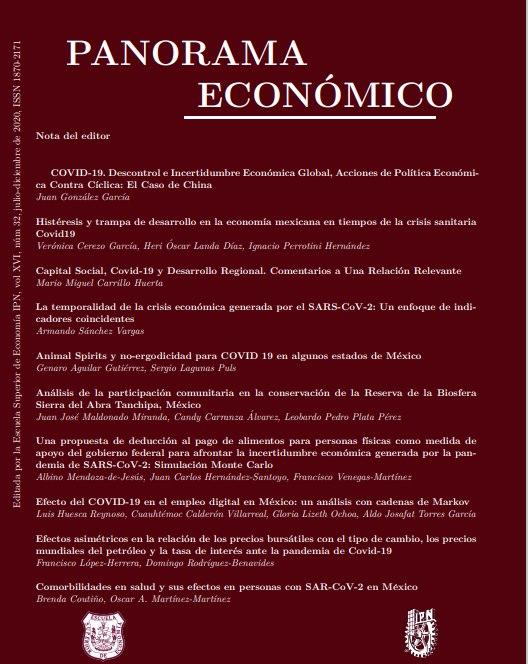
Animal Spirits y no-ergodicidad para COVID 19 en algunos estados de México
Resumen
A partir de datos día a día de los fallecimientos por COVID-19 en México, se desarrolla un modelo de ajuste para la predicción de la cima de fallecimientos en cuatro estados de México; 2 con vocación turística y 2 con vocación industrial. Se pronostica que la cima o “pico” de fallecimientos ocurrirá el día 107 de la pandemia para el estado de Quintana Roo y los días 68, 109 y 72 para los estados de Baja California Sur, Estado de México y Nuevo León. Sin embargo, los hallazgos sugieren que el comportamiento no-ergódico es característico a fenómenos que dependen del comportamiento humano, debido al “animal spirits” que conduce a la irracionalidad en la toma de decisiones de las personas. La evidencia apunta a la necesidad de construcción de hipótesis alternativas, para analizar el comportamiento humano, ante fenómenos de incertidumbre.
Palabras clave
incertidumbre, ergodicidad, animal spirits
Referencias
- Akerlof, G. A. & Shiller, R. J. (2010). Animal spirits: How human psychology drives the economy, and why it matters for global capitalism. Princeton university press.
- Batista, M. (2020). Estimation of the final size of the coronavirus epidemic by the SIR model. Onlinepaper, ResearchGate, 1-12.
- Berger, R. (1981). Comparison of the Gompertz and Logistic Equations to Describe Plant Disease Progress.Phytopathology,71(7), 716-719.
- Blanchard, O. (2016). Do DSGE models have a future?Revista de Econom ́ıa Institucional,18(35), 39-46.
- Blanchard, O. (2017). The need for different classes of macroeconomic models. Peterson Institute for International Economics, Realtime Economics Watch January 12th. %5Curl % 7Bhttps://piie.com/blogs/realtime-economic-issues-watch/need-different-classes-macroeconomicmodels%7D
- Farmer, R. E. (2013). Animal spirits, financial crises and persistent unemployment.The Economic Jour-nal,123(568), 317-340.
- Guerrazzi, M. (2015). Animal spirits, investment and unemployment: An old Keynesian view of the GreatRecession.EconomiA,16(3), 343-358.
- Hendry, D. F. & Muellbauer, J. N. (2018). The future of macroeconomics: macro theory and models at the Bank of England. Oxford Review of Economic Policy,34(1-2), 287-328.
- Huang, C., Wang, Y., Li, X., Ren, L., Zhao, J., Hu, Y., Zhang, L., Fan, G., Xu, J., Gu, X.et al. (2020). Clinical features of patients infected with 2019 novel coronavirus in Wuhan, China. The lancet,395(10223), 497-506.
- Jiang, F., Deng, L., Zhang, L., Cai, Y., Cheung, C. W. & Xia, Z. (2020). Review of the clinical characteristics of coronavirus disease 2019 (COVID-19). Journal of general internal medicine, 1-5.
- Korinek, A. (2017). Thoughts on DSGE Macroeconomics: Matching the Moment, But Missing the Point?But Missing the Point.
- Lucas Jr, R. E. (2003). Macroeconomic priorities. American economic review,93(1), 1-14.
- Oral, E. (2006). Binary regression with stochastic covariates.Communications in Statistics-Theory and Methods, 35(8), 1429-1447.
- Pang, F.-R., Luo, Q.-H., Hong, X.-Q., Wu, B., Zhou, J.-H., Zha, W.-T. & Lv, Y. (2019). The study on the early warning period of varicella outbreaks based on logistic differential equation model. Epidemiology & Infection, 147.
- SALUD. (2020). Información referente a casos COVID-19 en México. Consultado el 15 de mayo de 2020, desde %5Curl%7Bhttps://datos.gob.mx/busca/dataset/informacion-referente-a-casos-covid-19-en-mexico%7D
- Soo, C. (2015). Quantifying animal spirits: news media and sentiment in the housing market. Ross Schoolof Business Paper, (1200).
- Stephens, M. A. (1979).The anderson-darling statistic (inf. téc.). STANFORD UNIV CA DEPT OFSTATISTICS.
- Stiglitz, J. E. (2015).Towards a general theory of deep downturns (inf. téc.). National Bureau of Economic Research. https://www.nber.org/papers/w21444
- Stiglitz, J. E. (2018). Where modern macroeconomics went wrong.Oxford Review of Economic Policy,34(1-2), 70-106.
- Stilianakis, N. I., Perelson, A. S. & Hayden, F. G. (1998). Emergence of drug resistance during an influenzaepidemic: insights from a mathematical model.Journal of Infectious Diseases,177(4), 863-873.
- Tátrai, D. & V ́arallyay, Z. (2020). COVID-19 epidemic outcome predictions based on logistic fitting andestimation of its reliability.arXiv preprint arXiv:2003.14160.