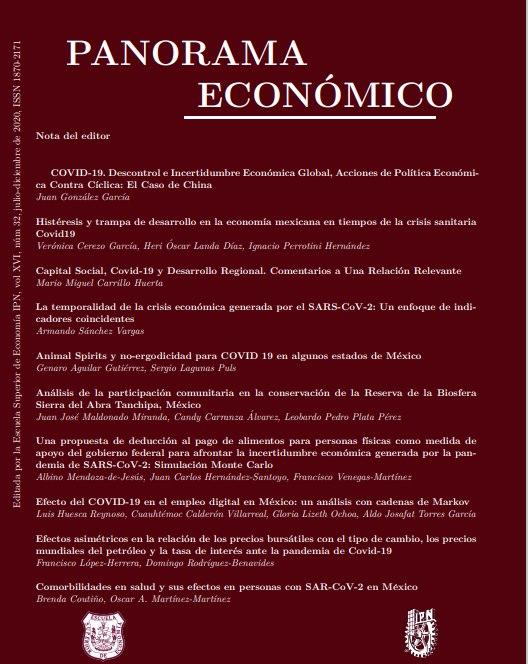
Social Capital, Covid-19 and Regional Development. Commentaries on A Relevant Relationship
DOI:
https://doi.org/10.29201/peipn.v16i32.8Keywords:
social capital, regional development, pandemics, Mexico, United States of AmericaAbstract
Social capital is known for having positive effects on development, by allowing all members of society to realize more easily their productive activities; however, upon occasion it can also have negative effects. Apparently, the Covid-19 pandemic generates negative effects through the higher social interaction associated with higher levels of social capital, which, in turn, causes higher contagion levels and diseases derived from the virus. However, positive effects derived from other components of social capital such as the identification with social values, mutual trust and cooperation could help to overcome the negative effects. Also, development is associated with higher levels of social wellbeing; yet, at the same time, it generates higher degrees of social interdependence and interaction, which mean higher possibilities of incidence of the pandemic. With the help of correlation analysis applied to data from the states of the United States of America and of Mexico, this paper shows that, regions with better development conditions and social capital might be the hardest-hit by the pandemic in the short run, but they are in better conditions to fight the pandemic and to recuperate from its negative effects than those where people live in disadvantage.
Downloads
References
Alvarez, H. A. U. (2000).Análisis cualitativo de la relación entre violencia, capital social y pobreza: análisis del caso del asentamiento ”La Esperanza”, Vil la Nueva. Universidad Francisco Marroquíen.
Carrillo-Huerta, M. M. (1978). Desarrollo y crecimiento económico: una interpretación. Ciencia administrativa,1(1), 75-97.
Carrillo-Huerta, M. M. (2017a). Capital social en México y Estados Unidos. Su relación con la gestión del desarrollo. En F. M. Gutiérrez Ochoa & C. Rivera Hernández (Eds.), Prologo (pp. 19-44). Madrid, España: Benemérita Universidad Autónoma de Puebla / Appalachian State University/ Plaza y Valdé.
Carrillo-Huerta, M. M. (2017b). Un Marco Conceptual para el Análisis de la Relación entre la Violencia y el Desarrollo [Libro electrónico]. En C. Rivera Hernández & M. M. Carrillo Huerta (Eds.), Violencia y desarrollo(pp. 11-36). Instituto de Ciencias de Gobierno y Desarrollo Estratégico, BUAP.
Carrillo-Huerta, M. M. (2019). El capital social y el desarrollo regional en dos regiones de México: la costa de Oaxaca y la Ciudad de Puebla, 2014-2015. En F. M. Gutiérrez Ochoa & C. Rivera Hernández (Eds.), Organización social y desarrollo sostenible en los municipios de Puebla, Tlaxcala y Oaxaca(Primera edición, pp. 19-44). Montiel y Soriano Editores S.A. de C.V. / Benemérita Universidad Autónoma de Puebla.
CDC. (2020). COVID-19 in Racial and Ethnic Minority Groups.Center for Deseases Control de losEstados Unidos de Norteam ́erica. Consultado el 23 de julio de 2020, desde https://www.cdc.gov/coronavirus%20/2019-ncov/need-extra-precautions/racial-ethnic-minorities.html
Coleman, J. S. (1990). Foundations of social theory. Harvard university press.
Contreras, A. (2020).Estudio alerta sobre la alta tasa de contagios de Covid-19 ‘en casa’ [Online]. Consultado el 21 de julio de 2020, desde https://www.eluniversal.com.mx/%20mundo/estudio-alerta-sobre-la-alta-tasa-de-contagios-de-covid-19-en-casa
Culebro-Martı´´´´´´´´´´´´enez, R.et al. (2009). Estimación de indicadores de capital social para los estados de México. eseconomıea, 4(23), 43-69.
Domingo Moratalla, A. (2006). Ética de la vida familiar. Claves para una ciudadanıéa comunitaria. Colección Ética Aplicada. Bilbao: Desclée de Brower.
Donati, P. (2006). Sociologia. Una introduzione allo studio del la societ`a. CEDAM, Mil ́an.
Espıéndola, A. (2009). Entre la Agenda y la Práctica: Dificultades en el Combate a la Violencia en el ́Ambito Doméstico (Tesis doctoral). Tesis de Maestrıéa. Puebla, México.
Fukuyama, F. (1995). Trust: the Social Values and the Creation of Prosperity, 1995.
Heyne, P., Prentice, E. F., Cano Soler, D.et al. (1998).Conceptos de Economıéa: el mundo según los economistas.
Morris, M. (1998). Social capital and poverty in India.
Mundial, B. (1998). The Initiative of Defining, Monitoring and Measuring Social Capital. Overview and Program Description. Social Capital Initiative.Documento de trabajo, (1).
Putnam, R. (1993). The prosperous community: Social capital and public life. The american prospect,13. http://www.prospect.%20org/print/vol/13
Ros Codoñer, J. et al. (2019). Familia, capital social y educación. Actas del II Congreso Internacional de Educación Católica para el siglo XXI. Fe, Ciencias y Educación(pp. 295-304). Valencia, España: Universidad Católica de Valencia ”San Vicente Mártir”.
Williams, A. S. & Anderson, D. (2008). Estadıéstica para administración y economıéa.10ma. Edición. México.
Woolcock, M. & Narayan, D. (2000). Capital social: Implicaciones para la teorıéa, la investigación y las polıéticas sobre desarrollo. World Bank Research Observer,15(2), 225-249.
World Health Organization. (2002). World report on violence and health. 70
Downloads
Published
How to Cite
Issue
Section
License

This work is licensed under a Creative Commons Attribution-NonCommercial-NoDerivatives 4.0 International License.