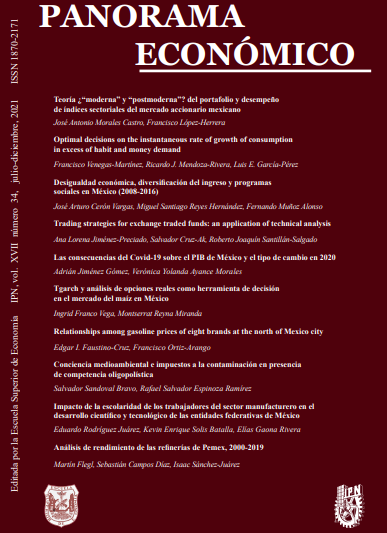
“Modern” and “Post-Modern”? Portfolio Theory and performance of Mexican stock market sectorial indexes
DOI:
https://doi.org/10.29201/peipn.v17i34.78Keywords:
Modern Portfolio Theory, Post-Modern Portfolio Theory, portfolio management, risk management, portfolio performanceAbstract
This paper shows an analysis of the risk and performance of some indexes used by Bolsa Mexicana de Valores to capture the behavior of the market and some economic activity sectors. The analysis is carried out based in metrics posited by the so called Modern and Post-Modern Portfolio Theory. Such metrics were also used to appraisse optimal portfolios under both approaches. The results suggest that the metrics posed by the Post-Modern Portfolio Theory can be useful to improve the measurement, analysis and appraissal of the risk and performance of assests and/or portfolios investments carried on the Mexican market exchange.
Downloads
References
Acosta Osorio, I. L. (2018). Consistencia del ratio Omega con el criterio de dominancia estocástica de segundo orden: evaluación del desempeño de ETF. Odeón, 14, pp. 99-130.
Allen, D.; M. McAleer; R. Powell and A. Singh (2015). Down-side Risk Metrics as Portfolio Diversification Strategies across the GFC. Tinbergen Institute Discussion Paper, TI 2015-122/III.
Ang, J. and J. Chua (1979). Composite measures for the evaluation of investment performance. Journal of Financial and Quantitative Analysis, 14 (2), pp. 361-384.
Arias, F. and C. Patricio (2014) Análise de desempenho dos investimentos susetentáveis no mercado acionário brasileiro. Procuction, 24 (2) pp. 420-434.
Bacon, Carl R. (2008). Practical portfolio performance measurement and attribution, 2nd edition, Wiley Finance Series, John Wiley & Sons: Chippenham, Wiltshire.
Barberis, N.; A. Shleifer and R. Vishny (1996). A Model of Investor Sentiment. Journal of Financial Economics, 49, pp. 307-343.
Cahya, A. y R. Robiyanto (2020). Performance evaluation of exchange traded fund in the Indonesia stock exchange. International Journal of Social Science and Business, 4(4), pp. 499-505.
Canbin, Y. (2018). A strategy considering both magnitude and duration of Drawdowmn. Management Science and Engineering, 12 (1), No. 1, pp. 58-61.
Chekhlov, A.; S. Uryasev and M. Zabarankin (2005). Drawdown measure in portfolio optimization. International Journal of Theoretical and Applied Finance, 8 (1), pp. 13-53.
Gallopo, Giuseppe (2010). A comparison of pre and post modern portfolio theory
using resampling. Global, vol. 4, No. 1, 1-16.
Geambusu, C.; R. Sova; I. Jianu and L. Geambasu (2018). Risk measurement in post-modern portfolio Theory: differences from modern portfolio Theory. https://www. researchgate.net/publication/286072010_Risk_measurement_in_post-modern_portfolio_theory_Differences_from_modern_portfolio_theory.
Gutiérrez, J. y T. Nanda (2009) Uso da medida omega na composição otimizada de uma Carteira de ativos. Conference: SBPO 2009. https://www.researchgate.net/publication /342787172_Uso_da_Medida_Omega_na_Composicao_Otimizada_de_uma_Carteira_de_Ativos.
Hogan, W. and J. Warren (1972). Computation of the efficient boundary in the E-S portfolio selection model. Journal of Financial and Quantitative Analysis, 7 (4), pp. 1881-1896.
Kahneman, D. and A. Tversky (1979). Prospect Theory: An Analysis of Decision under Risk. Econometrica, 47 (2), pp. 263-292.
Kazemi, H.; T. Schneeweis and B. Gupta (2004). Omega as a performance measure. Journal of Performance Measurement, 8 (3), 16-25.
Keating, C. and W. Shadwick (2002). A universal performance measure. Journal of Performance Measurement, 6 (3), 59-84
Kolbadi, P. and H. Ahmadinia (2011). Examining Sharp, Sortino and Sterling Ratios in Portfolio Management, Evidence from Tehran Stock Exchange. International Journal of Business and Management, 6 (4), pp. 222-236.
Klemkosky, R. (1973). The bias in composite performance measures. Journal of Financial and Quantitative Analysis, 8 (3), pp. 505-514.
Lorenzo, A. (2016). Exceso de confianza como determinante de la volatilidad en mercados
accionarios latinoamericanos. Contaduría y Administración, 61, pp. 324-333.
Mao, J. (1970). Models of capital budgeting, E-V Vs. E-S. Journal of Financial and Quantitative Analysis, 5 (5), pp. 657-676.
Markowitz, H. (1952). Portfolio selection. Journal of Finance, 7 (1), pp. 77-91.
___ (1959). Portfolio selection: efficient diversification of investment. John Wiley & Sons, New York.
Méndez, R. y H., Rocha (2019) Análisis de los fondos de pensiones en Chile: periodo 2011-2018. Multidisciplinary Business Review, 12 (1), pp. 39-46.
Ming-Feng, T. and W. Chuan-Ju (2012). Post-Modern Portfolio Theory for Information Retrieval. Procedia Computer Science, 13, pp. 80-85.
Morales, J. y F. López-Herrera (2020). Los nuevos índices sectoriales de la Bolsa Mexicana de Valores y la diversificación sectorial. Revista de Investigación en Ciencias Contables y Administrativas, 6 (1), pp. 130-154.
Nawrocki, D. (1999) A brief history of downside risk measures. The Journal on Investing, 8 (3), pp. 9-25. DOI: https://doi.org/10.3905/joi.1999.319365.
Omisore, I.; M. Yusuf and N. Christopher (2012). The modern portfolio theory as an investment decision tool. Journal of Accounting and Taxation, 4 (2), pp. 19-28.
Quirk, J. and R. Saposnik (1962). Admissability and measurable utility functions. Review of Economic Studies, 92 (2), pp. 140-146.
Reveis, C. and C. Léon (2008). Efficient Portfolio Optimization in the Wealth Creation and Maximum Drawdown Space. Borradores de Economía, 520, pp. 1-21.
Robiyanto, R. (2018). Performance Evaluation of Stock Price Indexes in the Indonesia Stock Exchange. International Research Journal of Business studies, 10 (3), pp. 173-182.
Roy, D. (1952). Safety first and the holding of assets. Econometrica, 20 (3), pp. 431-449.
Sharpe, W. (1966). Mutual Fund Performance. Journal of Business, pp. 119-138.
___ (1994). The Sharpe ratio. Journal of Portfolio Management, 21, pp. 49–58.
Sortino, Frank A. y Price, Lee N. (1994) Performance measurement in a downside risk framework, Journal of Investing, 3 (3), pp. 59-54. DOI: https://doi.org/10.3905/joi.3.3.59.
Sortino, Frank A. y Van der Meer, Robert (1991). Downside risk. The Journal of Portfolio Management, 17 (4), 27-31. DOI: https://doi.org/10.3905/jpm.1991.409343.
Sortino, Frank, Robert van der Meer, and Auke Plantinga (1999). The Dutch Triangle: A Framework to Measure Upside Potential relative to Downside Risk. Journal of Portfolio Management, 26 (1), pp. 50-58.
Stewart, Scott D.; Piros, Christopher D. y Heisler, Jeffrey C. (2019). Portfolio management: Theory and practice, 2ª edition.
Van, F.; G. Van and A. Heymans (2014). Hedge fund performance evaluation using the Sharpe and Omega ratios. International Business & Economics Research Journal, 13 (3), pp. 485-512.
Zhu, J.; J. Wang; I. Taylor y I. Cox (2009) Risk-aware information retrieval, Advances in
Information Retrieval, 17-28.
Downloads
Published
How to Cite
Issue
Section
License
Copyright (c) 2021 Panorama Económico

This work is licensed under a Creative Commons Attribution-NonCommercial-NoDerivatives 4.0 International License.