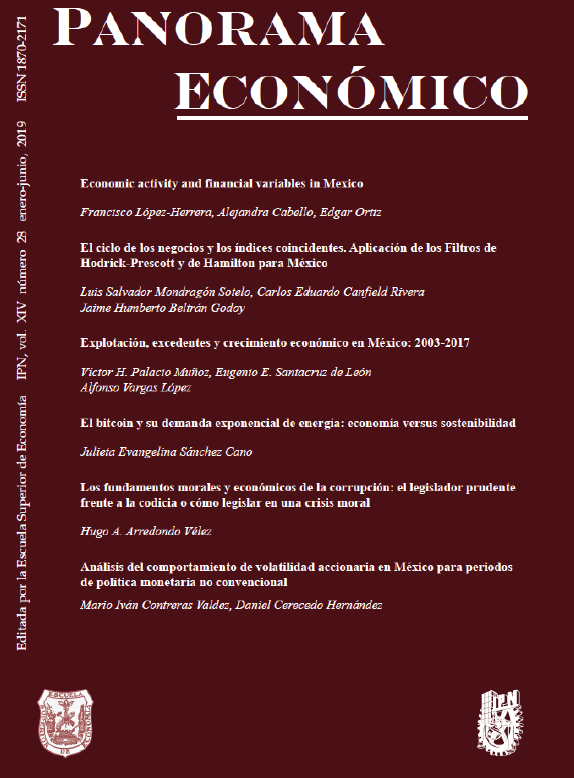
Analysis of stock volatility behavior in Mexico for periods of unconventional monetary policy
DOI:
https://doi.org/10.29201/peipn.v14i28.45Keywords:
monetary policy, Mexican stock market, volatility analysisAbstract
The work is developed around the effects of unconventional monetary policy on the stock market in Mexico. The problem emerge about how the stock market reacted to the adjustments in the interest rate derived from the 2008 crisis until mid-2016. Equally weighted portfolios of the sectors of the economy are formed, which through GARCH models and non-parametric tests of Kolmogrov-Smirnov determine whether there is evidence of statistically significant changes between a period prior to the 2008 crisis and after is. The results show a similar trend in both series, which could be interpreted as a preference on the part of investors in Mexico for the performance of the sector rather than the interest rate on which the cash flows are discounted.
Downloads
References
Arce, Rafael (1998). Introducción a los modelos autorregresivoc con heterocedasticidad condicional (ARCH). Programa de Doctorado en Modelización Económica del Instituto LR Klein.
Berger, Travis J. y Cao Guangye (2014). "Global Effects of US. Monetary Policy: Is Unconventional Policy Different?". Economic Review. Federal Reserve Bank of Kansas City.
Blanchard, Oliver; Dell´Ariccia Giovanni y Mauro Paolo (2010). Rethink Macroeconomic Policy. IMF Staff Position Note.
Bollerslev, Tim (1986). "Generalized Autoregressive Conditional Heteroskedasticity". Journal of Econometrics 31, pp. 307-327.
Boubaker, Sabri; Dimitrios, Gounopoulos; Nguyen, Duc Khong y Nikos Paltalidis (2017). "Assessing the effects of unconventional monetary policy and low interest rates on pension fund risk incentives". Journal of Banking and Finance 77, pp. 35-52.
Cochrane, John H. (2000). Asset Pricing. Graduate School of Business. University of Chicago. Cap. I pp. 15, Cap. I.
Chen Shiu-Sheng (2005). "Does Monetary Policy Have Asymmetric Effects on Stock Returns?" Journal of Money, Credit and Banking, vol. 39. No. 2-3.
Durré, Alain & Giot Pierre (2007). "An International Analysis of Earnings, stock prices and bond yields". Journal of Business Finance & Accounting, 34, pp. 613-641.
Ekelund, Robert y Herbert Robert (2005). Historia de la teoría económica y de su método. McGraw Hill Interamericana. 3er., ed. Cap. xix-xx.
Engle, Robert (1982). "Autoregressive Conditional Heteroscedasticity with Estimates of the Variance of United Kingdom Inflation". Econometrica, vol. 50 Issue 4, pp. 987-1008.
Eser, Fabian & Schwaab Bernd (2016). "Evaluating the impact of unconventional monetary policy measures: Empirical evidence from the ECB's Securities Markets Programme". Journal of Financial Economics, 119. pp. 147-167.
Gallo, Lindsay A.; Hann Rebecca N., Li Congcong (2016). "Aggregate earnings surprises, monetary policy, and stock returns". Journal of Accounting and Economics 62, pp. 103-120.
Hsing Yu (2013). "Effects of Fiscal Policy and Monetary Policy on the Stock Market in Poland". Economies, pp. 19-25.
Kurihara Yutaka (2015). "Asset Price and Monetary Policy": The Japanese Case. Journal of Applied Finance & Banking, vol. 5, No. 4, pp.
Downloads
Published
How to Cite
Issue
Section
License

This work is licensed under a Creative Commons Attribution-NonCommercial 4.0 International License.