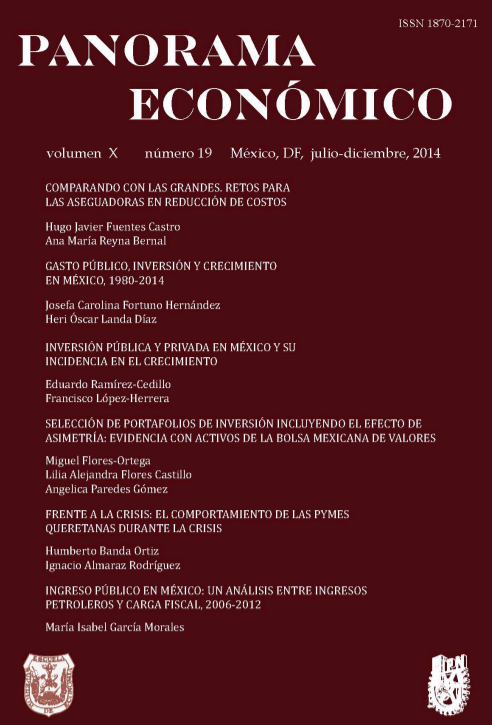
Selection of Investment Portfolios Including the Effect of Asymmetry: Evidence from Assets of the Mexican Stock Exchange
DOI:
https://doi.org/10.29201/peipn.v10i19.343Keywords:
Portfolio investment, optimization, statistical decision theoryAbstract
This paper shows the empirical evidence of the effect of asymmetry of return assets in the portfolio selection and integrates their participation in an investment portfolio. The theoretical review of the methodology is performed and con-trasts a results Markowitz model that uses only the mean and variance and mean-variance model incorporating asymmetry effect. The methodology propose a problem of multi-objective optimization, which selects the investment portfolio that minimizes the multi-objective function, whereby the simultaneous optimization of the specific aims of mean, variance and skewness is achieved. The results show that it is possible to decrease the probability of negative returns and losses in the case of selecting the portfolio more positively skewed. The model validates all selection options level of risk aversion, performance or asymmetry, the approach presented has the advantage of being flexible and selection of assets is expressed mathematically in a space defined by the variance, expected return and asymmetry. The paper presents empirical evidence of the Mexican stock exchange assets.
Downloads
References
Arditti, F. (1971). Another look at mutual fund performance. Journal of Financial and Quantitative Analysis, 6(03): 909-912.
Chunhachinda, P.; K. Dandapani, S. Hamid y A. Prakash. (1997). "Portfolio selection and skewness": Evidence from international stock markets. Journal of Banking & Finance, 21 (2): 143-167.
Fama, E. (1965). "The behavior of stock-market prices". The journal of Business, 38(1):34-105.
Hanoch, G. y H. Levy (1970). "Efficient portfolio selection with quadratic and cubic utility". The Journal of Business, 43 (2): 181-89.
Kane, A. (1982). "Skewness preference and portfolio choice". Journal of Financial and Quantitative Analysis, 17 (1): 15-25.
Konno, H. y K. Suzuki (1995). "A mean-variance-skewness portfolio optimization model". Journal of the Operations Research Society of Japan, 38 (2): 173-187.
Lai, T. (1991). "Portfolio selection with skewness; a multiple-objective approach". Review of Quantitative Finance and Accounting, 1 (3): 293-305.
Leung, M., H. Daouk y A. Chen (2001). "Using investment portfolio return to combine forecasts: a multiobjective approach". European Journal of Operational Research, 134 (1): 84-102.
Levy, H. y M. Sanat (1972). Investment and portfolio analysis. New York: Wiley.
Markowitz, H. (1952). "Portfolio selection". The journal of finance, 7 (1): 77-91.
Prakash, A.; Chang, C. y T. Pactwa (2003). "Selecting a portfolio with skewness: Recent evidence from US, European, and Latin American equity markets". Journal of Banking & Finance, 27 (7): 1375-1390.
Rubinstein, M. E. (1973). "The fundamental theorem of parameter-preference security valuation", Journal of Financial and Quantitative Analysis, 8 (01): 61-69.
Samuelson, P. (1970). "The fundamental approximation theorem of portfolio analysis in terms of means, variances and higher moments". The Review of Economic Studies, 37 (4): 537-542.
Simkowitz, My W. Beedles (1978). "Diversification in a three-moment world", Jour nal of Financial and Quantitative Analysis, 13(5): 927-941.
Usta, I. y Y. Kantar (2011), "Mean-Variance-Skewness-Entropy Measures: A Multi-Objective Approach for Portfolio Selection". Entropy, 13 (1): 117-133.
Zuluaga, L. y S. Cox (2010). "Improving skewness of mean-variance portfolios". North American Actuarial Journal, 14 (1): 59-67.
Downloads
Published
How to Cite
Issue
Section
License
Copyright (c) 2025 Panorama Económico

This work is licensed under a Creative Commons Attribution-NonCommercial-NoDerivatives 4.0 International License.