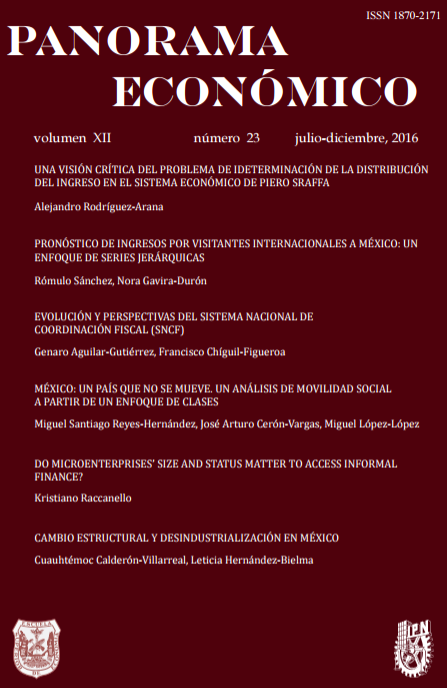
Do microenterprises' size and status matter to access informal finance?
DOI:
https://doi.org/10.29201/peipn.v12i23.384Palabras clave:
economía informal, finanzas informales, microempresasResumen
Las microempresas (MEs) cuando no obtienen los recursos que requieren por parte del sector financiero formal pueden obtenerlos a través de otros intermediarios informales. En este artículo analizamos si las MEs, de acuerdo a su tamaño y estatus de registro ante las autoridades, utilizan el sector financiero informal. Con una muestra de 400 MEs de la ciudad de Puebla (Mexico) durante 2006, encontramos que tanto las MEs informales como las formales utilizan créditos informales pero, aunque el estatus de la MEs tenga relevancia per-se, las medianas MEs informales piden créditos a prestamistas y familiares/amigos. Debido que las MEs formales, sin importar su tamaño, también utilizan el mercado financiero informal, los resultados indican la falta de crédito para las MEs.
Descargas
Citas
Allen, F. (1983). “Credit Rationing and Payment Incentives”. The Review of Economic Studies, 50 (4), pp. 639-646.
Armendariz, B. & J. Morduch (2005). The Economics of Microfinance. Cambridge, MA: MIT Press, pp. 320-383.
Angelucci, M.; D. Karlan, J. Zinman (2015). “Microcredit Impacts: Evidence from a Randomized Microcredit Program Placement Experiment by Compartamos Banco”. American Economic Journal: Applied Economics, 7(1), pp. 151-182.
Aryeetey, E. (1995). Filling the Niche-Informal Finance in Africa. Nairobi: African Economic Research Consortium, pp. 250-287.
___ (1996). “The Informal Financial Sector”. M. Matthew & G. Ngola. (Eds.), Forging Links: Economic Research and Policy Making in Sub-Saharan Africa Nairobi: African Economic Research Consortium, pp. 22-35.
Atieno, R. (2001). “Formal and informal institutions’ lending policies and access to credit by small-scale enterprises in Kenya: An empirical assessment”. AERC Research Paper No. 111. Nairobi: African Economic Research Consortium, pp. 130-160.
Bates, T.M. (1997). Race, Self-Employment, and Upward Mobility: An Illusive American Dream. Baltimore, MD: John Hopkins University Press, pp. 123-166.
Bell, C. (1990). “Interactions between institutional and informal credit agencies in rural India”. The World Bank Economic Review, 4 (3), pp. 297-327.
Berensmann, K.; K. Bartels; H. Höffler; K. Hölscher; K. Losse & J. Majewski (2002). "Informal Financing for Small-Scale Enterprises in Sri Lanka", Reports and Working Papers 10/2002. Bonn: German Development Institute, pp. 111-145.
Berger, A. N. & G.F. Udell (1995). "Relationship Lending and Lines of Credit in Small Firm Finance", The Journal of Business, 68(3), pp. 351-381.
Berger, M., & M. Buvinic (Eds.) (1989). Women’s ventures: Assistance to the informal sector in Latin America. Boulder, CO: Kumarian Press, pp. 98-134.
Besanko, D., & A.V. Thakor (1987). "Collateral and Rationing: Sorting Equilibria in Monopolistic and Competitive Credit Markets". International Economic Review, 28(3), pp. 671-689.
Bester, H. (1985). "Screening vs. Rationing in Credit Markets with Imperfect Information". The American Economic Review, 75 (4), pp. 850-855.
Brick, I.E. & D. Palia (2007). "Evidence of Jointness in the Terms of Relationship Lending". Journal of Financial Intermediation, 16 (3), pp. 452-476.
Casolaro, L.; L. Gambacorta & L. Guiso (2006). "Regulation, Formal and Informal Enforcement and the Development of the Household Loan Market: Lessons from Italy. In Bertola G; R. Disney & C. Grant (Eds.), The Economics of Consumer Credit. Cambridge, MA: MIT Press, pp. 93-134.
Castañeda, G. (1998). La empresa mexicana y su gobierno corporativo: Antecedentes y desafíos para el siglo XXI. Cholula, Puebla: Alter Ego, pp. 56-90.
Chiodi, V.; E. Jaimovich & G. Montes-Rojas (2012). "Migration, remittances and capital accumulation: Evidence from rural Mexico". Journal of Development Studies, 48 (8), pp. 1139-1155.
Coco, G. (2000). "On the Use of Collateral". Journal of Economic Surveys, 14 (2), pp. 191-214.
Cotler, P. (2009). "La oferta de financiamiento para las micro y pequeñas empresas en México". (Departamento de Economía, Nuevos Documentos de Trabajo núm. 8). México, DF: Universidad Iberoamericana, pp. 309-380.
Cotler, P., & C. Woodruff (2008). "The Impact of Short-Term Credit on Microenterprises: Evidence from the Fincomun-Bimbo Program in Mexico". Economic Development and Cultural Change, 56(4), pp. 829-849.
Crook, J. (2006). "The Demand and Supply for Household Debt: A Cross Country Comparison". Bertola, G.; R. Disney & C. Grant (Eds.), The Economics of Consumer Credit. Cambridge, MA: MIT Press, pp. 63-92.
Dalla-Pellegrina, L. (2008). "Illegal finance, interest rates and bank lending: the missing supply side of usury". Global Business and Economics Review, 10 (3), pp. 265-283.
Datar, S. M.; M. J. Epstein & K. Yuthas (2009). "Lessons for and from the World's tiniest businesses". Strategic Finance (november), pp. 27-34.
De Ferranti, D.; G. E., Perry; D. Lederman & W. F. Maloney (2002). De los recursos naturales a la economía del conocimiento: Comercio y calidad del empleo. Washington, DC: The World Bank, pp. 68-103.
De Soto, H. (1987). El otro sendero: La revolución informal. México, DF: Diana, pp. 89-130.
Diamond, D.W. (1989). "Reputation Acquisition in Debt Markets". The Journal of Political Economy, 97 (4), pp. 828-862.
Djankov, S.; R. La Porta; F. Lopez-de-Silanes & A. Shleifer (2002). "The Regulation of Entry". Quarterly Journal of Economics, 117 (1), pp. 1-37.
Espinosa-Rugarcia, A. & E. Cárdenas-Sánchez (Eds.) (2011). Privatización bancaria, crisis y rescate del sistema financiero. México, DF: Centro de Estudios Espinosa Yglesias, pp. 230-280.
Evans, D. S. & B. Jovanovich (1989). "An Estimated Model of Entrepreneurial Choice under Liquidity Constraints". Journal of Political Economy, 97 (4), pp. 808-826.
Fafchamps (1997). "Trade Credit in Zimbabwean Manufacturing". World Development, 25(5), pp. 795-815.
Fleisig, H., & N. De la Peña (2002). "Microenterprises and Collateral". Issues Brief no. 2. Washington, DC: Center for the Economic Analysis of Law, pp. 220-266.
Friedman, E.; S. Johnson; D. Kaufmann & P. Zoido-Lobatón (2000). "Dodging the Grabbing Hand: The Determinants of Unofficial Activity in 69 countries". Journal of Public Economics, 76 (3), pp. 459-493.
Garrido, C. & G. García (2010). "Bancarización, crédito al consumo y opacidad regulatoria. Desafío y posibilidades del sistema financiero mexicano ante la crisis global". Economía Informa, 363: marzo-junio, pp. 34-56.
Giné, X. (2011). "Access to capital in rural Thailand: An estimated model of formal vs. informal credit". Journal of Development Economics, 96 (1), pp. 16-29.
Heino, H. (2006). "Use of borrowed start-up capital and micro enterprises in Mexico: existence of liquidity constraints". Portuguese Economic Journal, 5 (1), pp. 1-30.
Hernández-Trillo, F.; J. A. Pagán & J. Paxton (2005). "Start-up Capital, Microenterprises and Technical Efficiency in Mexico". Review of Development Economics, 9 (3), pp. 434-447.
Hussmanns, R. (2004). "Measuring the Informal Economy: From Employment in the Informal Sector to Informal Employment", (Working Paper no. 53). Geneva: International Labour Organization, pp. 234-267.
Instituto Nacional de Estadística y Geografía (INEGI). (2006). Indicadores estratégicos de ocupación y empleo, trimestre 1-2006. Aguascalientes: INEGI, pp. 123-155.
Instituto Nacional de Estadística y Geografía (INEGI). (2009). Encuesta Nacional de Ocupación y Empleo 2009. Aguascalientes: INEGI, pp. 89-134.
International Labour Organization [ILO]. (2002). Women and Men in the Informal Economy: A Statistical Picture. Geneva: International Labour Organization, pp. 34-98.
Isaksson, A. (2002). "The importance of Informal Finance in Kenyan Manufacturing". Working Paper, no. 5. Wien: Statistics and Information Networks Branch of UNIDO. pp. 45-99.
Jaffee, D.M. & T. Russell (1976). "Imperfect Information, Uncertainty, and Credit Rationing". The Quarterly Journal of Economics, 90 (4), pp. 651-666.
Johnson, S.; D. Kaufmann; A. Shleifer; M.I. Goldman & M.L. Weitzman (1997). "The Unofficial Economy in Transition". Brookings Papers on Economic Activity, 1997 (2), pp. 159-239.
Karim, L. (2011). Microfinance and Its Discontents. Minneapolis, MN: University of Minnesota Press, pp. 36-87.
Leeth, J. D. & J.A. Scott (1989). "The Incidence of Secured Debt: Evidence from the Small Business Community". Journal of Financial and Quantitative Analysis, 24 (3), pp. 379-393.
Madestam, A. (2014). "Informal finance: A theory of moneylenders". Journal of Development Economics, 107, pp. 157-174.
Manove, M.; J.A. Padilla & M. Pagano (2001). "Collateral versus Project Screening: A Model of Lazy Banks". RAND Journal of Economics, 32 (4), pp. 726-744.
Mansell-Carstens, C. (1995). Las finanzas populares en México. México, DF: Editorial Milenio, Centro Estudios Monetarios Latinoamericano, Instituto Tecnológico Autónomo de México, pp. 203-245.
Mayoux, L. (2000). "Micro-finance and the empowerment of women: A review of the key issues". Social Finance Unit, Working Paper no. 23. Geneva: International Labour Organization, pp. 77-99.
Nenova, T.; C. Thioro Niang & A. Ahmad (2009). Bringing Finance to Pakistan's Poor: Access to Finance for Small Enterprises and the Underserved. Washington, DC: The World Bank, pp. 245-289.
Ochoa, S.O. (2005). Economía Informal: Evolución Reciente y Perspectivas. México, DF: Centro de Estudios Sociales y de Opinión Pública, Cámara de Diputados, pp. 122.
Organisation for Economic Cooperation and Development [OECD], International Monetary Fund [IMF], International Labour Organisation [ILO] & Statistical Committee of the Commonwealth of Independent States [CIS STAT] (2002). Measuring the Non-Observed Economy-A Handbook. Paris: OECD Publishing, pp. 233-266.
Organisation for Economic Co-operation and Development [OECD] (2005). SME and Entrepreneurship Outlook. Paris: OECD Publishing, pp. 342.
Picker, R.C. (1992). "Security Interests, Misbehavior, and Common Pools". University of Chicago Law Review, 59 (2), pp. 645-679.
Pavón, L. (2010). Financiamiento a las microempresas y las pymes en México (2000-2009). (Serie financiamiento del desarrollo 226). Santiago de Chile: CEPAL-Naciones Unidas, pp. 98-140.
Raccanello, K. (2008). "El financiamiento informal de la salud en San Andrés Cholula. Puebla. Un estudio exploratorio". N.; González, M.I. Ángeles Constantino & F. Cruz (Eds.), Salud Sociedad y Democracia, México, DF: Plaza y Valdés, pp. 119-144.
Raccanello, K.; F. Bello; J. Anand & N. López Mena (2009). "Financial Markets: Differences in Impoverishment Perception between Formal and Informal Credit Sector". Lazar, D. & M. Deo (Eds.), Micro Finance: Performance Evaluation and Enterprise Development. Chennai: Allied Publishers, pp. 96-110.
Raccanello, K. & C.B. Saucedo-Carranza (2015). "Microempresas y microcrédito en la ciudad de Puebla". Perspectivas: Revista de Análisis de Economía, Comercio y Negocios Internacionales, 9 (1), pp. 5-27.
Robinson, M.S. (2001). The Microfinance Revolution: Sustainable Finance for the Poor. Washington, DC: The World Bank, pp. 45-89.
Roubaud, F. (1995). La economía informal en México. De la esfera doméstica a la dinámica macroeconómica. México, DF: FCE, ORSTOM, INEGI & IFRSPDC, pp. 234.
Schreiner, M. & G. Woller (2003). "Microenterprise Development Programs in the United States and in the Developing World". World Development, 31 (9), pp. 1567-1580.
Stiglitz, J. E. & A. Weiss (1981). "Credit Rationing in Markets with Imperfect Information". The American Economic Review, 71 (3), pp. 393-410.
Swedish International Development Cooperation Agency [SIDA] (2004). The Informal Economy. Stockholm: SIDA. Retrieved on February 15$^{text{th}}$, 2009 from: http://www.sida.se/sida/jsp/sida.jsp?d=118&a=3107&language=en_US.
Tybout, J.R. (1983). "Credit Rationing and Investment Behavior in a Developing Country". The Review of Economics and Statistics, 65 (4), pp. 598-607.
Valenzuela, M. E. (2005). "Informality and Gender in Latin America", Policy Integration Department, Working Paper no. 60. Geneva: International Labour Organization.
Valenzuela, M. L. & I. Solares (1998). "Los sistemas financieros de la microempresa: una alternativa para su análisis". González, C.; M.L. Valenzuela & I. Solares (Eds.). El entorno financiero de la microempresa en Guatemala. Guatemala: Universidad Rafael Landívar, pp. 59-111.
Van Bastelaer, T. (2000). Does Social Capital Facilitate the Poor's Access to Credit? A Review of the Microeconomic Literature. Social Capital Initiative, Working Paper no. 8. Washington, DC: The World Bank, pp. 56-87.
Velez-Ibañez, C. G. (2010). An Impossible Living in a Transborder World-Culture, Confianza, and Economy of Mexican-Origin Populations. Tucson, AZ: The University of Arizona Press, pp. 79-110.
Voordeckers, W. & Steijvers T. (2006). "Business Collateral and Personal Commitments in SME Lending". Journal of Banking and Finance, 30 (11), pp. 3067-3086.
Williamson, S.D. (1987). "Costly Monitoring, Loan Contracts, and Equilibrium Credit Rationing". The Quarterly Journal of Economics, 102 (1), pp. 135-146.
Woodruff, C. (2001). "Firm Finance from the Bottom Up: Microenterprises in Mexico". Center for Research on Economic Development and Policy Reform, Working Paper no. 112. Palo Alto, CA: Stanford University.
Descargas
Publicado
Cómo citar
Número
Sección
Licencia
Derechos de autor 2025 Panorama Económico

Esta obra está bajo una licencia internacional Creative Commons Atribución-NoComercial-SinDerivadas 4.0.