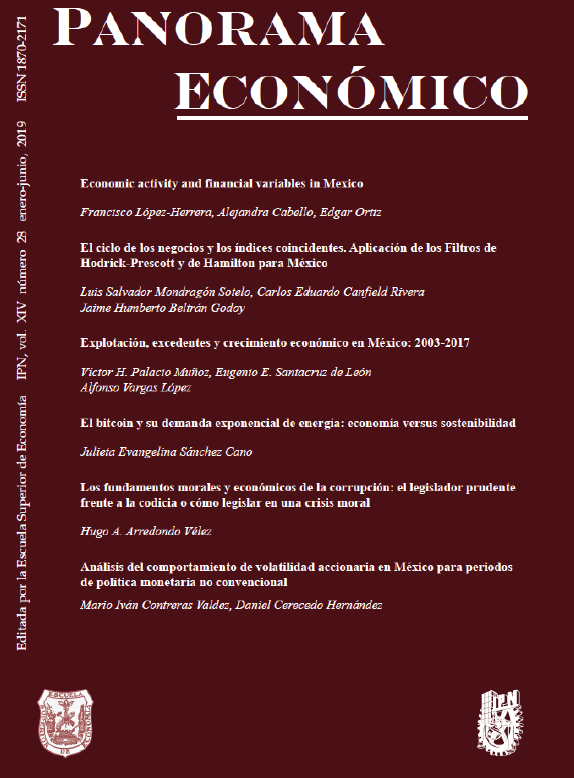
The moral and economic foundations of corruption
the prudent legislator in the face of greed or how to legislate in a moral crisis
DOI:
https://doi.org/10.29201/peipn.v14i28.44Keywords:
moral, corrupción, codicia, economía política, prudencia, legislaciónAbstract
Given the growing problem of corruption and the moral, political, economic and legal implications posed by the current state of affairs in the modern world, and in our country, the following question arises: what is the cause and the alternatives to this solution so widespread problem? Is it possible to uproot it? Is it possible to legislate the positive-destructive effects of greed? Two tentative hypotheses are proposed here. The first of them holds that the cause of corruption is greed; therefore, it is a structural phenomenon, that is, cultural phenomenon. Corruption is not a problem that belongs to a class, but crosses all social strata that behave through an ideal model i.e., the homo oeconomicus. The second is that it is possible to legislate to counteract institutional corruption with what I call the “second disenchantment of the world” –in Weber's sense– from the intervention of the Prudent Legislator and an alternative ideal model. From both aproaches on the effects of greed and ideal models derive state reforms that will allow, on the one hand, the accumulation of capital and, on the other, the distribution of social wealth. The legislator has thus a difficult task very difficult: to legislate for organist capital.
Downloads
References
Apel, K. O. (2004). Estudios éticos. Barcelona. Fontamara.
Aristóteles (2006). Poética. México. Colofón.
Bentham, J. (1965). Escritos económicos. México. FCE.
Hayek, F. (2005). Caminos de servidumbre. Madrid. Alianza.
Hinkelammert, F. (2002). Crítica de la razón utópica. Bilbao. Deslcée de Brouwer.
Horkheimer, M. (2002). Crítica de la razón instrumental. Madrid. Trotta.
Hume, D. (2005). Tratado de la naturaleza humana. Madrid. Tecnos.
Jevons, W. S. (1998). La teoría de la economía política. Madrid. Esfinge.
Marx, K., und Engels, F. (1972). Das Kapital. Berlin. Dietz Verlag.
___ (1976). El capital. México. Siglo xxi.
___ (2005). La tecnología del Capital. México. Ítaca.
Mill, J. S. (1994). El utilitarismo. Barcelona. Altaya.
Méndez, V. (2004). El filósofo y el mercader. México. FCE.
Rojas, M. (2011). La razón ético-objetiva y los problemas morales del presente: Critica ético racional del relativismo moral-cultural. México. Ítaca.
___ (2011). Hegel y la libertad: Autodeterminación racional, intersubjetividad ética, Estado racional. México. Ítaca.
Sandoval, E. (2015). Interés Público, Asociaciones Público Privadas y Poderes Fácticos. México. UNAM-IIS.
Smith, A. (2007). An Inquiry into the Nature an Cuase of the Wealth of Nation. New York. Metalibri.
___ (2004). Teoría de los sentimientos morales. Madrid. Alianza.
___ (1987). Investigación sobre la naturaleza y causas de la riqueza de las naciones. México. FCE.
Traducción del Nuevo Mundo de las Santas Escrituras. (1987). Brasil.
Weber, M. (2008). La ética protestante y el espíritu del capitalismo. México. FCE.
Downloads
Published
How to Cite
Issue
Section
License
Copyright (c) 2021 Panorama Económico

This work is licensed under a Creative Commons Attribution-NonCommercial 4.0 International License.