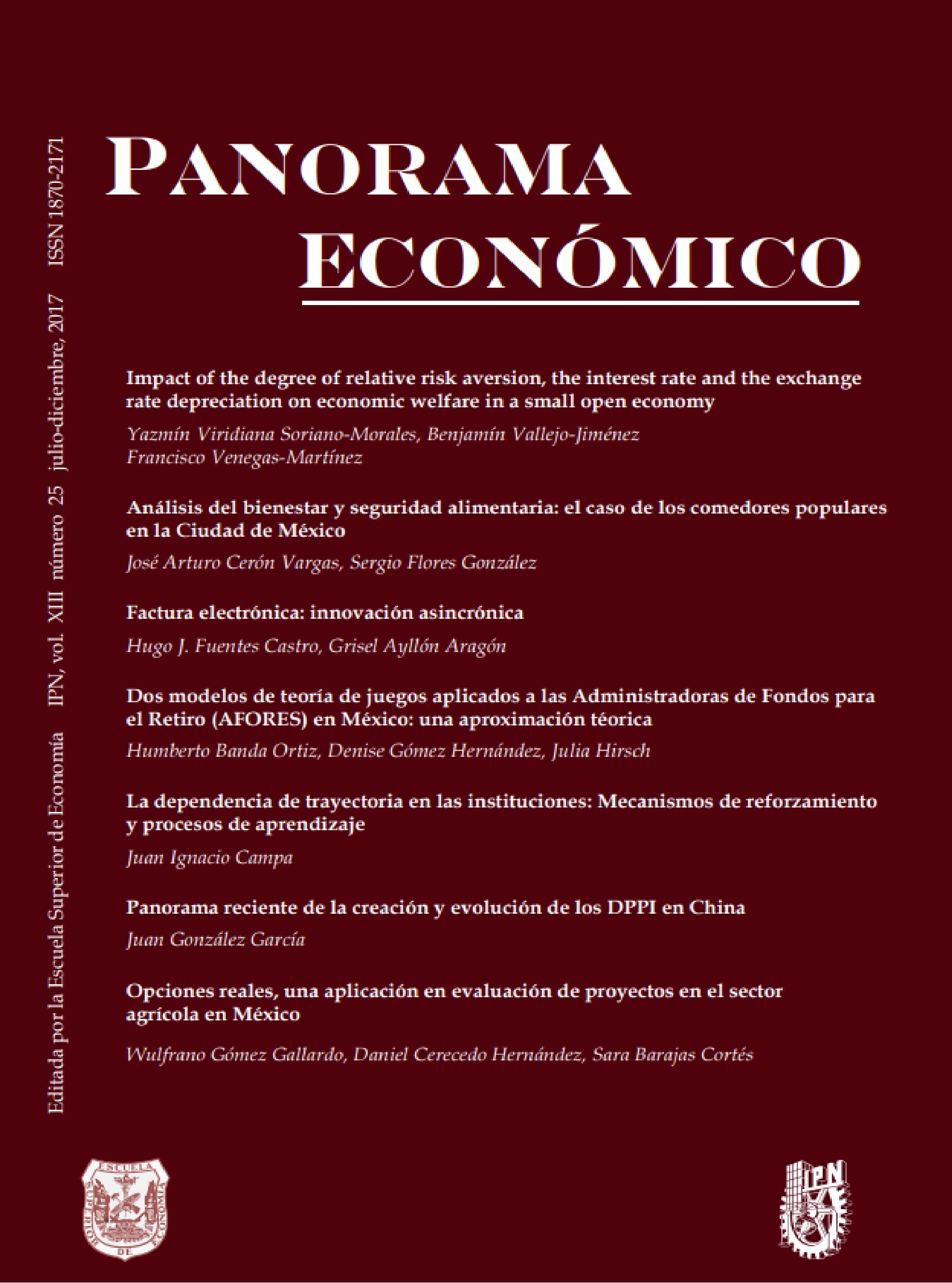
The dependence of trajectory in the institutions: mechanisms reinforcement and learning processes
DOI:
https://doi.org/10.29201/peipn.v13i25.403Keywords:
institutions, increasing, returns, growthAbstract
Institutions change over time. The institutional change is incremental and its direction is path-dependent. In this paper, it is emphasized that the path dependency is not a deterministic inertia but imposes constraints that specifically frame the present decision alternatives of the agents of change. Moreover, it is shown that increasing returns are an important source of permanence of political, economic or social institutions. However, there are also other reinforcing mechanisms that can perpetuate the orientation of institutional frameworks, such as functional ones, of power, legitimating, layering and conversion.
Downloads
References
Aoki, M. (2001). Towards a Comparative Institutional Analysis, Cambridge, MIT Press, pp. 80-120.
Antaki, I. (1998). En el banquete de Platón. Ciencia. México, Editorial Joaquín Mortiz, pp. 130-167.
Boas, T. (2007). “Conceptualizing Continuity and Change. The Composite-Standard Model of Path Dependence”. Journal of Theoretical Politics, 19(1), pp. 33-54.
Campa, J. I. (2015). “Patentes en México en la época de la Industrialización por Sustitución de Importaciones”. Tesis doctoral, España, Universidad Autónoma de Barcelona, pp. 56-90.
Greif, A. (2006). Institutions and the Path to the Modern Economy: Lessons from Medieval Trade. Cambridge, Cambridge University Press, pp. 88-125.
Haber, S. (2002). Crony Capitalism and Economic Growth in Latin America: Theory and Evidence, Hoover Institution Press, pp. 81-111.
Kingston, C. y G. Caballero (2009). “Comparing Theories of Institutional Change”. Journal of Institutional Economics, 5(2), pp. 151-180.
North, D., Wallis J. y B. Weingast (2009). Violence and Social Orders. A Conceptual Framework for Interpreting Recorded Human History, Cambridge, Cambridge University Press, pp. 77-100.
North, D. (2005). Understanding the process of economic change, Princeton y Oxford, Princeton University Press, pp. 112-138.
___ (1998). “Desempeño económico en el transcurso de los años”, Revista Teoría y Práctica, 9, 127-138.
___ (1993). Instituciones, cambio institucional y desempeño económico, México, Fondo de Cultura Económica.
Mahoney, J. (2000). “Path Dependence in Historical Sociology”. Theory and Society, 29(4), 507-548.
Mokyr, J. (2005). “The Intellectual Origins of Modern Economic Growth”. The Journal of Economic History, 65(2), 285-351.
Mokyr, J. y J. Nye (2006). “Distributional Coalitions, the Industrial Revolution, and the Origins of Economic Growth in Britain”, preparado para la sesión especial en honor de Mancur Olson, Southern Economic Meeting, Charleston S.C., pp. 66-99.
Pierson, P. (2000). “Increasing returns, Path Dependence, and the Study of Politics”. The American Political Science Review, 94(2), 251-267.
Vergne, J. y R. Durand (2010). “The Missing Link Between the Theory and Empirics of Path Dependence: Conceptual Clarification, Testability Issue, and Methodological Implications”. Journal of Management Studies, 47(4), 736-759.
Downloads
Published
How to Cite
Issue
Section
License
Copyright (c) 2026 Panorama Económico

This work is licensed under a Creative Commons Attribution-NonCommercial-NoDerivatives 4.0 International License.