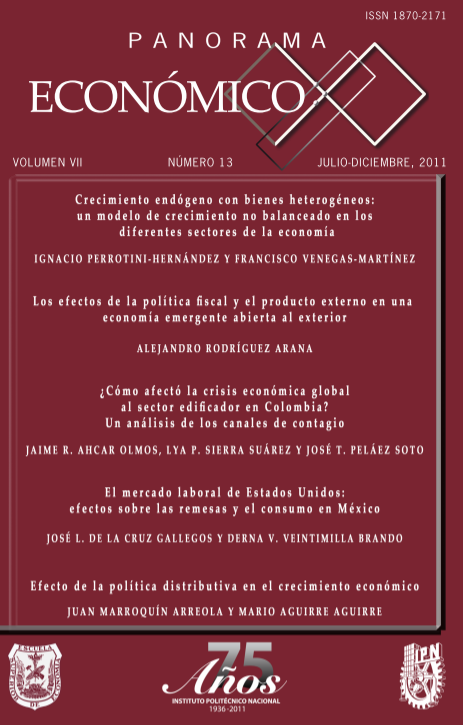
Effect of distributive policy on economic growth.
DOI:
https://doi.org/10.29201/peipn.v7i13.307Keywords:
Government selfish, distributive policies, political gain, economic growthAbstract
The aim of this paper is to analyze how the government determines the proportion of public spending to maximize its political benefit and stay in power. Using growth models and making modifications in them, this study demonstrates that the actions of public expenditure and growth rate are determined by the parameters of political gain. Also, the results of the simulations show that if the political gain of distribution policy is high, the government will allocate a greater share of the fund for purposes of distribution adversely affecting economic growth.
Downloads
References
Agenor, P, R. (2008), “Fiscal policy and endogenous growth with public infrastructure`, Oxford Economic Papers, núm. 60, 57-87.
Aidt, T.S. y J. Shvets (2011), “Distributive Politics and Electoral Incentives: Evidence from Seven US State Legislatures”, Cambridge Working Papers in Economics, núm. 1130, Faculty of Economics, University of Cambridge.
Alesina, A., y D. Rodrick (1994), Redistributive Politics and Economic Growth Quarterly Journal of Economics, núm. 109, 465-90.
Afonso, A. y R. M. Sousa (2009), “The Macroeconomic Effects of Fiscal Policy”, ECB Working Paper Series, núm. 991.
Banerjee, A V. y A. F. Newman (1993), “Occupational Choice and the Process of Development”, Journal of Political Economy, núm. 2, vol. 101, 274-98.
Barro, R. J. (1990), “Government Spending in a Simple Model of Endogenous Growth”, Journal of Political Economy, núm. 98, S103-S 125.
Barro, R. J., y Becker, G. S. (1989), “Fertility choice in a Model of Economic Growth”, Econometrica, nům. 57, 481-501.
Barro, R. J., y X. Sala-i-Martin (1995), Economic Growth, Boston: McGraw Hill Chen, B. L. (2006), “’Economic Growth with an Optimal Public Spending Composition”, Oxford Economic Papers, núm. 58, 123-36.
Christiano, L., M. Eichenbaum y S. Rebelo (2009), “When is the Government Spen- ding Multiplier Large?”, NBER Working Paper, núm. 15394
Devarajan, S., V. Swaroop y H. Zou (1996), “The Composition of Public Expenditu- re and Economic Growth”, Journal of Monetary Economics, núm. 37, 313-344.
Galor, O. y J. Zeira (1993), “Income Distribution and Macroeconomics”, Review of Economic Studies, núm. 1, vol. 60, 35-52.
Galor, O. (2011), Inequality and the Process of Development, Handbook of Economics of Education.
Garcia-Peñalosa, C. y S.J. Turnovsky (2006), “’Growth and income inequality: A canonical model, Economic Theory, núm. 28, 25-49.
Ghosh, S. y A. Gregoriou (2008), “The Composition of Government Spending and Growth: Is Current or Capital Spending Better?”, Oxford Economic Papers, núm. 60, 484-5 16.
Grossman, G. M. y E. Helpman (1991), Innovation and Growth in the Global Economy, Cambridge, MA: MIT Press.
Marjit, S. M. Kolmar y V. Mukherjee (2001), Redistributive Politics, Corruption and Ouality of Public Investment, Paper presented at the Fiscal Affairs Division, IMF.
Marjit, S. y D. Maity (2006), “Politics and Contemporary Macroeconomy of India” en India Macroeconomics Anmal, Centre for Studies in Social Sciences (pp 9-55). India: Sage Publications Ltd.
Marjit, S., V. Mukherjee y M. K olmar (2006), “Poverty, Taxation and Governance”: Journal of International Trade & Economic Development, núm. 3, vol. 15 325-333.
Meltzer, A. H. y S. F. Richard (1981), “A Rational Theory of the Size of the Gover- nment, Journal of Political Economy, núm. 51, vol. 89, 914-27.
Persson, T. y G. Tabellini (1994), “Is Inequality Harmful for Growth?”, American Economic Review, núm. 3, vol. 84,600-621.
Posner D. N. y E. Kramon (2011), “Who Benefits from Distributive Politics? How the Outcome One Studies Affects the Answer One Gets”, MIT Political Science Department Research Paper, núm. 9, 2011.
Ramsey, F. (1928), “A Mathematical Theory of Saving”, Economic Journal, núm: 38, 543-559.
Rebelo, S. (1991), “Long-run Policy Analysis and Long-run Growth”, Journal of Political Economy, núm. 99, 500-521.
Romer, P. M. (1986), “Increasing Returns and Long-run Growth”, Journal of Politi- cal Economy, núm. 94, 1002-1037.
Romer, P. M. (1990), “Endogenous Technological Change”, Journal of Political Economy, núm. 94, S71-S102.
Sarkar, A. (2006), “Political Economy of West Bengal: A Puzzle and a Hypothesis”, Economic and Political Weekly, núm. 4, vol. 61, 341-48.
Sasmal, J. (2002), “Size of Government, Nature of Govemment Spending and Level of Corruption in a Low Income Country: A Static Partial Equilibrium Analysis”., Artha Beekshan, núm. 3, vol. 11. 12-21.
Sasmal, J. (2004), Endogenous Growth with Government Spending – Effects of Size of Government, Distributive Politics and Corruption with Special Reference to Low Income Countries. Paper presented at the Annual Conference of the Dept. of Economics, Jadavpur University, India.
Sasmal, J. (2007), “Size of Government, Distributive Politics and Governance : A Simple Political Choice Model”, Proceedings of the 90th Annual Conference Volume, Indian Economic Association, 1240-1246.
Uzawa, H. (1965), “Optimal technical change in an aggregative model of economic growth’, International Economic Review, num. 6, 18-31.
Downloads
Published
How to Cite
Issue
Section
License
Copyright (c) 2025 Panorama Económico

This work is licensed under a Creative Commons Attribution-NonCommercial-NoDerivatives 4.0 International License.