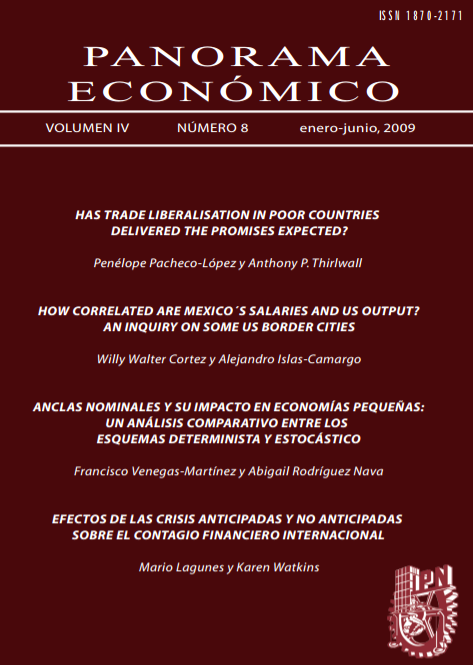
Nominal Anchors and Their Impact on Small Economies: A Comparative Analysis Between Deterministic and Stochastic Frameworks
Abstract
This paper is aimed to develop several models to study stabilization policies under the deterministic and stochastic frameworks when the exchange rate is taken as a nominal anchor. The proposed models are useful to examine the effects of such policies on the current account of the balance of payments, the real exchange rate, and consumption. Under the deterministic scheme, it is shown that this kind of stabilization programs generates a temporary deficit on the current account of the balance of payments in economies with one good (internationally tradable), and an appreciation of the real exchange rate in economies with two goods (tradable and non tradable). In the first case (with a single good) the shorter the stabilization period, the greater the deficit in the current account. In the second case (with two goods) the shorter the stabilization period, the greater the type of real exchange rate. Subsequently, a stochastic model of temporary stabilization is developed under similar assumptions to the deterministic scheme to study consumption behavior. Finally, the deterministic and stochastic frameworks are compared and their advantages and limitations are established in terms of the provided results.
Keywords
Array, Array, Array
References
- Calvo, G. A. y C. A. Végh (1999), “Inflation stabilization and balance-of-payments crises in developing countries”, en: J. Taylor, W. Woodford eds., Handbook of Macroeconomics, Vol. 1C. North-Holland, Amsterdam, pp. 1531-1614.
- Drazen, A. y E. Helpman (1988), “Stabilization with exchange rate management under uncertainty”, en: E. Helpman, A. Razin y E. Sadka eds., Economic effects of the government budget (MIT Press, Cambridge, MA).
- Dorfman, R. (1969), “An Economic Interpretation of Optimal Control Theory”, The American Economic Review, Vol. 59, No. 5, pp. 817-831.
- Kamien, M. I. y N. L. Schwartz (1981), Dynamic Optimization, The Calculus of Variations and Optimal Control in Economics and Management, North-Holland.
- Uribe, M. (2002), “The price-consumption puzzle of currency pegs”, Journal of Monetary Economics, Vol. 49, No. 3, pp. 533-569.
- Uribe, M. y E. G. Mendoza (2000), “Devaluation risk and the business-cycle implications of exchange rate management”, Carnegie-Rochester Conference Series on Public Policy, Vol. 53, No. 1, pp. 239-296.
- Venegas-Martínez, F. (2001), “Temporary Stabilization: A Stochastic Analysis”, Journal of Economic Dynamics and Control, Vol. 25, No. 9, pp. 1429-1449.