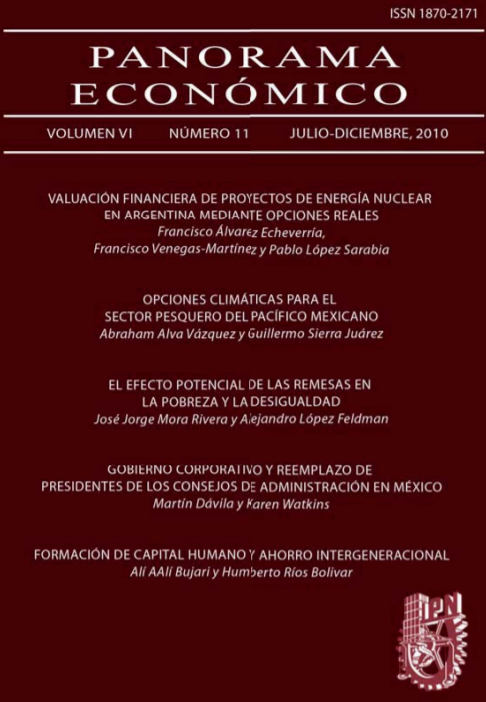
Human capital formation and intergenerational savings
Abstract
The accumulation of capital, and therefore savings, have a key role in economic growth. The aim of this paper is to model the main situations where, for a rational agent is optimal not to save but to devote its resources to other objectives, such as human capital accumulation. From the point of view of its economic structure, investment in human capital takes place in two stages: the first is the childhood and the second labor stage of life. To analyze the problem of children's needs, we added a further life span model of Diamond (1965), the infant stage. Examine the differential behavior of agents based on their wealth when, in deciding on the education of their children decide on human capital formation. We found that a representative family of few resources spends his income to the formation of human capital and therefore not saved. This happens even in an open economy where the foreign interest rate is lower than domestic.
Keywords
Human capital, savings, economic growth, infancy
References
- Abel D. y R. Kimball (1987). "The Economic Implications of Learning by Doing", Review of Economic Studies 29. 1962, pp. 155-173.
- Aghion. P. y P. Howitt (1992), "A model of growth through creative destruction", Econometrica 60, pp. 323-702.
- Arnold. L. (1998), "Growth. welfare, and trade in an integrated model of human-capital accumulation and research", Journal of Macroeconomics 20, pp. 81-105.
- Barro. Robert J.; N. Gregory Mankiw y Xavier Sala-i-Martin (1992), "Capital Mobility in Neoclassical Models of Growth", National Bureau of Economic Research. Working Paper No. 4206.
- Becker, G. (1971) The Economies of Discrimination. Chicago: Chicago University Press. 2nd ed.
- Caballé. J. y M. S. Santos (1993), "On endogenous growth with physical and human capital". Journal of Political Economy 101, pp. 1042-1067.
- Funke, M y H Strulik (2000). 'On endogenous growth with physical capital. human capital and product variety", European Economic Review 44, pp. 491-515.
- Diamond, P (1965), "National Debt in a neoclassical growth model". American Economic Review 41. 1126-50.
- Griliches, Z. (1979), "Issues in Assessing the Contribution of Research and Development to Productivity Growth", Bell Journal of Economics 10. pp. 92-116.
- Grossman, G.M y E. Helpman (1991), Innovation and Growth in the Global Economy. Cambridge, MA: MIT Press.
- Jappelli, Tullio y Marco Pagano (1994), "The Welfare Effects of Liquidity Constraints. n mimeo.
- Keller, W. (1996), "Absorptive capacity: On the creation and acquisition of technology In development", Journal of Development Economics 49, pp. 199-227.
- Lucas. R. E. Jr. (1988). "On the Mechanics of Development Planning". Journal of Monetary Economics 22, pp. 3-42.
- Mayer D. Foulkes (1997), "Sectoral Public Power and Endogenous Growth", Economia Mexicana NUEVA EPOCA, vol. 0 (1), Enero-Julio, pp. 33-81.
- Modigliani, F. (1985), "Measuring the Contribution of Intergenerational Transfers to Total Wealth: Conceptual Issues and Empirical Findings", paper presented at Modeling the Accumulation and Distribution of Personal Wealth seminar, Paris, France, September 10-11.
- Rebelo, S. (1991), "Long-Run Policy Analysis and the Long-Run Growth", Journal of Political Economy 99, 3, pp. 500-521.
- Romer, P. (1988), "Increasing Returns and Long-Run Growth", Journal of Political Economy, October, 1986.
- Romer, P. (1990), "Endogenous technological change", Journal of Political Economy 98, pp. 71-102.
- Uzawa, H. (1965), "Optimal technical change in an aggregative model of economic growth", International Economic Review 6, pp. 18-31.