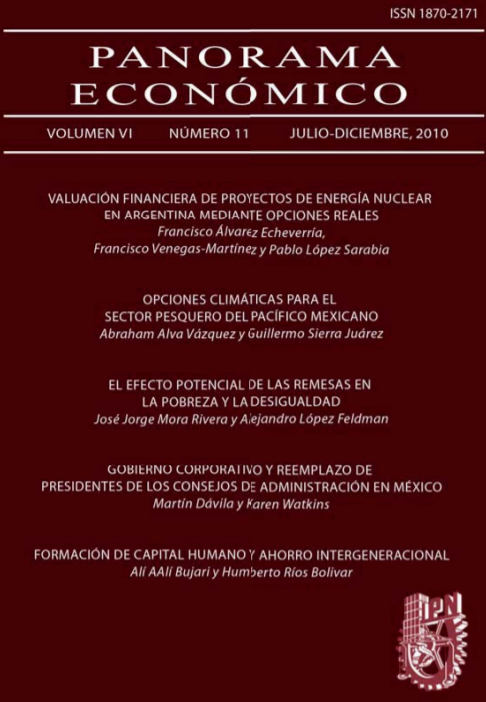
Climate options for the Mexican Pacific fishing sector
Abstract
The first purpose of this paper is the valuation of a kind of weather derivatives which underlying is the sea surface temperature and it could be used for hedging in the fall in fishing production like consequences of the natural phenomenon "El Niño". We used historical data of several regions of Mexican Pacific (Ensenada, Isla Cedros, Cabo San Lucas, Golfo de México, Puerto Vallarta, Acapulco and Golfo de Tehuantepec) and thus suggest a stochastic process that describes the evolution of the sea surface temperature. Since the temperature is a not-tradable quantity, we used the market price of risk, which is an important parameter to estimate the prices of contracts of weather options in an incomplete derivatives market. We are presenting the application of model to industry in a few regions of the Fisheries of Mexican Pacific using the method of Monte Carlo simulation. In addition, we show the specifications that should have some contracts of weather options.
Keywords
Weather options, Black-Scholes Equation, derivatives
References
- Alaton, P. B. Djehiche y D. Stillberger (2002), “On modeling and pricing weather derivatives”, Applied Mathematical Finance, 9(1): 1-20.
- Baqueiro, C. E. y T. Sinha (2005), Seguros de lluvia mediante el uso de derivados, Tesis.
- Basawa, I. V. y B. L. S. Prasaka Rao (1980), Statistical Inference for Stochastic Process, Academic Press.
- Benth, F. E., W. K. Härdle y C. B. López (2009), “Pricing of Asian temperature risk”, SFB649 Working Paper, Humboldt-Universität zu Berlin.
- Benth, F. E. y J. Saltyté-Benth (2005), “Stochastic Modelling of Temperature Variations with a View Towards Weather Derivatives”, Applied Mathematical Finance 12(1): 53-85.
- Benth, F. E. y J. Saltyté-Benth (2007), “The volatility of temperature and pricing of weather derivatives”, Quantitative Finance 7(5): 553-561.
- Bibby, B. M. y M. Sørensen (1995), “Martingale estimation functions for discretely observed diffusion processes”, Bernoulli 1(1/2): 17-39.
- Brockwell, P. J. y R. A. Davis (1990), Time Series: Theory and Methods, 2a ed. Springer.
- Cienfuentes, J. L., G. P. Torres y M. M. Frías (2003), El océano y sus recursos, IX. La pesca (81), 5a ed. (La ciencia para todos) Fondo de Cultura Económica, México, D.F.
- CME (2005), “An introduction to cme weather products”, <http://www.levow.com/SGdownload/-Commodities/CME Weather products.pdf>, CME Alternative Investment Products.
- Dagpunar, J. S. (2007), Simulation and Monte Carlo with applications in finance and MCMC, John Wiley & Sons, London.
- Díaz, T. J. y M. F. Venegas (2001), “Política Agrícola y Contratos de Futuros: Un Modelo de Arbitraje”, Momento Económico (115): 2-21.
- Fernández, D. J. J. y D. M. M. Gregorio (2005), “Valuación Actuarial de Bonos Catastróficos para Desastres Naturales en México”, El Trimestre Económico 72(288): 877-912.
- Hernández, M. y B. Barón (2009), Sardina, especie indicadora de variabilidad climática. Gaceta CICESE 136. Todos@CICESE, Sección Ciencia y Tecnología. <http://gaceta.cicese.mx/>
- Ibarra, P. H. (2003), Administración de riesgos naturales en México: un caso práctico en el diseño de un derivado climático para la agricultura, Tesis.
- IRI/LDEO (2010), Climate Data Library, IGOSS nmc Reyn SmithOlv2 weekly <http://iridl.ldeo.columbia.edu/SOURCES/.IGOSS/.nmc/.Reyn SmithOlv2/.weekly/.sst/>.
- Jewson, S. (2004), “Introduction to Weather Derivative Pricing”, The Journal of Alternative Investments: 57-64.
- Jewson, S. y A. Brix (2005), Weather Derivative Valuation: The Meteorological, Statistical, Financial and Mathematical Foundations, Cambridge University Press.
- López, C. B. (2003), Valuación de Bonos Catastróficos para terremotos en México, Tesis.
- López, C. B. (2006), Pricing Catastrophic Bonds for Earthquakes in Mexico, Masther, Tesis.
- Magaña, V., J. L. Pérez y C. Conde (1998), “El fenómeno de El Niño y la Oscilación del sur y sus impactos en México”, Revista Ciencias 51: 14-18.
- Magaña, R. V. (ed) (2004), Los Impactos de El Niño en México, Centro de Ciencias de la Atmósfera, UNAM, Secretaría de Gobernación, 229 p.
- McPhaden, M. (2001), “El Niño and La Niña: causes and global consequences”, en: M. Cracken y J. Perry (ed), Encyclopedia of global environmental change I, John Wiley & Sons, New York: 929-948.
- Myers, R. (2007), “What Every CFO Needs to Know Now About Weather Risk Management”, http://www.cmegroup.com/trading/weather/, CME Group.
- Ramos, C. S. y S. E. Ramos (2006), “Abundancia relativa de postlarvas de camarones peneidos en la bahía Salinas de Marqués. Golfo de Tehuantepec, México”, Marzo a junio de 1999, Revista de Biología Marina y Oceanografía 41(1): 121-128.
- Reynolds, R. W., N. A. Rayner, T. M. Smith, D. C. Stokes y W. Wang (2002), “An Improved In Situ and Satellite SST Analysis for Climate”, Journal of Climate 15: 1609-1625.
- Richards, T. J., M. R. Manfredo y D. R. Sanders (2004), “PricingWeather Derivatives”, American Journal of Agricultural Economics. 86(4): 1005-1017.
- Ropelewsky, C. F. y M. S. Halpert (1989), “Precipitation patterns associated with the high index phaase of the Southern Oscillation”, Journal of Climate 2: 268-284.
- SAGARPA (1984-2008), Secretaría de Agricultura, Ganadería, Desarrollo Rural, Pesca y Alimentación. CONAPESCA, Anuarios Estadísticos de Acuacultura y Pesca de 1984 a 2008, <http://www.conapesca.sagarpa.gob.mx/wb/cona/cona_anuario_estadistico_de_pesca>.
- SEMARNAT (2009), Secretaría de Medio Ambiente y Recursos Naturales, Compendio de Estadística Ambiental, http://www.semarnat.gob.mx/.
- Trenberth, K. E. (1997), “The deifnition of El Niño”, Bulletin of American Meteorological Society, 78: 2771-2777.
- Trujillo, P. M. L. y T. R. C. Navarro (2002), Derivados Climáticos, Tesina.
- Zapranis, A. y A. Alexandridis (2008), “Modelling the Temperature Time-dependent Speed of Mean Reversion in the Context of Weather Derivatives Pricing”, Applied Mathematical Finance 15(4): 355-386.