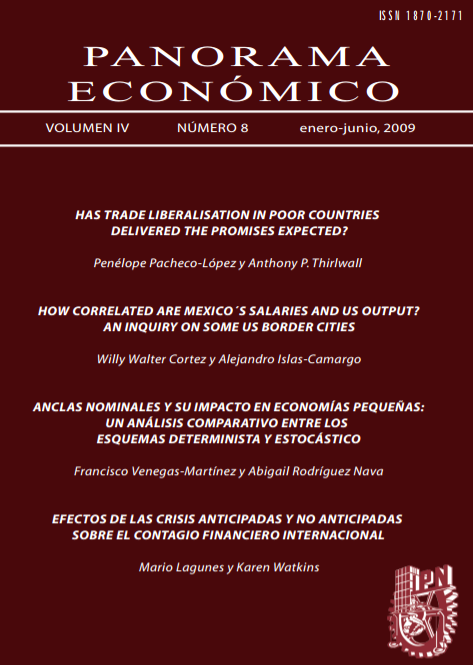
Effects of Anticipated and Unanticipated Crises on International Financial Contagion
Abstract
The literature on international financial contagion explains that anticipated crises do not produce contagion; the contrary occurs with non-anticipated ones. This paper proposes a methodology to compare the contagion effects that could have occurred with the Hong Kong-1997 crisis (non-anticipated) and the Argentinean one (anticipated), over Brazil and Mexico. As contagion variables we use stock returns and real interest rates. Results show that the anticipation of the Argentinean crisis avoided the contagion effects over Mexico and Brazil; on the contrary, the Hong Kong crisis had contagion outcomes over these markets.
Keywords
Array, Array, Array, Array, Array
References
- Alba, P., A. Bhattacharya, S. Claessens, S. Ghosh y L. Hernandez (1998), “Volatility and Contagion in a Financially Integrated World: Lessons from East Asia’s Recent Experience”, Banco Mundial y Banco Central de Chile, documento de trabajo, núm 2008.
- Baele, L. y K. Inglelbrecht (2006), “Time Varying-Integration Interdependence and Contagion”, Tilburg University y Ghent University, documento de trabajo, versión preliminar.
- Baig, T. y I. Goldfjan (2000), “The Russian Default and the Contagion to Brazil”, Fondo Monetario Internacional, documento de trabajo, núm. 160.
- Banco Central de la República Argentina (2007), Estadísticas e Indicadores; recuperado de .
- Banxico (1997), Estadísticas Económicas y Financieras, recuperado de .
- Bayoumi, T., G. Fazio, M. Kumar y R. MacDonald (2003), “Fatal Attraction: A New Measure of Contagion”, Fondo Monetario Internacional, documento de trabajo, núm. 80.
- Bekaert, G., H. Campbell y A. Ng (2005), “Market Integration and Contagion”, Journal of Business, Vol. 78, núm. 1, pp. 39-70.
- Bikhchandani, S. (1992), “A Bargaining Model with Incomplete Information”, Review of Economics Studies, Vol. 59, núm. 1, pp.187-203.
- Boschi, M. (2005), “International Financial Contagion: Evidence from the Argentina Crisis of 2001-2002”, Applied Financial Economics, Vol. 15, núm. 3, pp. 153-163.
- Bustelo, P. (2007), “Capital Flows and Financial Crises: A Comparative Analysis of East Asia (1997-1998) and Argentina (2001-2002)”, en: K. N. Rao (comp.), Exchange Rate Management in Emerging Economies of Asia, ICFAI University Press, Hyderabad.
- Calvo, G. (2006), “Monetary Policy Challenges in Emerging Markets: Sudden Stop, Liability Dollarization, and Lender of Last Resort”, Banco Interamericano de Desarrollo, documento de trabajo, núm. 596.
- Calvo, G. (2005), “Crises in Emerging Market Economics. A Global Perspective”, National Bureau of Economic Research, documento de trabajo, núm. 11305.
- Calvo, S. y C. Reinhart (1996), “Capital Inflows to Latin America: Is there Evidence of Contagion Effects?”, World Bank Policy Research, documento de trabajo, núm. 1619.
- Calvo, G. y E. Mendoza (1999), “Regional Contagion and the Globalization of Securities Markets”, National Bureau of Economic Research, documento de trabajo, núm. 7153.
- Caramazza, F., L. Ricci y R. Salgado (2004), “International Financial Contagion in Currency Crises”, Journal of International Money and Finance, Vol. 23, núm.1, pp. 51-70.
- Chen, F. y R. Ng (2000), “Regaining International Competitiveness: Hong Kong after the Asian Financial Crisis”, en: S. Masuyama, D.
- Vandenbrink y Chia Siow Yue (eds), Restoring East Asia’s Dynamism, Tokyo, Nomura Research Institute y Singapore Institute of Southeast Asian Studies, pp. 134-162.
- Chul Park, Y. y C. Song (1999), “Financial Contagion in the East Asian Crisis”, Korea University, documento de trabajo.
- Corsetti, G., P. Pesenti y N. Roubini (1999), “What Caused the Asian Currency and Financial Crises?”, Japan and the World Economy, Vol. 11, núm. 3, pp. 305-373.
- Daseking, C., A. Ghosh, T. Lane y A. Thomas (2005), “Lessons from the Crisis in Argentina”, Fondo Monetario Internacional, ISBN-10: 1589063597.
- De la Torre, A., E. Yeyati y S. Schumukler (2002), “Argentina’s Financial Crisis: Floating Money, Sinking Banking”, Banco Mundial, Mimeo.
- Didier, T., P. Mauro y S. Schmukler (2006), “Vanishing Contagion?”, Fondo Monetario Internacional, Policy Discussion Paper, Research Department, núm. 01.
- Dornbusch, R. y W. Cline (1997), “Brazil’s Incomplete Stabilization and Reform”, Brookings Papers on Economic Activity, Vol. 1997, núm. 1, pp. 367-404.
- Dornbusch, R., Y. Chul Park. y S. Claessens (2000), “Contagion: Understanding how it Spreads”, The World Bank Research Observer, Vol. 15, núm. 2, pp. 177-197.
- Dungey, M., R. Fry, B. Gonzalez y V. Martin (2005), “A Comparison of Alternative Tests of Contagion with Applications”, en: M. Dungey y D. Tambakis (eds), International Financial Contagion: A Reader, Oxford University Press.
- Edwards, S. y R. Susmel (1999), “Contagion and Volatility in the 1990’s”, Universidad del Cema, documento de trabajo, núm. 153.
- Eichengreen, B., A. Rose y C. Wyplosz (1996), “Contagious Currency Crises: First Tests”, The Scandinavian Journal of Economics, Vol. 98, núm. 4, pp. 463-484.
- Evangelist, M. y V. Sathe (2006), “Brazil’s 1998-1999 Currency Crisis”, documento de trabajo.
- Feldstein, M. (2002), “Lessons from Argentina”, Harvard University, Mimeo.
- Forbes, K. y R. Rigobon (2001), “Measuring Contagion: Conceptual and Empirical Issues”, en: S. Claessens y K. Forbes (eds), International Financial Contagion, Kluwer Academic Publishers, Boston, pp. 43-66.
- Forbes, K. y R. Rigobon (2002), “No Contagion, only Interdependence: Measuring Stock Market Co-Movements”, The Journal of Finance, Vol. 57, núm. 5, pp. 2223-2261.
- Forbes, K. (2004), “The Asian Flu and Russian Virus: The International Transmission of Crises in Firm-Level Data”, Journal of International Economics, Vol. 63, núm. 1, pp. 59-92.
- Frankel, J. y S. Schmukler (1998), “Crisis, Contagion, and Country Funds: Effects on East Asia and Latin America”, en: R. Glick (ed), Managing Capital Flows and Exchange Rates, Cambridge University Press, pp. 1-47.
- Fondo Monetario Internacional (1999), Base de Datos de Estadísticas Financieras: recuperado de .
- Fondo Monetario Internacional (2007), Base de Datos de Estadísticas Financieras: recuperado de .
- Ganapolsky, E. y S. Schmukler (1998), “Crisis Management in Capital Markets: The Impact of Argentine Policy during the Tequila Effect”, World Bank Policy Research, documento de trabajo, núm. 1951.
- Geithner, T. (2003), “Lessons from the Crisis in Argentina”, Fondo Monetario Internacional, Policy Development and Review Department, Octubre.
- Gerlach, S. y F. Smets (1995), “Contagious Speculative Attacks”, European Journal of Political Economy, Vol. 11, núm.1, pp. 45-63.
- Glick, R. y A. Rose (1999), “Contagion and Trade: Why are Currency Crises Regional?”, Journal of International Money and Finance, Vol. 18, núm, 4, pp. 603-617.
- Goldstein, M. (1998), “The Asian Financial Crisis: Causes, Cures, and Systemic Implications”, Policy Analyses in International Economics, núm. 55.
- Greene, W. (1997), Econometric Analysis, Prentice Hall, Tercera edición.
- Hernández, L. y R. Valdés (2001), “What Drives Contagion: Trade, Neighborhood or Financial Links”, International Review of Financial Analysis, Vol. 10, núm. 3, pp. 203-218.
- IBGE (1998), Instituto Brasileiro de Geografía e Estadística, Clasificaciones Estadísticas, recuperado de .
- INEGI (1998), Instituto Nacional de Estadística Geográfica e Informática, Cuentas Nacionales, recuperado de .
- Jaque, F. (2004), “Emerging Market Economies: The Aftermath of Volatility Contagion in a Selection of Three Financial Crises”, Banco Central de Chile, documento de trabajo, núm. 305.
- Kaminsky, G. y S. Schmukler (1999), “What Triggers Market Jitters? A Chronical of the Asian Crisis”, Journal of International Money and Finance, Vol. 18, núm.4, pp. 537-560.
- Kaminsky, G., C. Reinhart y C. Végh (2003), “The Unholy Trinity of Financial Contagion”, Journal of Economic Perspectives, Vol. 17, núm. 4, pp. 51-74.
- Karolyi, A. (2003), “Does International Financial Contagion Really Exist?”, Journal of International Finance, Vol. 6, núm. 2, pp. 179-199.
- Kodres, L. y M. Pritsker (2002), “A Rational Expectations Model of Financial Contagion”, Journal of Finance, Vol. 57, núm. 2, pp. 769-799.
- Kumar, M. y A. Peraud (2002), “Pure Contagion and Investors’ Shifting Risk Appetite: Analytical Issues and Empirical Evidence”, International Finance, Vol. 5, núm. 3, pp. 401-36.
- Maletta, H. (2007), “A Catastrophe Foretold: Economic Reform, Crisis, Recovery, and Employment in Argentina”, Universidad de El Salvador, Instituto de Investigación en Ciencias Sociales, documento de trabajo.
- Moreno, R. (2002), “Learning from Argentina’s Crisis”, FRBSF Economic Letter, núm. 31, pp. 1-4.
- Moser, T. (2003), “What is International Financial Contagion?”, International Finance, Vol. 6, núm. 2, pp. 157-178.
- Pritsker, M. (2001), “The Channels for Financial Contagion”, en: S. Claessens y K. Forbes (eds), International Financial Contagion, Kluwer Academic Publishers, Boston, pp. 67-98.
- Perry, G. y L. Serven (2002), “The Anatomy and Physiology of a Multiple Crisis: Why was Argentina Special and what can we Learn from it”, World Bank Policy Research, documento de trabajo, núm. 3081.
- Radelet, S. y J. Sachs (1999), “What Have We Learned, So Far, From the Asian Financial Crisis”, Harvard Institute for International Development, CAER Discussion Paper, núm. 37.
- Reuters (2007), Información Histórica, recuperado de .
- Reyes, A., “Desperate Measures”, Asiaweek, 28 de agosto, 1999:50.
- Sachs, J., A. Tornell, A. Velasco, G. Calvo y R. Cooper (1996), “Financial Crisis in Emerging Markets: The Lessons From 1995”, Brookings Papers On Economic Activity, Vol. 27, núm. 1, pp. 146-215.
- Shleifer, A. y R. Vishny (1997), “The Limits of Arbitrage”, The Journal of Finance, Vol. 52, núm. 1, pp. 35-55.
- Stiglitz, J. (1999), “Reforming the Global Economic Architecture: Lessons from Recent Crises”, The Journal of Finance, núm. 54, pp. 1508-1521.
- Valdés, R. (1997), “Emerging Markets Contagion: Evidence and Theory”, Banco Central de Chile, documento de trabajo, núm. 7.
- Van Rijckeghem, C. y B. Weder (2001), “Sources of Contagion: Is it Finance or Trade?”, Journal of International Economics, Vol. 54, núm. 2, pp. 293-308.
- Yam, J. (1999), “Hong Kong: From Crisis to Recovery”, Hong Kong Monetary Authority, (Speech at HKMA Luncheon, London, Septiembre 28, 1999).