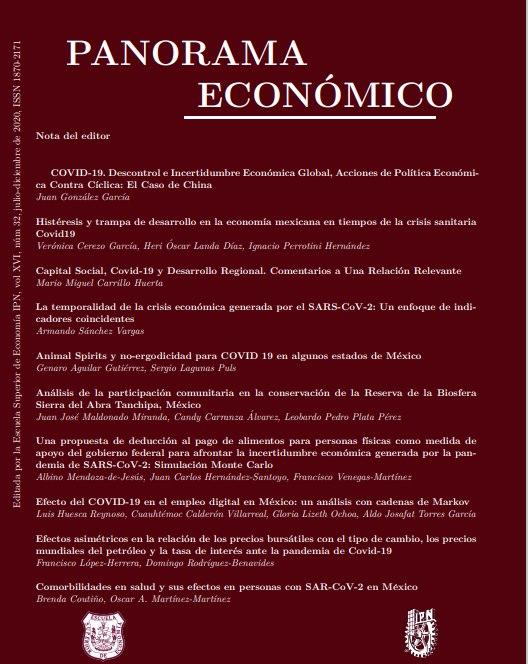
The effect of COVID-19 on digital employment in Mexico: an analysis of the Markov chains
Abstract
The late sanitary measures adopted by the U.S in order to face the COVID-19 pandemic caused a deep economic recession that caused an unprecedented increase in unemployment. In Mexico, the applied sanitary measures by the state were insufficient and late in their implementation deepened the recession that had existed since 2019. In this scenario of health and economic crisis, some companies have tended to use new digital technologies to promote insufficient jobs but also precarious. For such reason, the objective of this paper is to analyze the current dynamics of employment in Mexico. For this we utilize the data provide by the National Poll of Occupation and Employment Survey and the Markov chain methodology. Probable scenarios of employment mobility are established between sectors by type of occupation (digital and non-digital). The results show that for next year, in the presence of Covid-19, the proportion of digital jobs will reach to be 49% and the unemployment will be 6%.
Keywords
Unemployment, digital occupations, Covid-19
References
- Acemoglu, D. & Autor, D. (2011). Skills, tasks and technologies: Implications for employment and earnings.
- Handbook of labor economics (pp. 1043-1171). Elsevier. https://doi.org/10.1016/S0169-7218(11)02410-5
- Acemoglu, D. & Restrepo, P. (2020). Robots and jobs: Evidence from US labor markets. Journal of Political Economy, 128 (6), 2188-2244. https://doi.org/10.1086/705716
- Albarracıén, E. J. G., Erazo, S. C. R. & Palacios, F. C. (2014). Influencia de las tecnologías de la información y comunicación en el rendimiento de las micro, pequeñas y medianas empresas colombianas. Estudios gerenciales, 30 (133), 355-364. https://doi.org/10.1016/j.estger.2014.06.006
- Autor, D. H., Levy, F. & Murnane, R. J. (2003). The skill content of recent technological change: An empirical exploration. The Quarterly journal of economics, 118 (4), 1279-1333. https://doi.org/10.1162/003355303322552801
- Bound, J. & Johnson, G. E. (1989). Changes in the Structure of Wages during the 1980’s: An Evaluation of Alternative Explanations (inf. téc.). National Bureau of Economic Research. https://www.nber.org/papers/w2983
- Calderón-Villarreal, C., Ochoa-Adame, G. L. & Huesca-Reynoso, L. (2017). Mercado laboral y cambio
- tecnológico en el sector manufacturero mexicano (2005-2014). Economıéa, sociedad y territorio, 17 (54), 523-560. http://www.scielo.org.mx/scielo.php?pid=S1405-84212017000200523&script=sci_arttext
- Card, D. & Lemieux, T. (2001). Can falling supply explain the rising return to college for younger men? A cohort-based analysis. The Quarterly Journal of Economics, 116 (2), 705-746. https://doi.org/10.1162/00335530151144140
- David, H. & Dorn, D. (2013). The growth of low-skill service jobs and the polarization of the US labor market. American Economic Review, 103 (5), 1553-97. https://doi.org/10.1257/aer.103.5.1553
- DiNardo, J. E. & Pischke, J. (1997). The returns to computer use revisited: Have pencils changed the
- wage structure too? The Quarterly Journal of Economics, 112 (1), 291-303. https://doi.org/10.
- /003355397555190
- Felix, G. & Torres Garc´ıa, A. (2016). El uso intensivo de la computadora y su relaci´on con el desempeño
- económico: el caso de la industria manufacturera en México. En V. Luis y Germán-Soto (Ed.), Retos Locales de un Paradigma Global: la Innovación en México y sus Regiones (pp. 255-286). DeLaurel.
- Félix-Verduzco, G. & Torres Garcıéa, A. J. (2018). Prima salarial al uso de computadora en el trabajo. Evidencia de microdatos para México. El trimestre económico, 85 (337), 137-168. https://doi.org/10.20430/ete.v85i337.662
- Goos, M., Manning, A. & Salomons, A. (2014). Explaining job polarization: Routine-biased technological change and offshoring. American economic review, 104 (8), 2509-26. https://doi.org/10.1257/aer.104.8.2509
- Helpman, E. & Trajtenberg, M. (1994). A time to sow and a time to reap: growth based on general purpose technologies (inf. t´ec.). National Bureau of Economic Research. https://www.nber.org/papers/w4854
- Hofer, H. & Riedel, M. (2003). Computer use and the wage structure in Austria (inf. téc.). Reihe ¨Okonomie/
- Economics Series. https://www.econstor.eu/handle/10419/72261
- INEGI. (2020). Estimación oportuna del Producto Interno Bruto en México. https://www.inegi.org.mx/
- contenidos/saladeprensa/boletines/2020/pib_eo/pib_eo2020 04.pdf
- Jones, M. M. T. (2005). Estimating Markov transition matrices using proportions data: an application to credit risk. International Monetary Fund. https://doi.org/10.5089/9781451862386.001
- Katz, L. F. & Murphy, K. M. (1992). Changes in relative wages, 1963–1987: supply and demand factors. The quarterly journal of economics, 107 (1), 35-78. https://doi.org/10.2307/2118323
- Krueger, A. B. (1993). How computers have changed the wage structure: evidence from microdata, 1984–1989. The Quarterly Journal of Economics, 108 (1), 33-60. https://doi.org/10.2307/2118494
- Lay, D. C. (2007). Algebra lineal y sus aplicaciones. Pearson educación.
- Liu, J.-T., Tsou, M.-W. & Hammitt, J. K. (2004). Computer use and wages: evidence from Taiwan. Economics Letters, 82 (1), 43-51. https://doi.org/10.1016/j.econlet.2003.07.001
- Meyer, C. D. (2000). Matrix analysis and applied linear algebra (Vol. 71). Siam.
- OECD. (2019). OECD Employment Outlook 2019 (inf. t´ec.). OECD. Paris. http://www.oecd.org/employment/outlook/
- Oosterbeek, H. & Ponce, J. (2011). The impact of computer use on earnings in a developing country: Evidence from Ecuador. Labour Economics, 18 (4), 434-440. https://doi.org/10.1016/j.labeco.2010.11.002
- Parish Flannery, N. (2020, 1 de julio). President Lopez Obrador Is Failing Mexico. https://www.forbes.com/sites/nathanielparishflannery/2020/07/01/president-lopez-obrador-is-failing-mexico/#4132ae6712f0
- Poole, D. (2011). Algebra lineal: una introducción moderna. Cengage Learning Editores.
- Reljic, J., Evangelista, R., Pianta, M. et al. (2019). Digital technologies, employment and skills (inf. téc.). Laboratory of Economics y Management (LEM), Sant’Anna School of Advanced . . . http://www.lem.sssup.it/WPLem/files/2019-36.pdf
- Torres Garcıéa, A. J. & Ochoa Adame, G. L. (2018). Desigualdad salarial asociada al uso de las TIC en México: un análisis por ocupaciones. Cuadernos de Economıéa, 37 (74), 353-389. http://dx.doi.org/10.15446/cuad.econ.v37n74.56549.
- Velasco, O. A. P., Kolman, B. & Hill, D. R. (1999). Algebra Lineal con aplicaciones y Matlab. Prentice Hall.
- Villarreal, C. C., Reynoso, L. H. & Adame, G. L. O. (2017). An´alisis comparativo de la desigualdad salarial entre México y Estados Unidos. Investigación económica, 76 (300), 3-31. https://doi.org/10.1016/j.inveco.2017.02.004168