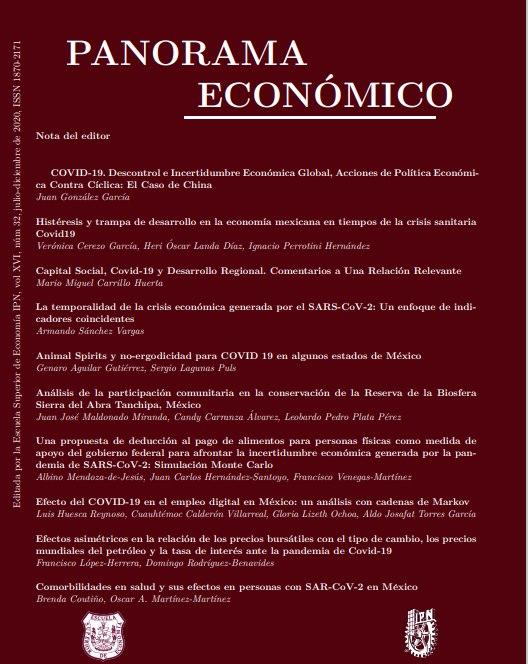
Animal Spirits and non-ergodicity for COVID 19 in some states of Mexico
Abstract
Using day-to-day data of the deceases due to COVID-19 throughout Mexico, a preciseness model for prediction of the decease spike is developed in four states of Mexico; 2 of which have a touristic tendency and 2 of which have an industrial tendency. It is predicted that the spike or the “top” of deceases will occur the day 107 of the pandemic in the state of Quintana Roo, and the days 68, 109 and 72 in the states of Baja California Sur, Mexico and Nuevo Le´on. However, findings suggest the non-ergodic behaviour is characteristic to phenomena that rely on human behaviour, due to the “animal spirits” which conduct to irracionality during someone´s decision-making. The evidence points to the necessity of the construction of alternative hypothesis to analize human behaviour in the face of phenomena of uncertainty.
Keywords
uncertainty, ergodicity, animal spirits
References
- Akerlof, G. A. & Shiller, R. J. (2010). Animal spirits: How human psychology drives the economy, and why it matters for global capitalism. Princeton university press.
- Batista, M. (2020). Estimation of the final size of the coronavirus epidemic by the SIR model. Onlinepaper, ResearchGate, 1-12.
- Berger, R. (1981). Comparison of the Gompertz and Logistic Equations to Describe Plant Disease Progress.Phytopathology,71(7), 716-719.
- Blanchard, O. (2016). Do DSGE models have a future?Revista de Econom ́ıa Institucional,18(35), 39-46.
- Blanchard, O. (2017). The need for different classes of macroeconomic models. Peterson Institute for International Economics, Realtime Economics Watch January 12th. %5Curl % 7Bhttps://piie.com/blogs/realtime-economic-issues-watch/need-different-classes-macroeconomicmodels%7D
- Farmer, R. E. (2013). Animal spirits, financial crises and persistent unemployment.The Economic Jour-nal,123(568), 317-340.
- Guerrazzi, M. (2015). Animal spirits, investment and unemployment: An old Keynesian view of the GreatRecession.EconomiA,16(3), 343-358.
- Hendry, D. F. & Muellbauer, J. N. (2018). The future of macroeconomics: macro theory and models at the Bank of England. Oxford Review of Economic Policy,34(1-2), 287-328.
- Huang, C., Wang, Y., Li, X., Ren, L., Zhao, J., Hu, Y., Zhang, L., Fan, G., Xu, J., Gu, X.et al. (2020). Clinical features of patients infected with 2019 novel coronavirus in Wuhan, China. The lancet,395(10223), 497-506.
- Jiang, F., Deng, L., Zhang, L., Cai, Y., Cheung, C. W. & Xia, Z. (2020). Review of the clinical characteristics of coronavirus disease 2019 (COVID-19). Journal of general internal medicine, 1-5.
- Korinek, A. (2017). Thoughts on DSGE Macroeconomics: Matching the Moment, But Missing the Point?But Missing the Point.
- Lucas Jr, R. E. (2003). Macroeconomic priorities. American economic review,93(1), 1-14.
- Oral, E. (2006). Binary regression with stochastic covariates.Communications in Statistics-Theory and Methods, 35(8), 1429-1447.
- Pang, F.-R., Luo, Q.-H., Hong, X.-Q., Wu, B., Zhou, J.-H., Zha, W.-T. & Lv, Y. (2019). The study on the early warning period of varicella outbreaks based on logistic differential equation model. Epidemiology & Infection, 147.
- SALUD. (2020). Información referente a casos COVID-19 en México. Consultado el 15 de mayo de 2020, desde %5Curl%7Bhttps://datos.gob.mx/busca/dataset/informacion-referente-a-casos-covid-19-en-mexico%7D
- Soo, C. (2015). Quantifying animal spirits: news media and sentiment in the housing market. Ross Schoolof Business Paper, (1200).
- Stephens, M. A. (1979).The anderson-darling statistic (inf. téc.). STANFORD UNIV CA DEPT OFSTATISTICS.
- Stiglitz, J. E. (2015).Towards a general theory of deep downturns (inf. téc.). National Bureau of Economic Research. https://www.nber.org/papers/w21444
- Stiglitz, J. E. (2018). Where modern macroeconomics went wrong.Oxford Review of Economic Policy,34(1-2), 70-106.
- Stilianakis, N. I., Perelson, A. S. & Hayden, F. G. (1998). Emergence of drug resistance during an influenzaepidemic: insights from a mathematical model.Journal of Infectious Diseases,177(4), 863-873.
- Tátrai, D. & V ́arallyay, Z. (2020). COVID-19 epidemic outcome predictions based on logistic fitting andestimation of its reliability.arXiv preprint arXiv:2003.14160.