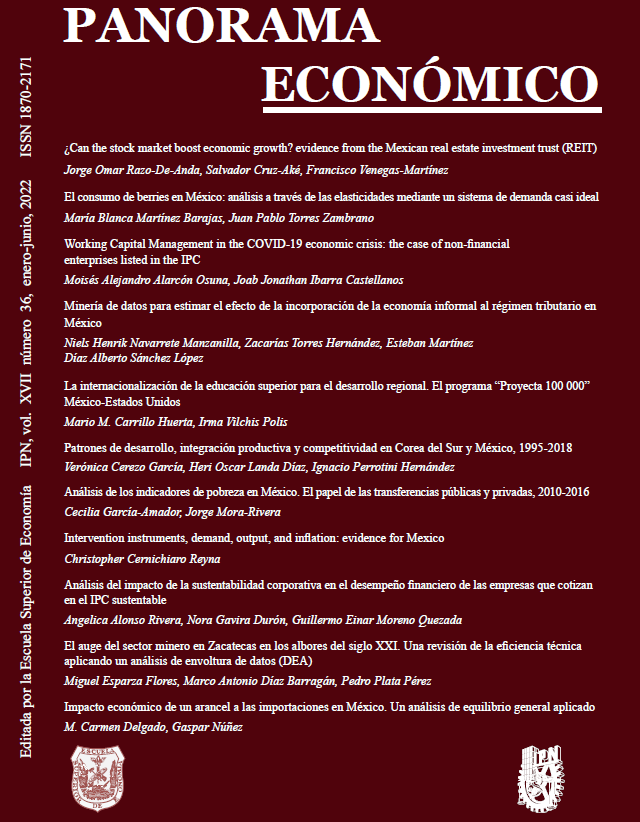
Analysis of the impact of corporate sustainability on the financial performance of companies listed in the sustainable IPC
Abstract
The objective of this research is to determine whether the incorporation of companies to the CPI sustainable, impacts their financial performance. The hypothesis proposes that, with the incorporation of the company to the sustainable CPI, there are patterns of structural change in the behavior of financial indicators related to profitability, debt, volume of sales, growth and liquidity. The methodology is based on structural stability tests, CUSUM of squares and the Chow stability test; with quarterly data for a sample of 13 companies that are listed constantly, in the IPC Sustainable from 2002 to 2019. The results show medium term structural changes for some companies and in some indicators, with different trends and temporalities. The study leaves out the analysis of stock market indicators for future research.
Keywords
Array, Array, Array, Array
References
- Artiach, T.; D. Lee; D. Nelson & J. Walker (2010). The determinants of corporate sustainability performance. Accounting & Finance, 50(1), 31-51. https://doi.org/10.1111/j.1467-629X.2009.00315.x.
- Banxico (2006). Resumen del informe anual 2005. https://www.banxico.org.mx/publicaciones-y-prensa/informes-anuales/%7B41B02B81-1617-34DA-4C35-FA16E6980ABC%7D.pdf.
- Blázquez, M., & M. F. Peretti (2012). Modelo para gestionar la sustentabilidad de las organizaciones a través de la rentabilidad, adaptabilidad e imagen. Estudios Gerenciales, 28(125), 40-50. https://doi.org/10.1016/S0123-5923(12)70006-2.
- Becchetti, L.; S. Di Giacomo & D. Pinnacchio (2008). Corporate social responsibility and corporate performance: evidence from a panel of US listed companies. Applied Economics, 40(5), 541-567. https://doi.org/10.1080/00036840500428112.
- Campa Navarro, J. I.; F. Venegas-Martínez & S. Cruz-Aké (2019). Comparación del proceso de innovación en México entre los regímenes proteccionista y de apertura: un análisis econométrico de inestabilidad de parámetros y cambio estructural, 1940-2015. Economía: teoría y práctica, (50), 11-35. https://doi.org/10.24275/etypuam/ne/502019/campa.
- Chow, Gregory (1960). “Tests of Equality between Sets of Coefficients in Two Linear Regressions”, Econometrica, vol. 28, No. 3, pp. 591-605. https://doi.org/10.2307/1910133.
- Consolandia, C.; P. Nascentiz & A. Jaiswal-Dalec (2008). Ethical Stock Indexes: Does Sustainability Pay Off?. https://www.crrconference.org/Previous_conferences/downloads/2006consolandietalethicalstockindexes.pdf.
- Consolandi, C., Jaiswal-Dale, A., Poggiani, E., & Vercelli, A. (2009). Global standards and ethical stock indexes: The case of the Dow Jones Sustainability Stoxx Index. Journal of Business Ethics, 87(1), 185-197. DOI 10.1007/s10551-008-9793-1.
- Fauzi, H.; L. S. Mahoney & A. Abdul Rahman (2007). The link between corporate social performance and financial performance: evidence from Indonesian companies. Issues in Social and Environmental Accounting, 1(1), 149-159. DOI: 10.22164/isea.v1i1.12.
- Expansión (2020). La Bolsa mexicana estrena un índice de Empresas Socialmente Responsables. https://expansion.mx/mercados/2020/06/22/bolsa-mexicana-estrena-indice-empresas-responsables.
- Gavira-Durón, N., D. G. Martínez Peña & I. C. Espitia Moreno (2020). Determinantes financieras de la Sustentabilidad Corporativa de Empresas que cotizan en el IPC Sustentable de la BMV. Revista mexicana de economía y finanzas, 15(2), 277-293. https://doi.org/10.21919/remef.v15i2.485.
- Grupo BMV (2017). Guía de Sustentabilidad. Hacia el desarrollo sustentable de las empresas en México. https://www.bmv.com.mx/docs-pub/SERVICIOS_EMISORAS/di7k28u7rwg3n01dgdru.pdf.
- Grupo BMV (2020). El Índice ESG y la Inversión Responsable. https://blog.bmv.com.mx/2020/09/el-indice-esg-y-la-inversion-responsable/.
- Gujarati, D., y D. Porter (2010). Econometría. Quinta edición, Mc Graw Hill.
- Ibarra Salazar, J.; J. D. J. Salazar & R. Navarro Aguirre (2017). Estimación de modelos estructurales y la evolución del tipo de cambio Peso-Dólar después de la crisis subprime. Revista mexicana de economía y finanzas, 12(4), 405-429. DOI: 10.21919/remef.v12i4.241.
- Ioannou, I., G. Serafeim & R. Eccles (2014). The impact of a corporate sustainability on organizational processes and performance. Management Science, 60(11), 2835-2857. https://doi.org/10.1287/mnsc.2014.1984.
- Leal, F.; R. González & L. Romo (2014). Sustentabilidad de las Pymes en base al Índice de Precios y Cotizaciones (IPC Sustentable) En México y el Financiamiento Verde. Aguascalientes : Universidad Autónoma De Aguascalientes.
- López, M. V.; A. Garcia & L. Rodriguez (2007). Sustainable development and corporate performance: A study based on the Dow Jones sustainability index. Journal of business ethics, 75(3), 285-300. https://doi.org/10.1007/s10551-006-9253-8.
- McWilliams, A., & D. Siegel (2000). Corporate social responsibility and financial performance: correlation or misspecification?. Strategic management journal, 21(5), 603-609. https://doi.org/10.1002/(SICI)1097-0266(200005)21:5<603::AID-SMJ101>3.0.CO; 2-3.
- Morales-Castro, J. A. (2015). La acreditación de sustentabilidad y su impacto en los márgenes de rentabilidad del sector industrial de la Bolsa Mexicana de Valores. Respuestas, 20(1), 16-29. https://doi.org/10.22463/0122820X.256.
- Ortiz, H. B.; D. G. Hernández & L. A. C. Ruiz (2016). La industria automotriz en el estado de Querétaro:¿ cambio estructural?. Pensamiento & Gestión, (41), 36-59. http://www.redalyc.org/articulo.oa?id=64650087003.
- Renneboog, L.; J. Ter Horst & C. Zhang (2008). Socially responsible investments: Institutional aspects, performance, and investor behavior. Journal of banking & finance, 32(9), 1723-1742. https://doi.org/10.1016/j.jbankfin.2007.12.039.
- Ruf, B. M.; K. Muralidhar; R. M. Brown; J. J. Janney & K. Paul (2001). An empirical investigation of the relationship between change in corporate social performance and financial performance: A stakeholder theory perspective. Journal of business ethics, 32(2), 143-156. https://www.jstor.org/stable/25074563.
- S&P Dow Jones Indices (2018). S&P/BMV Índices Metodología. https://espanol.spindices.com/indices/equity/sp-bmv-ipc-sustainable.
- Sánchez, P. A. (2008). Cambios estructurales en series de tiempo: una revisión del estado del arte. Revista Ingenierías Universidad de Medellín, 7(12), 115-140. https://repository.udem.edu.co/bitstream/handle/11407/958/Cambios%20estructurales%20en%20series%20de%20tiempo%20una%20revisi%C3%B3n%20del%20estado%20del%20arte.pdf?sequence=2.
- Simpson, W. G., & T. Kohers (2002). The link between corporate social and financial performance: Evidence from the banking industry. Journal of business ethics, 35(2), 97-109. https://link.springer.com/article/10.1023/A:1013082525900.
- Ulrich Emily (2016). Entendiendo las inversiones según criterios ESG. S&P Dow Jones Indices. https://espanol.spindices.com/documents/education/practice%20essentials-understanding-esg-investing-spa.pdf.
- Ziegler, A., & M. Schröder (2010). What determines the inclusion in a sustainability stock index?: A panel data analysis for european firms. Ecological Economics, 69(4), 848-856. https://doi.org/10.1016/j.ecolecon.2009.10.009.