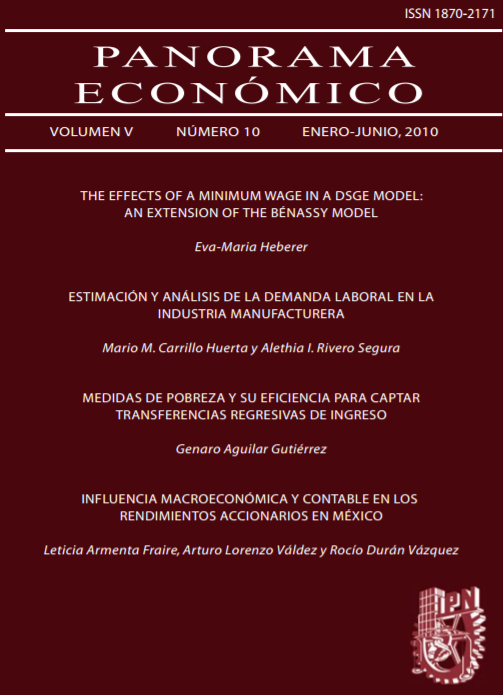
Estimation and analysis of labor demand in the manufacturing industry in Tlaxcala, 2002-2003
Abstract
This paper presents the results from estimating the labor demand for the manufacturing sector of the state of Tlaxcala, for the period 2002-2003. Through the use of an econometric model of Seemingly Unrelated Regressions (SUR), the elasticities of the demand for labor were estimated, considering the interaction of four types of labor in the production process: permanent skilled workers, temporary skilled workers, permanent unskilled workers, temporary unskilled workers, the price of the product and the capital input. The results show that skilled and unskilled labor are complementary inputs and that unskilled permanent workers and unskilled temporary workers are complement.
Keywords
Array, Array, Array, Array
References
- Arango C. y Rojas A. (2003), “Demanda laboral en el sector manufacturero colombiano: 1977-1999”, Documentos de Trabajo del Banco de la República de Colombia.
- Berndt E. R., y Christensen L. R. (1974), “Testing for the Existence of a Consistent Aggregate Index of Labor Inputs”, The American Economic Review.
- Berndt, E. (1991), The Practice of Econometrics: Classic and Contemporary, Boston, Mass.: Addison-Wesley Longman, Incorporated.
- Carrillo Huerta, Mario M. (2005), La mano de obra para el desarrollo de Tlaxcala, 2003-2005, Vol. I, II y III, San Pablo Apetatitlán, Tlax.: El Colegio de Tlaxcala.
- Clark, K. and Freeman, R. (1980), “How Elastic is the Demand for Labor?”, The Review of Economics and Statistics, MIT Press, vol. 62(4), pages 509-20, November.
- Court, R.H. y Woods M. (1970), “Testing for Profit Maximization in an Empirical Situation”, International Economic Review, Vol. 11, No. 3.
- Dunne, T. (1993), “The Long-run Demand for Labor: Estimates from Census Establishment Data”, Center of Economic Studies, pp. 93-13.
- Engenllandt A. y Riphahn R. (2005), “Temporary Contracts and Employee Effort”, Labour Economics, N°12 (2005), pp. 281-299.
- Estevão, M. (1999), “Measuring Temporary Labor Outsourcing in U.S. Manufacturing”, NBER Working Paper, 7421.
- Flaig G. y Steiner, V. (1989), “Stability and Dynamic Properties of Labor Demand in West German Manufacturing”, Oxford Bulletin of Economics and Statistics, 51(4), pp. 395-412.
- Fuss, M. (1977), “Demand for Energy in Canadian Manufacturing”, Journal of Econometrics, No. 5 (Jan): 89-116.
- Gagliarducci, S. (2005), “The Dynamics of Repeated Temporary Jobs”, Labor Economics, N°12, pp. 429-448.
- Gould J. (1968), “Adjustment Costs in the Theory of Investment of the Firm”, Review of Economic Studies, 35: pp. 47-55.
- Green, W. (2003), Econometric Analysis, Prentice Hall.
- Griffin, J. M. y Gregory P. (1976), “An Intercountry Translog Model of Energy Substitution Responses”, American Economic Review, No. 66, pp. 845-857.
- Hamermesh, D. (1992), “A General Model of Dynamic Labor Demand”, The Review of Economics and Statistics, Vol 74, No. 4, pp. 733-737.
- ___________ (1993), Labour Demand, Princeton University Press.
- ___________ (1991) “Labor Demand: What do we Know? What don’t we know?”, NBER Working Paper, No. 3890.
- ___________ (1988), “Data Difficulties in Labor Economics”, NBER Working Paper.
- Klein, L. R. (1953), A Textbook of Econometrics, Evanston, Illinois: Row, Peterson & Co..
- Ingram, B. y Neumann G. (2006), “The Returns to Skill”, Labor Economics, N°13, pp. 35-59.
- Nickell, S. (1984), “An Investigation of the Determinants of Manufacturing Employment in the United Kingdom”, Review of Economic Studies, 51: pp. 529-557.
- Pencavel, J. y Craig B. (1994), “The Empirical Performance of Orthodox Models of the Firm: Conventional Firms and Worker Cooperative”, Journal of Political Economy, pp. 718-744.
- Roberts, M. y Skoufias E. (1997), “The Long-Run Demand of Skilled and Unskilled Labor in Colombian Manufacturing Plants”, The Review of Economics and Statistics, Vol. 79, N° 2, pp. 330-334.
- Sargent, T. (1978), “Estimation of Dynamic Labor Demand Schedules Under Rational Expectations”, Journal of Political Economy, 86: pp. 1009-44.
- Shephard, R. (1970), Theory of cost and production functions, Princeton University Press.
- Wooldrige, J.M (1999), Econometric Analysis of Cross Section and Panel Data, MIT Press.
- Zellner, Arnold (1962), “An Efficient Method of Estimating Seemingly Unrelated Regressions and Test for Aggregation Bias”, Journal of the American Statistical Association, Vol. 57, No. 298, pp. 348-368.